

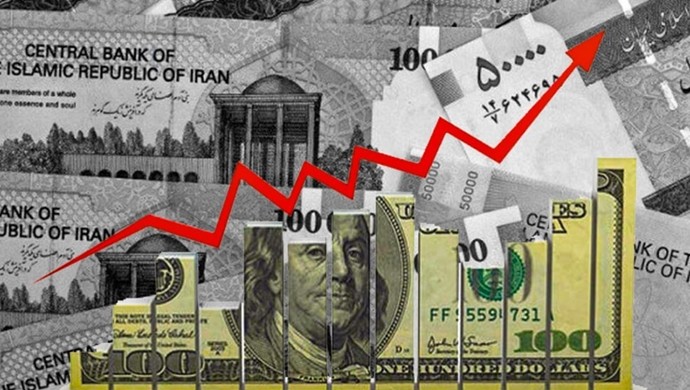

According to Justin Perkins’ travelogue, during the time of Mohammad Shah Qajar (approximately 170 years ago), ten rials was equivalent to $2.50. During the reign of Mozaffar ad-Din Shah, the value of the US dollar and the Iranian toman were nearly equal. At the time of Reza Shah’s fall (1941), one US dollar was approximately 1.5 tomans.
It is well-known that during the reign of Shah the former dictator, due to crude oil sales and the abundance of windfall wealth, the price of the dollar reached 70 rials. During the rule of Ruhollah Khomeini (1979-1989), war, repression, and destruction were among the factors that destroyed Iran’s economy, so much so that the dollar reached 1,200 rials. In the presidency of Akbar Hashemi Rafsanjani (1989-1997), it reached about 4,500 rials. When Mohammad Khatami became president (1997-2005), the dollar reached 9,000 rials. During Mahmoud Ahmadinejad’s presidency (2005-2013) it rose above 32,000 rials, and during Hassan Rouhani’s tenure (2013-2021), it went up to 253,000 rials. When Ebrahim Raisi was appointed as president by regime supreme leader Ali Khamenei in 2021, the dollar continued to rise and at one point reached 700,000 rials. Today, it stands at around 590,000 rials.
Iran’s Economy from the Perspective of International Rating Agencies
In addition to the exchange rate and other indicators of economic bankruptcy in Iran, the critical situation caused by Raisi’s death and the imposition of premature presidential election has intensified the chaos. The global community is also monitoring this situation. The most important rating agencies consider factors such as political stability, governmental transparency, economic efficiency, and financial risks. Also, one of the key indicators of a country’s credit rating is the election process in that country:
On June 8, Iran Emrooz newspaper wrote, “The formalistic voting ceremonies in the Velayat-e Faqih (The Rule of the Guardian Jurist) system have extensive and profound impacts on Iran’s credit rating. This process lacks transparency, accountability, competition, and fairness in voting procedures and shows the decline of the state’s social capital. Such conditions lead to a decrease in foreign investors’ trust (international social capital) in the regime’s ability to maintain economic and political stability… A decline in the credit rating leads to an increase in the exchange rates of major international currencies and a decrease in the national currency’s value. The devaluation of the national currency, in turn, increases inflation and reduces the people’s purchasing power.”
Different Exchange Rates and the Layered Corruption of the Clerical Regime
On June 9, the market price of the dollar reached 593,000 rials. The exchange dollar for importing licensed goods was over 452,800 rials. The NIMA dollar related to exporters and importers exceeded 420,000 rials. The preferential exchange rate was 285,000 rials. Travel currencies have a different rate as well.
For years, economists and production and trade activists have criticized the multi-rate currency system in the clerical regime. This multi-rate system has increased the length, width, and height of corruption and rent-seeking among Khamenei’s officials, the religious hypocrites, their children, and the Islamic Revolutionary Guard Corps (IRGC). Cover companies, semi-private and military institutions, cultural institutions, so-called sacred foundations, and other shops and banks of the regime benefit greatly from this chaotic multi-rate currency market. However, it is the oppressed people of Iran and the millions of poor and destitute who bear the burden of inflation, liquidity, and the rising prices of necessary goods and services.
After the preferential exchange rate of 42,000 rials for importing essential food items was eliminated in 2022 by the Raisi government, the necessary currency for these goods reached 280,000 rials.
Before the elimination of the preferential exchange rate, only six essential items, including wheat, barley, corn, soybeans, crude oil, and oilseeds, along with some medicines and medical equipment, received the 42,000 rials exchange rate. The Raisi government, by promising cheaper goods through the elimination of this rate, caused the prices of food items, including flour and bread, to rise. Simultaneously, the dollar price in the free market increased and exceeded 280,000 rials. Therefore, since then, this rate (285,000 rials) has been used for importing essential goods and continues to be used.
Over time, items such as rice, sugar, and other foodstuffs were removed from the announced lists. The rent-seeking and corruption that led to the elimination of the 42,000 rials exchange rate also occurred with the 285,000 rials rate, funneling billions of rials into the pockets of regime’s officials, mafia gangs, and the interconnected exclusive trade rings. While the free-market exchange rate is close to 600,000 rials, the substantial difference in exchange rates benefits the regime’s institutions and cover companies.
During this period, under the orders of Mohammad Mokhber, now acting president of Iran’s regime, rice was removed from the list of goods eligible for the preferential exchange rate, and today, sugar was also removed from this list. One can guess that when $4.444 billion is allocated for importing essential goods, a significant amount enters the free currency market, and vast sums flow into the bank accounts of regime gangs.
On June 5, the official ILNA news agency reported that from today, imported sugar would no longer be entered at the 285,000 rials rate but at the exchange rate of 422,000 rials.
Crippling Food Prices
A look at the prices of food items is enough to show the extent of the pain and suffering of millions of homeless, hungry people living below the survival line. Items that were supposed to be obtained at reasonable exchange rates have become more expensive for millions of Iranians to the benefit of the regime mafia.
Chicken meat: 850,000 rials / Eggs (per tray): 990,000 rials / Rice: 900,000 rials / 400g cheese: 444,000 rials / Canned tuna: 790,000 rials / 4 kg oil: 2,617,000 rials / 900g pinto beans: 1,339,000 rials. (Source: Mehr News agency, June 6, 2024)