


Finally, after days of contention, on June 9, the Iranian regime’s Ministry of Interior announced the names of six candidates from among the 80 who had registered for the upcoming presidential elections, held prematurely due to the death of regime president Ebrahim Raisi. It was revealed that the Guardian Council had disqualified and eliminated the majority of the applicants.
Thus, regime supreme leader Ali Khamenei selected the minimum number of candidates to navigate the impending crises and engineer the elections to make sure his desired candidate emerges from the ballot boxes.
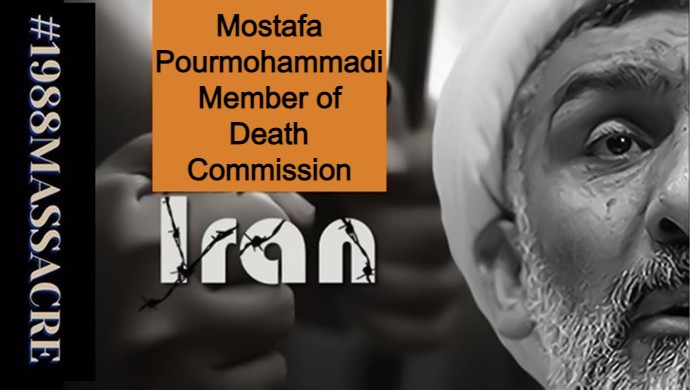
Although all these candidates, from Majlis speaker Mohammad Bagher Ghalibaf and former chief nuclear negotiator Saeed Jalili to Tehran mayor Alireza Zakani, acting Vice President Amir-Hossein Ghazizadeh Hashemi, and former health minister Masoud Pezeshkian, have extensive backgrounds in violence, thuggery, and crimes, the executioner mullah Mostafa Pourmohammadi has exceptional characteristics worthy of attention.
A record full of crimes
A look at the resume and record of this ruthless cleric shows that his main occupation has been the death and killing of people.
He began his work at the age of 20, in 1979, as the revolutionary prosecutor in Khuzestan province. He continued his work as a prosecutor in Hormozgan and Khorasan provinces, being involved in the execution of hundreds of 16- and 17-year-olds.
Until 1986 and 1987, he continued to kill and hang political activists, and in 1987, he entered the Ministry of Intelligence. There, he rose to the position of advisor and deputy to the then Minister, Mohammad Reyshahri.
In 1988, he was the representative of the Ministry of Intelligence and Security (MOIS) on the Death Committee, a group of so-called judges who were tasked with the execution of more than 30,000 political prisoners, most of whom were members and supporters of the PMOI.
After that, until the late 1990s, he continued to hold various positions in the Ministry of Intelligence, and he played an important role in eliminating regime opponents.
During his time under Minister of Intelligence Ali Fallahian, many, including human rights martyr Dr. Kazem Rajavi, Abdul Rahman Ghassemlou, Sadegh Sharafkandi, Shapour Bakhtiar, and others, were killed by MOIS agents abroad.
When Mohammad Khatami became president in 1997 and put Ghorbanali Dorri-Najafabadi in charge of the MOIS, Pourmohammadi was his deputy, and the chain murders and killings of dissident writers and intellectuals were carried out under their supervision.
Due to his services and major crimes on the Death Committee, in the 2000s, he briefly held the Ministry of Interior in Mahmoud Ahmadinejad’s government and then, since 2008, took over the presidency of the National Inspection Organization.
He re-entered the cabinet in the first term of regime President Hassan Rouhani as the Minister of Justice and returned to his main profession of prosecuting and killing Iranian citizens, especially dissidents.
One of the greatest criminals in history
But his greatest “masterpiece” occurred in 1988. In that hot summer, following the fatwa by regime founder Ruhollah Khomeini, he became a member of the “Death Committee” and was one of the four executioners who hanged thousands of political prisoners.
Pourmohammadi was the representative of the MOIS on this committee and later admitted his crimes on various occasions.
The 1988 massacre was so disgraceful and heavy that on August 15, 1988, Hossein-Ali Montazeri, the then-deputy supreme leader, addressed him and other members of the Death Committee and said, “The greatest crime committed in the Islamic Republic, which history will condemn us for, has been carried out by you, and your names will be recorded as criminals in history!”
Nevertheless, Mostafa Pourmohammadi openly defended it and said in 2016, “We are proud to have carried out God’s order regarding [the PMOI] and stood and fought against the enemies of God and the nation with strength.” (Asr-e Iran, August 29, 2016)