

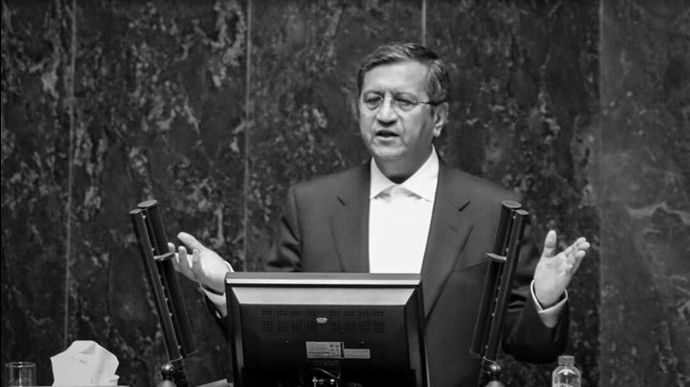

Despite all of the efforts by Iranian regime president Masoud Pezeshkian to prevent the impeachment of his Minister of Economy, on Sunday, March 2, Abdolnaser Hemmati was ousted with 182 votes in favor. Hemmati was removed while Pezeshkian, from the moment the issue began to the very last day, spared no effort in groveling, pleading, and flattering to keep him in the position of Minister of Economy.
As soon as the impeachment was proposed on Tuesday, February 18, without prior coordination or notice, he rushed himself to the Ministry of Economy building and said: “All banking, currency, and monetary policies have been decided in the meeting of the heads of the three branches, and it has nothing to do with the Minister of Economy. If we are at fault, then we are at fault; come and arrest us” (ISNA, February 19). This turned into a new scandal in the parliament, and MP Hamid Rasaee played it on the parliament’s loudspeakers, lashing out at him.
On March 2, the day of the impeachment, Pezeshkian, referring to the crisis of imbalances in the Iranian regime and the astronomical debts of the ministries, said in parliament: “I didn’t want to say many things because the process of what we are doing causes despair in society. This is detrimental to the country and to society. Our duty is to create hope and belief in faith and ability, not to create and pump despair…” He continued, while warning about the dangerous consequences of impeachment, pleadingly said: “I beg you dear ones not to destabilize the government’s process. We have flaws; I accept our flaws, but we can solve them through dialogue. The problem is not solved by removing, removing only leads to instability, insecurity, and worsening of the market and subsequent problems that you know better, in my opinion, it will not have any benefit for us. You have helped so far, continue to help. Whoever wants to show us a way, help us, we will kiss their hand, but we must join hands and help and not let people worry.”
In this way, the regime president showed his fear of the explosive conditions of society and the fragile position of the regime by raising the issue of “instability, insecurity, worsening of the market, and subsequent problems that you know better.” Vice president Mohammad Reza Aref also expressed concern about the consequences of the impeachment in the current situation, saying, “The conditions of the country and the government are not such that they would lead to a change of cabinet, and it is not in the interest [of the regime], and God willing, the parliament will take steps towards unity on the issue of impeachment…” (Ham-Mihan, March 2).
Prior to this, Mohammad Jafar Ghaempanah, Pezeshkian’s executive deputy, had said in this regard: “Really, the conditions of the country are not such that, God forbid, our ministers should be impeached and receive a vote of no confidence. Probably, the honorable members of parliament understand the national interests better, and we hope that the Minister of Economy will also receive a vote of confidence with a high vote” (state TV, February 26).
Pezeshkian’s requests, the regime’s parliament has removed Hemmati “with a high vote.” The meaning of this situation, beyond the removal of a minister, is the disruption of the arrangements that they had laid out seven months ago with the “unity” plan. At that time, by deception and bringing the supreme leader behind the ministers, he was able to get a vote of confidence, but the rapid developments of these seven months have put the mullahs’ government in a situation where one of the results is this impeachment. The unstable, cracked, and hole-ridden edifice of the regime and the smoke and mirrors of unity have been disrupted, and they must await the effects of “instability, insecurity, and worsening” of the regime’s situation.