

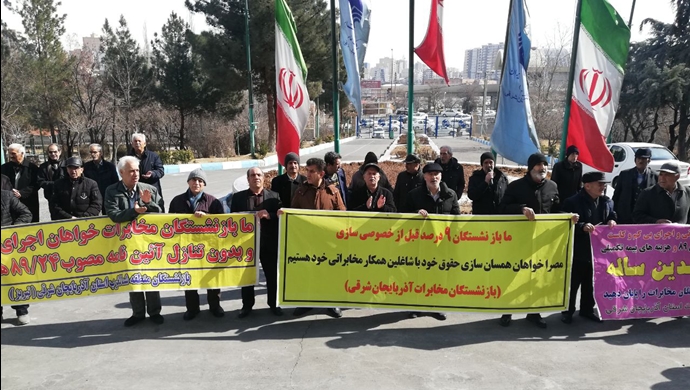

Iran is witnessing a growing wave of popular protests reflecting public outrage against the regime’s oppressive policies and the plundering of the nation’s wealth to benefit its corrupt institutions and fund its foreign projects. In recent days, retirees, telecommunications employees, steel workers, and education ministry applicants have taken to the streets to voice their opposition to the worsening economic situation and widespread corruption within the regime.
In Shiraz, retirees staged a protest in front of the governor’s office, demanding their living rights and rejecting the regime’s policies that have led to their economic hardship.
In Zanjan, telecommunications retirees gathered in front of the company’s central office, chanting slogans against the organization for the Execution of Imam Khomeini’s Order (EIKO) and the Cooperation Foundation of the IRGC, which systematically loot their funds through organized plundering schemes.
March 3—Tabriz, northwest Iran
Retirees of the Telecommunication Company of Iran (TCI) resume rally to protest corrupt policies by regime-affiliated managers and demanding higher pensions and other basic needs.#IranProtests pic.twitter.com/rD732qJQZT— People's Mojahedin Organization of Iran (PMOI/MEK) (@Mojahedineng) March 3, 2025
In Ahvaz, telecommunications retirees protested outside the company’s headquarters, highlighting that the deterioration of their financial conditions is a direct result of the regime-affiliated institutions’ control over their resources, while their demands are entirely ignored.
In Rasht, demonstrators assembled in front of the regional telecommunications office, raising slogans condemning the theft of their rights and accusing the regime’s economic institutions of seizing their entitlements without accountability.
March 3—Isfahan, central Iran
Retirees of the Telecommunication Company of Iran (TCI) hold protest rally as authorities refrain from addressing their demands for higher pensions and basic services.#IranProtestspic.twitter.com/wGPvo4mqoZ— People's Mojahedin Organization of Iran (PMOI/MEK) (@Mojahedineng) March 3, 2025
In Isfahan, retirees once again took to the streets, vowing to continue their protests until their demands are met and condemning the authorities’ indifference to their rightful claims.
In Shushtar, retirees gathered in front of the Social Security Organization, protesting against economic policies that have deprived them of their rightful benefits and calling for the prosecution of corrupt officials responsible for their suffering.
Beyond the retirees’ protests, Lamerd witnessed a massive strike by contract oil workers in the Parsian operational fields, who refused to report to work in response to wage reductions, increased taxes, and unpaid dues. Workers emphasized that their actual income has significantly decreased, with each worker losing nearly 4 million tomans per month due to the continuous collapse of the national currency and skyrocketing inflation rates.
March 3—Lamerd, southern Iran
Contract workers of the oil sector in the Parsian operational area of Larmerd rally to protest salary cuts, tax increases and non-payment of claims and arrears.#IranProtestspic.twitter.com/YBeznN80u9— People's Mojahedin Organization of Iran (PMOI/MEK) (@Mojahedineng) March 3, 2025
In Tehran, applicants who participated in the Ministry of Education’s employment exam gathered outside the Presidential Office, protesting the results, which they deemed fraudulent. They demanded transparency in the hiring process, as favoritism and corruption continue to dominate state institutions.
Behind these crises stand the EIKO and the Cooperation Foundation of the IRGC, which have taken control of a large portion of Iran’s economy by seizing major corporations and looting the funds of retirees and workers. These institutions, operating under the regime’s cover, have become tools for plundering national resources and channeling them into domestic repression and expansionist projects abroad.
March 3—Ilam, western Iran
Retirees of Telecommunication Company of Iran resume weekly protest rallies in front of the provincial office of TCI, demanding higher pensions and other basic rights.#IranProtests pic.twitter.com/rCRBDHrjQP— People's Mojahedin Organization of Iran (PMOI/MEK) (@Mojahedineng) March 3, 2025
In reality, these funds have not been used to benefit the Iranian people. Instead, billions of dollars have been funneled into terrorist militias and proxy groups in Iraq, Syria, Lebanon, and Yemen, in addition to financing the nuclear program and military adventures that have led to severe international sanctions on the regime. The Iranian people, who suffer from poverty, inflation, and the collapse of public services, can clearly see how their nation’s wealth is squandered on failed projects that only bring further international isolation and internal misery.
As these policies persist, protests continue to escalate across various Iranian cities. It is highly likely that they will transform into a nationwide uprising, similar to those in 2019 and 2022, when the Iranian people rose up demanding radical change. With each passing day of repression and looting, the chances of these protests evolving into a full-scale revolution that threatens the regime’s survival increase.