

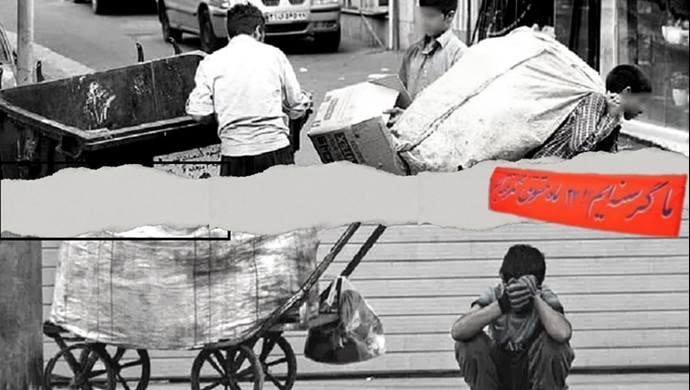

Iran has turned into an exhibition of social, political, and economic crises during the rule of the mullahs. This short report looks at a simple crisis, namely the crisis in food supplies for the poor and low-income masses. The Iranian people work around the clock, with most of them having two or three different shifts in various occupations. In many families, almost all members of the family are engaged in labor, yet they still struggle to even obtain their nightly bread, facing a crisis. This bitter reality is acknowledged even by the media and regime experts.
Economist Hossein Raghfar, in an interview with one the state-run Fararu website, said, “The average households in the country spend 65% of their income on food. This statistic is very alarming. Not too long ago, this figure was 16% in Tehran, and 25% to 26% in urban areas across the country. In rural areas, it reached up to 35%.”
Raghfar added, “Nowadays, households’ meat consumption has decreased from three kilograms per year to two kilograms, and these figures are unbelievable. It should be noted that when a family spends 65% of its income on the basic food items such as bread, cheese, vegetables, and a few tomatoes, one should ask, what do they do about housing costs? What about healthcare expenses?”
The question of whether parents can afford the necessary expenses for their children’s basic education or if their children are forced to drop out of school is a valid concern. Official statistics from the regime indicate that dropping out of school is the simplest response for low-income families. Fararu wrote, “In the 2010s, the per capita annual meat consumption among Iranians was higher than ten kilograms, which is more than ten times the current consumption.”
For example, in 2012, the per capita meat consumption was around 12 kilograms, and in December 2023, it dropped to approximately 2.6 kilograms.
Based on regime statistics, a wage-earning head of a four-person household needs to spend approximately 65% of their income to purchase a minimum basket of food items. This is happening at a time when the purchasing power of wage earners with minimum wages has decreased by over 65% since 1980. The real minimum wage of workers has reached its lowest point in the past 28 years.
With these conditions faced by workers and vulnerable segments of society, the solution to this dilemma is none other than overthrowing the current regime.