

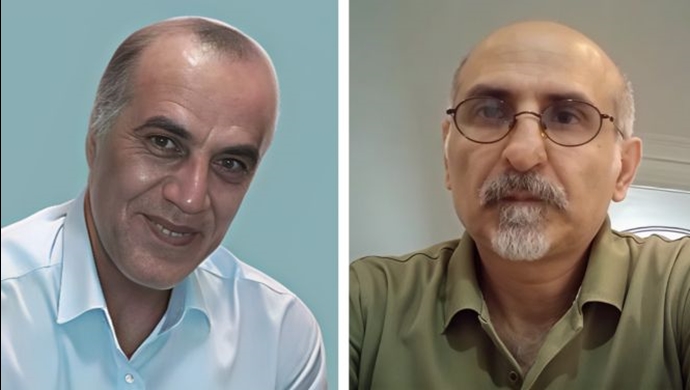

On the morning of March 30, 2026, the Iranian regime executed two dedicated political prisoners and members of the People’s Mojahedin Organization of Iran (PMOI/MEK), Mohammad Taghavi and Ali Akbar (Shahrokh) Daneshvarkar.
In a desperate bid to justify this state-sanctioned murder, the regime’s Tasnim News Agency, which is affiliated with the terrorist Quds Force, announced that “two terrorists affiliated with the Monafeghin terrorist group were hanged,” using the regime’s derogatory term for the PMOI. The state media outlet claimed the two men were executed for “carrying out armed operations in Tehran using launchers,” “participating in riots,” creating “safe houses” using PMOI budgets, and intending to “overthrow the Islamic Republic.”
By executing political dissidents, the regime seeks to mask its fear of a growing resistance and justify the physical elimination of its organized opposition.
Flawed judicial process, and unyielding brutality
Both victims were highly educated professionals who dedicated their lives to a free Iran. Mohammad Taghavi, 59, was a veteran political prisoner from the 1980s and 1990s who had previously served three years in prison starting in 2020 on charges of association with the PMOI.
Ali Akbar Daneshvarkar, 59, was a civil engineer arrested in January 2024. Following their arrests, both men were subjected to months of severe physical and psychological torture in Evin Prison’s notorious Ward 209. Taghavi was kept in solitary confinement and even went on a hunger strike to protest the brutal conditions and to condemn a guard for holding a knife to the throat of a helpless Afghan prisoner.
The judicial process was a complete mockery of due process. Presided over by the criminal judge Iman Afshari in Branch 26 of Tehran’s Revolutionary Court, the initial death sentences were issued in November 2024.
During their retrial on November 16, 2025, Afshari ignored the defense lawyers’ insistence that the clients be tried together. Instead, he held separate hearings lasting only a few minutes each.
Taghavi courageously refused to participate in the sessions, declaring the court completely illegitimate. Furthermore, the regime carried out these executions in blatant defiance of widespread international condemnation.
Over 150 international experts, the UN Special Rapporteur on Iran, and global human rights groups such as Hands Off Cain, Nouveaux Droits de l’Homme (NDH), and the British Committee for Iran Freedom (BCFIF) had previously demanded an immediate halt to the executions, citing severe human rights violations and the use of torture to extract confessions.
A systematic campaign of terror against the PMOI
This latest atrocity is not an isolated incident but part of a systematic campaign to execute PMOI members and supporters. The bloodshed has continued seamlessly under the presidency of Masoud Pezeshkian, who took office in August 2024.
In July 2025, the regime executed two other PMOI members, Behrouz Ehsani, 69, and Mehdi Hassani, 48. Just like Taghavi and Daneshvarkar, Ehsani and Hassani were severely tortured in Ward 209, denied a fair defense, and sentenced to death by the exact same judge, Iman Afshari, simply for their allegiance to a free Iran.
The regime’s unabated bloodthirst places a grave and imminent threat on the lives of other political prisoners in Iran. Four other PMOI supporters from Taghavi and Daneshvarkar’s shared case—Abolhassan Montazer, 66, who suffers from heart, lung, and kidney diseases; Pouya Ghobadi, 33; Vahid Bani Amerian, 33; and Babak Alipour, 34—are currently on death row facing the exact same fabricated charges. These consecutive executions represent a desperate and brutal campaign by the ruling clerics to terrorize a restless society and crush the youth who are increasingly gravitating toward the Iranian Resistance.
These efforts are futile, as Iran’s rebellious youth and PMOI Resistance Units are determined to overthrow this regime. As Daneshvarkar and other death-row political prisoners wrote in a statement in December 2024, “We and all political prisoners sentenced to death find no recourse for justice other than the oppressed people of Iran, the brave Rebellious Youth, and awakened consciences. And that is enough for us; it is a source of pride.”
Preparing for another massacre under the fog of war
The timing of these executions exposes a paralyzed and fearful regime acting out of profound vulnerability. Following the massive nationwide uprisings of December 2025 to January 2026, which nearly brought the ruling regime to its knees, the state only managed to maintain its hold on power through the massacre of thousands of protesters. Now, exploiting the fog of war and the domestic chaos following the death of supreme leader Ali Khamenei in a February 28 airstrike, the regime is quietly moving to eliminate its most capable adversaries.
Driven by the paralyzing fear of yet another popular uprising, the mullahs are actively preparing to carry out a new massive purge of political prisoners. Just as it did during the 1988 massacre of political prisoners, the regime is using the gallows to hide its own terminal weakness and frailty.
Mohammad Taghavi and Akbar Daneshvarkar, members of the PMOI/MEK, were executed this morning by the executioners of Iran’s religious dictatorship. We salute the two heroes for their unwavering resilience—having endured prolonged torture and pressure, they remained faithful to… pic.twitter.com/ctsLIk1mAs
— Maryam Rajavi (@Maryam_Rajavi) March 30, 2026
In wake of the brutal executions, Mrs. Maryam Rajavi, President-elect of the National Council of Resistance of Iran, stated that “the desperate regime, in fear of the popular uprising that would uproot it, by resorting to this grave crime desperately tries to postpone the explosion of the people’s rage, but it would only intensify the resolve of Iran’s rebellious youth and the fighters of the National Liberation Army to overthrow this regime.”
Mrs. Rajavi further stated that the clerical regime is attempting to exploit the external war to conceal its deep and unresolvable internal crises, but that it cannot escape its inevitable overthrow at the hands of the Iranian people and their organized resistance.
The international community must move past mere verbal condemnations. It is long past time to take concrete, punitive actions to hold the criminal leaders of this regime accountable for their continuous crimes against humanity and save the lives of political prisoners.