

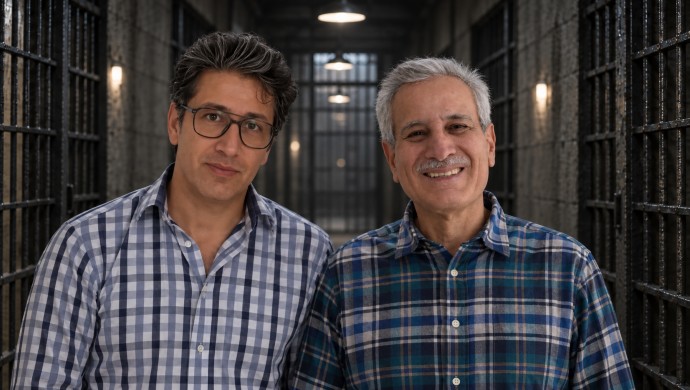

Political prisoners Akbar Bagheri and Assadollah Hadi have sent messages from Ghezel Hesar Prison marking the 61st anniversary of the founding of the People’s Mojahedin Organization of Iran (PMOI/MEK), offering two complementary explanations for how the resistance has survived decades of repression.
Bagheri places “sacrifice” at the center of the PMOI’s endurance, describing a flame lit by the organization’s founders in 1965 that “no wind” can extinguish. Hadi looks back across 120 years of Iranian struggles and emphasizes “organization,” arguing that earlier movements repeatedly suffered from the absence of a durable revolutionary organization.
Akbar and Assadollah join political prisoners from Evin, Yazd, Vakilabad, Karaj, and Ghezel Hesar, who have marked the PMOI anniversary despite death sentences, lengthy imprisonment, torture, medical deprivation, and repeated punishment for speaking out.
Akbar Bagheri: “No wind can extinguish” the flame
Bagheri begins by honoring PMOI founders Mohammad Hanifnejad, Saeid Mohsen, and Ali Asghar Badizadegan, then asks how an organization subjected to such enormous pressure and conspiracy could remain “firm and standing like Mount Damavand.”
His answer is sacrifice.
“Sacrifice is not just a word,” he writes. “It has depth—as deep as giving up one’s life.”
For Bagheri, the continuity of that sacrifice explains why the organization has survived both the Shah and the clerical regime. He draws a direct line from the founders to recently executed PMOI members, describing a new generation continuing to drink from the same “pure spring.”
He deliberately spans generations, from 70-year-old Behrouz Ehsani to 26-year-old Mehdi Khanaki, writing that this ability to continuously produce people willing to sacrifice themselves for freedom is “the secret of a dynamic and enduring organization.”
Bagheri’s own experience gives those words added significance. He spent six years in prison from 2017 to 2023. He was arrested again on November 10, 2024, taken to Ward 209 of Evin, and subjected to interrogation and torture before being transferred to Ghezel Hesar on February 15, 2025.
This was not his first experience of prison violence. In October 2021, criminal inmates armed with knives, clubs, and brass knuckles attacked Bagheri and other political prisoners while guards deliberately locked the hall, preventing their escape. Bagheri was among those wounded.
Yet from Ghezel Hesar, his anniversary message focuses not on what has been done to him, but on why he believes repression has failed to extinguish the movement he supports.
Assadollah Hadi: The missing element was organization
Hadi approaches the anniversary from a different direction. He begins with Sattar Khan, Mirza Kuchak Khan, Mohammad Mossadegh, and Mohammad Hanifnejad, placing the PMOI within more than a century of Iranian struggles against authoritarian rule and the denial of popular sovereignty.
Looking at those movements, Hadi argues that exploitation repeatedly generates protest and rebellion, but popular anger alone does not determine the outcome. Movements require people capable of giving them direction—and, crucially, organization.
According to Hadi, Hanifnejad, Mohsen, and Badizadegan studied the experience of earlier reformist struggles and “identified their deficiency as the absence of a revolutionary organization.”
He describes the PMOI’s subsequent 61-year struggle as one centered on popular sovereignty and opposition to the “two dictators, the Shah and the mullahs.”
Hadi’s own record stretches across several decades of imprisonment. A PMOI supporter imprisoned in the 1980s and again in later decades, he was arrested once more on October 1, 2022, during the nationwide uprising and transferred to Ward 209 of Evin. He suffers from serious heart, vascular, neurological, kidney, and spinal conditions.
His recent experience inside Ghezel Hesar makes the anniversary message especially striking. On March 29, 2026, anti-riot guards raided Unit 4 and forced political prisoners into solitary confinement. Despite his serious illnesses, Hadi was among those taken to solitary. The raid immediately preceded the executions of several imprisoned PMOI members.
Months later, Hadi is again speaking publicly from the same prison, arguing that 61 years of repression have not destroyed the organization he regards as essential to securing popular sovereignty.
The prison walls have not extinguished resistance
The messages of Bagheri and Hadi now stand alongside those of other political prisoners who are marking the anniversary of PMOI’s founding, including Arghavan Fallahi, Forough Taghipour, Parisa Kamali, Mehdi and Mohammad Javad Vafaei, Ali Moezzi, Meysam Dehbanzadeh, Mohammad Hassani, Khosrow Rahnama, and Sepehr Imam Jomeh.
The circumstances differ, but the cumulative message is difficult to miss: the regime controls the cells, the solitary wards, and the gallows. Yet even in the darkest corners of its dungeons, it has failed to suppress the spirit of resistance.
Full messages from Akbar Bagheri and Assadollah Hadi
Akbar Bagheri — Ghezel Hesar Prison
Message from the killing ground of Ghezel Hesar — September 2026
On the 61st anniversary of the proud People’s Mojahedin Organization of Iran, we honor the memory of its founders, Mohammad Hanifnejad, Saeid Mohsen, and Ali Asghar Badizadegan.
The lamp they lit in 1965 can be extinguished by no wind, because its torch is in the hands of Massoud Rajavi, the ever-present veteran of the most difficult passages. Over these 61 years, the People’s Mojahedin Organization has proven that it has passed through the treacherous passages of the Shah and the mullahs and overcome immense trials.
Truly, how is it possible that an organization which has experienced so much pressure and conspiracy throughout its existence remains firm and standing like Mount Damavand?
What is the secret of its endurance? When we review the path of Iran’s revolutionaries, was there not one thing common to all of them: sacrifice? Sacrifice is not merely a word. It has depth—a depth as great as giving up one’s life, the fundamental possession of every human being.
The secret of the PMOI’s endurance is that it has passed beyond all the deceptive attractions of worldly life. A Mojahed is the embodiment of honesty and sacrifice, and this has truly been proven in the Organization’s “commitment to the pledge” and “boundless sacrifice.”
An organization whose members sacrifice themselves entirely for the people—in the true meaning of the word “sacrifice”—wants nothing for itself, neither possessions nor life. They cast aside all attachments to life for one thing: “freedom.”
One must ask what a spring the Organization’s founders created, that after 61 years children of this land such as Commander Vahid [Bani Amerian] and his comrades, Naeim [Abdollahi] and Mehdi [Khanaki], still drink from this pure spring and sacrifice themselves for the liberation of their people. A thousand congratulations are due to Massoud and Maryam [Rajavi] for raising freedom fighters across countless generations—from 70-year-old Behrouz Ehsani, who went to the gallows, to 26-year-old Mehdi Khanaki. Yes, this is the secret of a dynamic and enduring organization.
In conclusion, I congratulate Massoud and Maryam Rajavi, [PMOI Secretary General] Zahra Merrikhi, the People’s Mojahedin in Ashraf 3, all the PMOI supporters, and especially the heroic Resistance Units on the 61st anniversary of the founding of my Organization.
Akbar Bagheri — September 2026
Ghezel Hesar Prison, Karaj
Please publish this on Simay-e Azadi and the networks affiliated with the People’s Mojahedin Organization.
Assadollah Hadi — Ghezel Hesar Prison
Message from the killing ground of Ghezel Hesar — September 2026
In the name of God and in the name of the heroic people of Iran.
Greetings, and following the example of Hussein ibn Ali.
Remembering and honoring the great leaders of Iran’s modern history—Sattar Khan, Mirza Kuchak Khan, the great Mossadegh, and the great Hanifnejad—and with greetings, gratitude, and salutations to Massoud and Maryam Rajavi, who preserved and developed this historical treasure of our people’s struggle, the People’s Mojahedin Organization of Iran, and established the National Council of Resistance of Iran, which is necessary for unity and solidarity in our people’s anti-colonial, anti-exploitation, anti-monarchical, and anti-reactionary struggle. And in remembrance of the martyrs who have fallen in blood throughout Iran’s history until today.
When we look at modern history, we see that two social phenomena have always stood against each other: the exploited and the exploiter. The exploiter usually possesses wealth, power, and the means of propaganda, rules over the great masses of society, and deprives the people of their right to sovereignty. For this reason, at certain turning points in history, people are compelled to protest, rebel, and rise up, and thinkers emerge from among them who, relying on a lofty ideal, give these movements direction.
This has also been the case in our homeland, Iran. Over the past 120 years, our people have repeatedly risen and rebelled against usurpers, despotic rulers, and their proxies in order to move beyond the bondage of feudalism and landlord-peasant relations, absolute monarchy, and the absence of freedom, independence, and popular sovereignty.
They gathered around men such as Sattar Khan, Mirza Kuchak Khan, and the great Mossadegh to struggle against the existing order. After Mossadegh, three young men named Mohammad Hanifnejad, Saeid Mohsen, and Ali Asghar Badizadegan, who came from the young members of the Freedom Movement, concluded from their study of previous reformist struggles that their deficiency was the absence of a revolutionary organization.
They stepped into the arena and founded the People’s Mojahedin Organization of Iran. Relying on revolutionary Islam and centered on the people’s right to sovereignty, this organization has for 61 years struggled against the two dictators, the Shah and the mullahs, with honesty, commitment to its pledge, and uncompromising struggle against the totalitarian exploiters of both the Shah and the mullahs. And this is a blessing for the oppressed people of Iran.
With hope for victory and the establishment of the Iranian people’s right to sovereignty—that is, the new democratic republic of Iran—I congratulate Massoud and Maryam, and everyone on the 61st anniversary of the founding of the People’s Mojahedin Organization of Iran.
Iran — Ghezel Hesar Prison
September 2026
Assadollah Hadi
Please publish this text in the Organization’s and Resistance’s media and all media affiliated with them.