

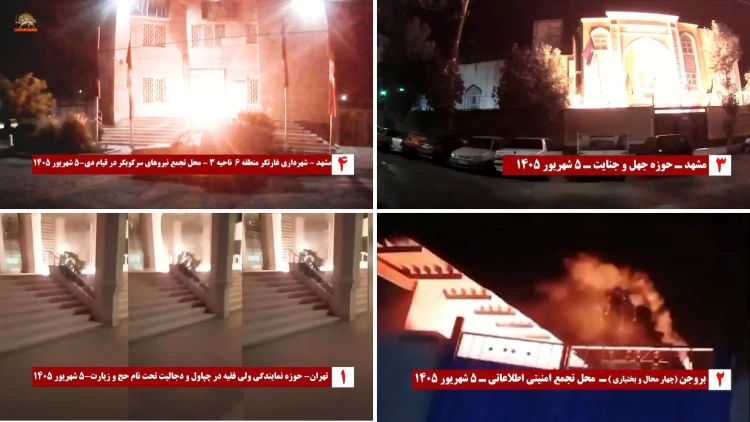

On August 27, PMOI/MEK Resistance Units carried out 60 operations in Tehran and 30 other cities in response to the Iranian regime’s plans to raise gasoline prices. The actions targeted IRGC and Basij bases, other centers of suppression, security-related facilities, and symbols of the ruling establishment.
The operations stretched from Tehran, Mashhad, Shiraz, Karaj and Kermanshah to Zahedan, Chabahar, Iranshahr and Dezful. Among the reported actions were attacks on Basij bases in Karaj, Shadegan, Iranshahr and Dezful, as well as security-force facilities in Chabahar, Borujen and Borazjan. Resistance Units also set fire to regime propaganda posters and billboards in numerous cities.
August 27—Iran
PMOI/MEK Resistance respond to the regime's plans for hiking the price of fuel by carrying out 60 daring operations across Iran, targeting institutions tasked with repression and corruption. pic.twitter.com/qXjnLdAU2j— People's Mojahedin Organization of Iran (PMOI/MEK) (@Mojahedineng) August 30, 2026
The timing was significant. The operations came as the regime was openly debating gasoline-price changes while senior officials and security bodies warned that economic dissatisfaction could spill into the streets.
Gasoline becomes a political flashpoint
The regime’s fuel problem has become increasingly difficult to contain. On August 15, Esmail Saghab Esfahani, head of the Energy Optimization Organization, said daily gasoline consumption had reached about 135 million liters, while refinery and petrochemical production stood at roughly 121 million liters, leaving a daily shortfall of 14 to 15 million liters.
Karaj
Resistance Units set fire to entrance of IRGC Basij base pic.twitter.com/G3DF6zSiri— People's Mojahedin Organization of Iran (PMOI/MEK) (@Mojahedineng) August 30, 2026
Officials have discussed rationing and multi-tier pricing. On August 26, Executive Vice President Mohammad-Jafar Ghaempanah said the existing pricing system could not continue and that the government would “inevitably” have to reform gasoline prices. On August 28, Pezeshkian said the third gasoline pricing tier would rise to around 10,000 tomans per liter.
The problem is therefore not only technical. A fuel-price increase risks imposing another economic shock while creating a potential trigger for unrest.
Officials warn of another social eruption
Regime officials have repeatedly described gasoline pricing in security terms. On August 17, Majlis Economic Commission member Hossein Samsami warned that a sudden change could become a “spark in a powder magazine” and said transportation-dependent workers could take to the streets.
Two days later, Majlis member Jalil Mir-Mohammadi Meybodi referred to the “bitter experience” of 2019 and warned that sudden gasoline decisions could become “the most acute security issue in the country.” Majlis Speaker Mohammad Bagher Ghalibaf also warned against policies that would increase public dissatisfaction.
Kermanshah
Resistance Units target regime center for spreading fundamentalism and terrorism pic.twitter.com/RRT4mNrSgp— People's Mojahedin Organization of Iran (PMOI/MEK) (@Mojahedineng) August 30, 2026
On August 27, the same day as the Resistance Unit operations, the IRGC Intelligence Organization warned against exploiting domestic “weaknesses, shortages and limitations” and pushing dissatisfaction into the streets. A day earlier, the Economic Security Police had announced expanded monitoring of fuel stations.
Resistance Units target the apparatus of repression
Against this backdrop, the choice of targets carries particular significance. The August 27 actions were directed not only at propaganda symbols but also at institutions associated with repression and surveillance.
The NCRI reported attacks on IRGC Basij bases, security-force gathering points, and signs connected to the Ministry of Intelligence and the IRGC. In dozens of other actions, Resistance Units burned images and symbols associated with Ruhollah Khomeini, Ali Khamenei, Mojtaba Khamenei and Qasem Soleimani.
Babol
Resistance Units set fire to poster featuring eliminated regime supreme leader Ali Khamenei and new supreme leader Mojtaba Khamenei pic.twitter.com/gpjgTSmnX9— People's Mojahedin Organization of Iran (PMOI/MEK) (@Mojahedineng) August 30, 2026
The pattern directly connects the fuel-price issue with the regime’s broader political vulnerability. As authorities increase surveillance and prepare for possible unrest, the Resistance Units are challenging institutions the regime relies on to maintain control.
The shadow of November 2019
The regime’s fear is rooted in experience. On November 15, 2019, protests erupted after authorities announced a sharp gasoline-price increase. The unrest spread to more than 190 cities across all 31 provinces and quickly moved beyond the immediate economic grievance to slogans against the regime.
According to NCRI and PMOI figures, at least 1,500 protesters were killed and around 12,000 arrested during the crackdown. Reuters later confirmed a death toll of about 1,500.
The uprising that began on December 28, 2025, reinforced the same danger. It began with an economic stoppage by bazaar merchants in Tehran over the rial’s plunge, price increases and fears of bankruptcy, then spread and adopted explicit anti-regime slogans.
The August 27 operations thus came at the intersection of a fuel shortage, plans for higher prices, memories of previous uprisings, and warnings from the regime’s own security apparatus. While authorities prepare for renewed unrest, the Resistance Units are signaling an organized presence across the country.