

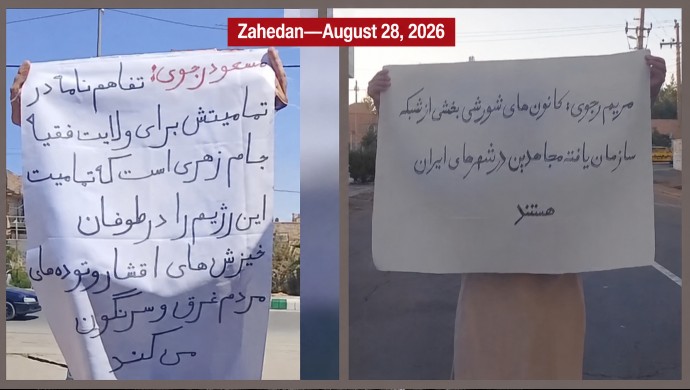

On August 28, PMOI/MEK Resistance Units resumed their weekly activities in Zahedan, southeast Iran, displaying placards in public places despite the regime’s security measures. Their messages reiterated their commitment to overthrowing the clerical regime while rejecting a return to monarchical dictatorship.
“A dictator is a dictator, whether with a turban or a crown,” one placard read. Another declared: “No to mullahs, no to shah. Yes to freedom and a democratic republic.”
The activities continued a recurring campaign by Resistance Units in Zahedan. In previous weekly actions, activists have likewise rejected both the ruling theocracy and restoration of the former monarchy, while advocating a democratic republic as Iran’s future.
August 28—Zahedan, southeast Iran
PMOI/MEK Resistance Units resume weekly activities, spreading the messages of the Iranian Resistance, reiterating their commitment to the overthrow of the mullahs' regime, and rejecting all forms of dictatorship. pic.twitter.com/FDTQVZALaE— People's Mojahedin Organization of Iran (PMOI/MEK) (@Mojahedineng) August 29, 2026
War does not resolve Iran’s fundamental conflict
War and its consequences were a major theme of the August 28 messages. “The regime exploits wartime conditions as cover to confront the Iranian people and the Resistance,” one placard stated.
PMOI reports have documented the escalation of repression under wartime conditions. In June, the regime’s State Security Forces announced 6,500 arrests, including 567 people it said were connected to the PMOI.
The Resistance Units’ message is that foreign conflict does not change the fundamental confrontation inside Iran between the regime and a population seeking political change. Their placards therefore rejected the idea that either war or accommodation by the regime can offer a durable solution.
"We have said all along that Khamenei’s heir, like the Shah’s heir, wants the war to continue. They know very well that without war, they have neither a future nor a chance." pic.twitter.com/KOhr25mbeA
— People's Mojahedin Organization of Iran (PMOI/MEK) (@Mojahedineng) August 29, 2026
“The overthrow of the regime is inevitable and destined to happen,” one message stated, “whether through retreat and drinking the poison, or through war.”
Rejecting a political project built around war and regime-linked networks
The Resistance Units also challenged Reza Pahlavi’s efforts to present himself as an alternative to the clerical regime.
“We have said all along that Khamenei’s heir, like the Shah’s heir, wants the war to continue,” one placard stated.
Pahlavi constantly advocated for foreign military pressure during the 2026 conflict. Having no organized force on the ground, he expects a foreign force to overthrow the regime and restore the ousted monarchy of his father.
"The demand of the majority of the Iranian people is a democratic republic based on the separation of religion and state and free elections" pic.twitter.com/WeNws6XlPz
— People's Mojahedin Organization of Iran (PMOI/MEK) (@Mojahedineng) August 29, 2026
The Zahedan placards also focused on Pahlavi’s connections with regime-linked security networks. In June 2025, Pahlavi announced a “secure communication channel” to recruit members of the IRGC and agents of the Ministry of Intelligence and Security (MOIS). His closest political allies have suspected connections to Iranian intelligence services.
A statement by Iranian-American professionals warned that the network closest to Pahlavi had become increasingly infiltrated by the MOIS and IRGC.
Against this background, the Resistance Units declared that Pahlavi had become “deeply enmeshed in a circle of associates having connections to the regime’s intelligence ministry.”
Neither shah nor mullahs
The rejection of both dictatorships formed the political core of the August 28 activities.
“We want neither the shah nor the mullahs. Dictators be damned,” one placard stated. Another declared: “Down with the oppressor, be it the shah or the supreme leader.”
Resistance Units in Zahedan have repeatedly used these slogans to reject the notion that overthrowing the clerical regime should mean returning Iran to the political system that preceded it. Recent Zahedan activities have described “neither the Shah nor the mullahs” as a red line against dictatorship in either form.
"A dictator is a dictator, whether with a turban or a crown" pic.twitter.com/q3hxdXLnj1
— People's Mojahedin Organization of Iran (PMOI/MEK) (@Mojahedineng) August 29, 2026
The messages linked this position to the enormous price Iranians have already paid in their struggle for freedom, including the 1988 massacre of political prisoners.
“A country whose people have paid a heavy price for freedom,” one placard read, “will not reject the current dictatorship only to return to the past.”
A democratic republic as the alternative
In their activities, the Resistance Units did not merely reject the existing regime, war, and restoration of monarchy. They also articulated the political alternative advocated by the Resistance Units.
“The demand of the majority of the Iranian people is a democratic republic based on the separation of religion and state and free elections,” one message stated.
Another described the Resistance Units as part of the PMOI’s organized network across Iranian cities and insisted that, for the Iranian people, “the only path is revolution to overthrow the clerical regime.”
The message emerging from Zahedan was therefore one of independent regime change: neither preservation of the theocracy nor restoration of the Shah, and neither dependence on foreign war nor reliance on elements of the regime’s repressive institutions.
Instead, the Resistance Units presented Iran’s democratic revolution as a struggle to be carried forward by the Iranian people and their organized resistance, with the objective of establishing a democratic republic. This is the same “Third Option” that recent Resistance Unit activities in Zahedan have emphasized: rejecting both appeasement and foreign war and placing the responsibility for change in the hands of the Iranian people.