

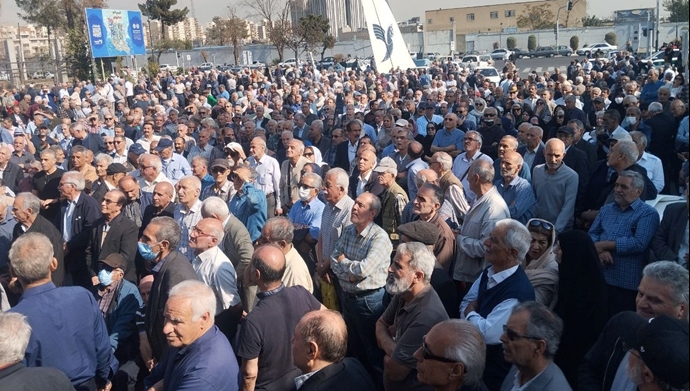

Labor and civil unrest surged across Iran today as retired staff from the national carrier, Iran Air (Homa), gathered in Tehran, coinciding with demonstrations by workers from the Khosheh Saba agro-industrial complex in East Azerbaijan province. This coordinated mobilization highlights a deepening livelihood crisis and economic devastation born from decades of systematic looting, the squandering of national resources on foreign military ventures, and the subordination of productive assets to corrupt networks and security-affiliated holding companies.
Iran Air (Homa) Retirees: Casualties of Military Co-optation and Asset Stripping
Dozens of retirees and former technical personnel of the national flag carrier assembled outside the company’s central headquarters and relevant ministries in Tehran, carrying banners denouncing the authorities’ refusal to honor their fundamental rights.
- Collapse of Healthcare Coverage: Demonstrators rallied against the effective cancellation of supplementary health insurance and specialized medical clinic services that previously guaranteed care, leaving thousands of elderly retirees and their dependents crushed by exorbitant medical costs without baseline coverage.
- Plunder of the Dedicated Pension Fund: Protesters condemned the administrative transfer of Homa’s dedicated pension fund to the insolvent Civil Servants Pension Fund, calling it a deliberate maneuver to evade statutory pension adjustments, the “pension equalization” law, and accumulated welfare arrears.
- Security and Military Exploitation: Participants underscored that decades of co-opting Homa’s commercial fleet for logistical support, weapons transport, and troop deployments to regional proxy conflicts—rather than modernizing civil aviation—directly triggered sweeping international sanctions, grounded the fleet, and shifted the financial ruin entirely onto workers and pensioners.
Khosheh Saba Workers in East Azerbaijan: Victims of Sham Privatization
In northwestern Iran, over 150 workers forcibly transferred from the Khosheh Saba Agro-Industry to the Mahan Investment Company organized protest rallies across the Khoda Afarin district and the Aras Free Trade Zone.
- Institutional Buck-Passing: The dispute erupted after the management of Mahan Investment refused to disburse back wages, severance packages, and accrued seniority benefits, while the former employer (Khosheh Saba) disclaimed all financial responsibility—leaving workers and their families facing abrupt unemployment and destitution.
- Frozen Social Security and Insurance Records: Workers exposed widespread irregularities and non-payment of social security premiums by management, barring eligible laborers from qualifying for early retirement under hazardous work regulations and depriving them of standard healthcare safety nets.
- Predatory Asset and Land Grabs: The root of the crisis lies in the handover of fertile agricultural lands near the Khoda Afarin dam reservoir to regime-linked financial conglomerates under the pretext of “infrastructure development and private investment.” These opaque transfers operate as vehicles for land speculation and budget absorption while discarding local labor contracts.
Behind the Collapse: Structural Corruption and Foreign Interventions
Far from isolated incidents of routine bureaucratic mismanagement, these simultaneous protests reflect deliberate structural patterns:
- Depleting Pension Funds for Security Spending: Iran’s pension and social insurance funds face systemic insolvency as the state routinely drains their capital reserves to finance massive deficits driven by uncontrolled military spending and foreign proxy operations, leaving lifelong workers without basic pensions or medication.
- Privatization as Regime Cartel Enrichment: Project transfers and deregulation schemes (such as the Khosheh Saba buyout) function as fronts for redistributing national assets to conglomerates tied to the IRGC and clerical foundations, enabling insiders to strip profitable land and resources while abandoning wage liabilities.
- Militarization of Civil Infrastructure: Repurposing civilian commercial entities like Homa into logistical arms for destabilizing regional operations destroyed their international standing and commercial revenue streams. The ongoing economic crisis is therefore an inevitable product of the regime’s political priorities, which consistently place ideological expansion over the basic survival of its citizens.