

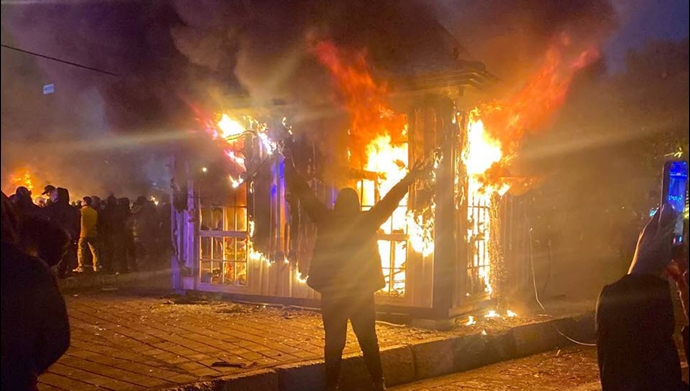

Iran’s regime rarely misses an opportunity to blame its mounting crises on foreign enemies. But a recent statement by the Intelligence Organization of the Islamic Revolutionary Guard Corps (IRGC) reveals what the regime actually fears most: the possibility that widespread dissatisfaction inside Iran will once again spill into the streets.
In its August 27 statement, the IRGC Intelligence Organization claimed that Iran’s adversaries have revised their strategy after failing to overthrow the regime through military pressure. Among the alleged new tactics, it listed exploiting domestic shortages, promoting dissatisfaction and polarization, and, most revealingly, seeking to “incite people to extend dissatisfaction to the streets.”
The regime presents this as a foreign conspiracy. Yet the warning contains an important admission. Foreign adversaries are not the people whose grievances concern the security apparatus. Iranian citizens are. And the scenario that alarms the IRGC is not simply economic hardship or criticism of the government, but the moment when those grievances become street protests.
That warning did not appear in isolation. Throughout August, officials, lawmakers and analysts speaking in Iran’s own media repeatedly described society in terms normally associated with an imminent security threat.
A society described as a powder magazine
On August 17, Hossein Samsami, a member of the regime’s Majlis Economic Commission, warned officials against making sudden changes to gasoline prices.
Samsami described such a decision under present conditions as a “spark in a powder magazine.” He also warned that people whose livelihoods depend on transportation could end up taking to the streets and said the proposed policies could cause social unrest and disturbances.
The metaphor is more revealing than the dispute over gasoline itself. Gasoline would merely be the spark. The powder magazine is the society that regime officials believe is already loaded with accumulated discontent.
This is precisely why an economic policy question is repeatedly discussed by regime figures in the language of public order and national security. The regime’s problem is not merely whether Iranians can absorb another economic shock. It is whether the shock could become the trigger that connects existing grievances and sends people back into the streets.
A government confident in the stability of the political order would not describe a price adjustment as a spark capable of detonating society. Samsami’s warning indicates that at least some within the ruling establishment see the underlying conditions as already combustible.
The regime has not forgotten November 2019
Two days later, Majlis member Jalil Mir-Mohammadi Meybodi made the connection even clearer.
Speaking in parliament on August 19, he explicitly invoked what he called the “bitter experience” of 2019 while warning against sudden decisions on gasoline. Such measures, he said, could turn into “the most acute security issue in the country.”
The reference is significant. In November 2019, a sudden gasoline price increase was followed by protests that rapidly spread across Iran and turned into a major challenge to the regime.
Years later, regime officials are still using that episode as the benchmark against which they measure new economic decisions. The lesson they drew from 2019 was clearly larger than gasoline policy: a livelihood grievance can become a political eruption with extraordinary speed.
For the regime, therefore, the issue is not simply preventing unpopular policy. It is preventing the recurrence of the chain reaction it has already witnessed—economic grievance, street protest and a nationwide security crisis.
From economic crisis to “social explosion”
Economist Hossein Raghfar was even more explicit in comments published by Rouydad24 on August 21. Warning about the social consequences of economic decisions, he said measures that create the conditions for a “social explosion” could be extremely costly.
Raghfar also argued that Iranian society is now more susceptible to social turbulence than before, pointing to widening economic and social divisions.
His assessment moves the discussion beyond one gasoline proposal. It describes the general condition of society.
Majlis Speaker Mohammad Bagher Ghalibaf was approaching the same problem from a security perspective three days earlier. On August 18, he said that, based on what he called open and covert information, the enemy was waiting for an opportunity to create unrest. He then warned government officials against decisions that generate popular dissatisfaction and said gasoline policy should be implemented in a way that produces the least possible discontent.
Ghalibaf blamed an external enemy. But his proposed remedy was directed inward: avoid increasing the Iranian population’s dissatisfaction.
That contradiction runs through the regime’s rhetoric. Officials constantly invoke foreign conspiracies, yet when describing how those conspiracies could supposedly succeed, they point to grievances already present inside Iranian society.
The enemy the regime sees inside Iran
Perhaps the clearest indication of the regime’s threat perception came from Mohammadreza Mirtajeddini, an official of the Islamic Propaganda Coordination Council.
In remarks reported on August 15, Mirtajeddini discussed the continuation of regime-organized nighttime gatherings. He said they should continue as long as conditions had not changed and until “foreign threats and the threats of the internal Monafeqin” had been eliminated, using the regime’s longstanding derogatory term for the People’s Mojahedin Organization of Iran (PMOI/MEK).
Tehran continues to tell the public that the main danger comes from outside Iran. But its own officials reveal a different nightmare: an angry population returning to the streets while an organized resistance movement remains committed to the overthrow of the ruling system.
The regime’s statements show that its leaders already regard the social conditions for renewed revolt as a serious security contingency. Their concern is increasingly about the trigger and timing, rather than whether widespread grievances exist.
For all the regime’s warnings about enemies abroad, the force it watches most anxiously is at home: the Iranian people themselves and the possibility that another nationwide uprising will once again put the survival of the regime at stake.