

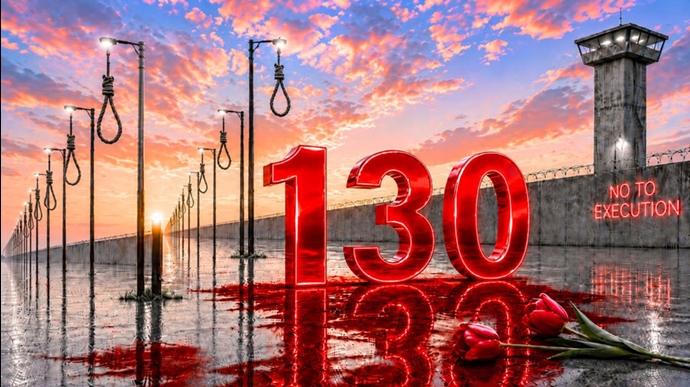

On Tuesday, July 21, 2026, political prisoners across Iran marked the 130th consecutive week of the “No to Executions Tuesdays” campaign. The movement, which organizes weekly hunger strikes to protest the regime’s systematic use of the death penalty, has now expanded to 59 facilities nationwide with the recent addition of Neyshabur Prison.
In a statement marking the 130th week, the striking prisoners warned of a surging execution rate, noting that according to reliable statistics, at least 280 individuals have been hanged since March 2026. The campaign’s statement “honors the memory of all executed prisoners, especially those who sacrificed their lives for freedom and the fight against the autocratic dictatorship.”
The 130th week of the campaign coincides with an unprecedented, week-long hunger strike and sit-in by more than 1,500 death-row prisoners in Unit 2 of Ghezel Hesar Prison in Karaj. Initiated on July 13, 2026, the inmates are demanding an immediate halt to their death sentences, which were predominantly issued for drug-related charges. Inside the prison yard, inmates raised a large banner declaring, “The right of Iranian youth is not prison and execution.”
The prisoners’ statement directly addressed the underlying corruption driving these convictions. “It is clear to everyone that the importers and producers of drugs in Iran are the heads of the government and the commanders of the Revolutionary Guards,” the prisoners wrote. “To cover up this obvious treason, they daily send people who have fallen into the trap of drugs out of poverty and destitution to the gallows.”
The defiance inside Ghezel Hesar has triggered solidarity outside its walls. On July 19, over 500 family members of the death-row inmates gathered outside the facility, holding placards and demanding the cancellation of the sentences. State security forces responded with physical assaults and threats to disperse the families. Inside, prison authorities heavily deployed anti-riot guards, deliberately jammed phone signals to impose an information blackout, and denied striking inmates necessary medical care despite reports of severe weight loss and dangerous drops in blood pressure.
The latest strikes follow a string of political executions. In their statement, the prisoners condemned the hangings of four political prisoners last week: Aref Khoshkar in Ghezel Hesar, and Mohammad Amini Dehaghani, Erfan Esfandiari, and Gol-Mohammad Mohammadi in Isfahan. The statement emphasized that these victims were “tried and executed in an unfair judicial process.”
Esfandiari, an 18-year-old Iranian, and Mohammadi, a 24-year-old Afghan national, were arrested during the massive nationwide uprisings of January 2026. Following the death of Ali Khamenei and the installation of Mojtaba Khamenei, the regime has heavily relied on the gallows to suppress unrest. The two youths were hanged in Isfahan on July 19 under fabricated charges of “waging war against God” and “corruption on Earth,” tying them to the deaths of four State Security Force officers during protests at Alikhani Square. Khoshkar and Dehaghani were executed just days prior, on July 15.
Ten other uprising detainees connected to the Alikhani Square case remain at imminent risk of execution after receiving sentences from notorious judges Mohammad Reza Tavakoli and Mohammad Barati Dorcheh, who systematically deprived them of independent lawyers. On July 18, these ten prisoners were abruptly removed from the general ward of Dastgerd Prison under the false pretext of meeting the case judge, prompting their cellmates to initiate strikes in protest of their unknown fate.
Despite the regime’s attempts to project absolute control through fast-tracked executions, the expanding resistance across 59 prisons demonstrates that the spirit of the Iranian people remains unbroken.