

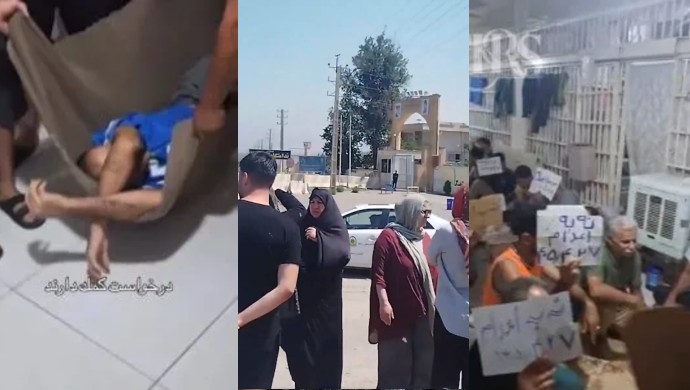

On Sunday, July 19, 2026, a massive and courageous act of defiance inside one of Iran’s most notorious dungeons reached a critical milestone. A sweeping hunger strike and sit-in by 1,500 death-row prisoners in Unit 2 of Ghezel Hesar Prison in Karaj entered its seventh day. The strike represents a direct challenge to the clerical regime’s survival strategy of state-sanctioned murder.
Following the massive nationwide uprisings of December 2025 to January 2026 that brought the regime to its knees, and the subsequent death of Ali Khamenei in a February airstrike, newly installed Supreme Leader Mojtaba Khamenei has heavily relied on the gallows to maintain their fragile grip on power.
However, the unprecedented resistance inside Ghezel Hesar proves that even in the shadow of the executioner’s noose, the Iranian people’s spirit remains unbroken.
Inside the prison walls: The demands and the toll
The striking prisoners initiated their protest on Monday, July 13, 2026, to actively resist the mullahs’ execution machine, demanding an immediate halt to anti-human death sentences, particularly those issued for drug-related charges. In a stunning display of bravery, inmates installed a large banner in the prison yard declaring, “The right of Iranian youth is not prison and execution.”
July 19—Ghezel Hesar prison, Iran
Videos from the seventh day of hunger strike by prisoners in Ward 2 in protest to executions. The prisoners warn about the condition of prisoners transferred to solitary confinement in preparation for their executions. pic.twitter.com/KAftc0Hqae— People's Mojahedin Organization of Iran (PMOI/MEK) (@Mojahedineng) July 20, 2026
The striking inmates have aligned their movement with the broader, ongoing “No to Executions Tuesdays” campaign, vowing to continue their protest until their demands are met. Unwilling to surrender to the regime’s systematic killings, they are now paying a severe physical toll.
Due to the prolonged lack of food, many prisoners are suffering from extreme weakness, dangerous drops in blood pressure, severe weight loss, dizziness, and a general decline in physical strength. Despite this critical health situation, the prisoners have bravely announced they will not stop their hunger strike until they receive a definitive response to their demands.
The resistance spreads: Families face down security forces
The extraordinary courage inside Ghezel Hesar has inspired a wave of resistance outside its walls. Coinciding with the seventh day of the strike, more than 500 family members of the death-row inmates gathered outside the prison to protest. Holding placards and chanting anti-regime slogans, the families demanded the cancellation of the death sentences, aiming to draw the attention of the public and authorities to the humanitarian crisis unfolding inside.
Instead of addressing the grievances of grieving mothers and fathers, the regime’s security forces responded with characteristic brutality. The criminal prison guards and security agents violently attacked the families, using threats and physical assault in a desperate attempt to create a climate of fear and disperse the crowd. However, the families bravely resisted the crackdown, answering the guards’ violence with resolute shouts of protest.
The regime’s cowardly tactics and information blackout
Terrified by the sheer scale of the protest, prison authorities have ramped up severe security measures rather than engaging with the prisoners or providing them with urgently needed medical care. Anti-riot guards have been heavily deployed throughout various sections of Unit 2, significantly heightening the security climate and raising concerns among inmates about imminent violent reprisals.
Furthermore, the regime’s executioners have deliberately deprived the striking inmates of basic necessities. In a cowardly attempt to silence the prisoners and prevent news of the strike from leaking to the outside world, authorities have actively jammed telephone signals and disrupted communications between the inmates and their families. Meanwhile, despite warnings from human rights activists who demand independent medical intervention, official judicial and prison authorities maintain a complete and deadly silence regarding the strike and the inmates’ failing health.
A call to the international community
The historic hunger strike at Ghezel Hesar exposes a regime terrified of its own people and entirely reliant on execution to survive. In response to this urgent crisis, the National Council of Resistance of Iran (NCRI) called upon the United Nations, relevant human rights rapporteurs, and all international bodies defending human rights to immediately support the striking prisoners and take concrete action to save the lives of thousands on death row.
The Iranian Resistance once again reiterates the absolute necessity for an international fact-finding mission to visit Iran’s prisons and witness the regime’s atrocities firsthand. The international community must not turn a blind eye to these crimes; it is time to stand firmly with the Iranian people in their fight for a free Iran devoid of executions.