

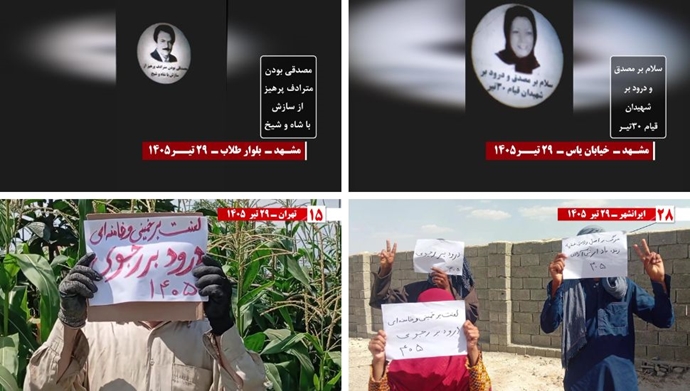

Coinciding with the anniversary of the historic July 21, 1952 uprising, rebellious youth and Resistance Units of the People’s Mojahedin Organization of Iran (PMOI) launched a widespread campaign across various Iranian cities to commemorate the legacy of Dr. Mohammad Mossadegh and the martyrs of the uprising. Through a series of coordinated actions, these units underscored the Iranian people’s enduring quest for freedom, independence, and steadfast resistance against dictatorship.
The historical legacy of July 21, 1952
To understand the significance of these modern acts of defiance, one must look back to the roots of Iran’s anti-colonial struggles. Dr. Mohammad Mossadegh led a decisive battle to nationalize Iran’s oil industry, successfully passing the nationalization law on March 20, 1951.
July 20—Iran
PMOI/MEK Resistance Units mark the anniversary of the July 21, 1952, uprising and honor the memory of Dr. Mohammad Mossadegh with anti-regime activities across the country.#No2ShahNo2Mullahs pic.twitter.com/rcbJPEmOdM— People's Mojahedin Organization of Iran (PMOI/MEK) (@Mojahedineng) July 21, 2026
Following his appointment as Prime Minister, Mossadegh bravely countered domestic and foreign plots. In an effort to curb the Shah’s dictatorial influence, he demanded control over the Ministry of War. When the Shah refused, Mossadegh resigned on July 16, 1952, prompting the Shah to appoint Qavam-os-Saltaneh, a puppet who threatened the public with severe crackdowns.
However, the threats failed to break the people’s will. On the morning of July 21, 1952, major cities including Tehran shut down. Workers, bazaar merchants, and people from all walks of life flooded the streets chanting, “Death or Mossadegh” and “Death to Qavam.” The Shah ordered his military to open fire on the defenseless crowds, leaving nearly 800 people dead or wounded. Ultimately, the Shah was forced to retreat, bowing to the nation’s demands and reinstating Mossadegh.
Nationwide campaign by resistance units
Honoring this legacy today, PMOI Resistance Units organized bold activities across a vast geographical expanse, including Tehran, Mashhad, Tabriz, Shiraz, Karaj, Bandar Abbas, Kermanshah, Qazvin, Gorgan, Amol, Marivan, Tabas, Hamedan, Malayer, Iranshahr, and Minudasht.
Mashhad—Tollab Boulevard
Image of Massoud Rajavi with the message: "Being a follower of Mossadegh means no compromise with the shah and the mullahs" pic.twitter.com/6LFm16hMHb— People's Mojahedin Organization of Iran (PMOI/MEK) (@Mojahedineng) July 21, 2026
In Mashhad, youth executed two major image projections. One featured a picture of Iranian Resistance Leader Massoud Rajavi with the slogan: “Being a follower of Mossadegh is synonymous with avoiding compromise with the Shah and the mullahs.” Another projection displayed the image of NCRI president-elect Maryam Rajavi alongside messages honoring the 1952 martyrs.
In Tehran, the units risked arrest to post flyers and spray-paint slogans, distributing handwritten and printed messages reading, “Curses upon Khomeini and Khamenei, hail to Rajavi,” “Death to the principle of Velayat-e Faqih, long live the National Liberation Army,” and “Hail to Rajavi.”
Similar photo calls and banner drops in cities like Karaj and Tabriz featured quotes from Massoud Rajavi, celebrating Mossadegh as the “symbol of the political will of an independent and free nation,” and noting that his uncompromising spirit continues today within the National Council of Resistance of Iran (NCRI).
Bridging the past and future
While the July 21 uprising was a profound victory, the subsequent August 19, 1953 coup d’état against Mossadegh proved that a popular movement without a cohesive organizational structure and a liberation army is vulnerable to military and colonial schemes. Dr. Mossadegh recognized this shortcoming.
In 1961, pointing to the Algerian revolution and its liberation army, he noted that a nation seeking independence must be willing to sacrifice everything, urging future generations to follow that path.
Tehran
Poster of Massoud Rajavi with the message: "Mossadegh was the manifestation of the political will of an independent and free nation" pic.twitter.com/kYgGuT3A1M— People's Mojahedin Organization of Iran (PMOI/MEK) (@Mojahedineng) July 21, 2026
The PMOI internalized this historic lesson. To answer this structural void, the National Council of Resistance of Iran (NCRI) was founded precisely on the anniversary of the uprising on July 21, 1981, followed by the establishment of the National Liberation Army of Iran in 1987. Today, the resistance against the clerical regime is equipped with what Mossadegh’s era lacked: a highly organized democratic alternative and Maryam Rajavi’s 10-point plan, which guarantees a transition to a secular, pluralistic republic with free elections, gender equality, and the abolition of the death penalty.
The nationwide activities of the Resistance Units prove that the unbreakable will of the Iranian people, which sparked the 1952 uprising, is alive and well, marching toward a definitive victory.