

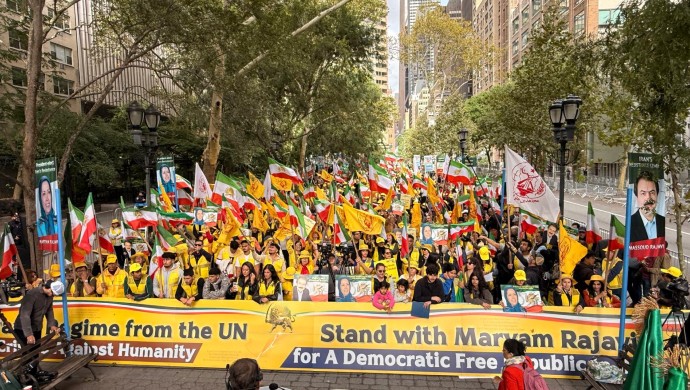

Thousands of Iranians and supporters of the National Council of Resistance of Iran rallied in New York as world leaders gathered for the United Nations General Assembly, focusing attention on Iran’s escalating use of executions, the fate of political prisoners facing death sentences, and the question of who should determine the country’s political future.
The demonstration came amid an unprecedented wave of political executions since 1988. At least 40 political opponents, including members of the People’s Mojahedin Organization of Iran (PMOI/MEK) and protesters detained during the December 2025-January 2026 uprising, have been executed in recent months, while at least 100 other political prisoners face death sentences.
Thousands will rally outside UN headquarters to condemn human rights violations in Iran and the presence of regime president Massoud Pezeshkian at UNGA. They also support a free and democratic republic of Iran that rejects both the shah and mullahs' dictatorships.…
— People's Mojahedin Organization of Iran (PMOI/MEK) (@Mojahedineng) September 23, 2026
Speakers repeatedly returned to several themes: accountability for human rights violations, opposition to executions, support for political prisoners and protesters inside Iran, rejection of both monarchical and clerical dictatorship, and the contention that Iran’s political future must be decided by Iranians rather than through foreign military intervention.
Mrs. Rajavi: “Neither war nor appeasement is the answer”
In her address to the rally, Maryam Rajavi, president-elect of the National Council of Resistance of Iran, framed the demonstration as a demand that governments gathering at the United Nations listen to the Iranian people rather than equate the ruling establishment with Iran itself.
“The people of Iran want neither war nor dictatorship,” Mrs. Rajavi said. “They want freedom, a democratic republic, and the right to decide their own future.” She stressed that the central confrontation was not between Iran and foreign powers but “between the Iranian people and the organized Resistance, on one side, and the religious dictatorship on the other.”
Day 2 of Rally by freedom-loving Iranians outside the UN General Assembly, New York
“The time has come to listen to the voice of the people of Iran, who want neither war nor dictatorship.”#FreeIran2026NYRally#UNGA https://t.co/mWNtk1QYnl pic.twitter.com/XdnByfvp1M— Maryam Rajavi (@Maryam_Rajavi) September 23, 2026
Mrs. Rajavi also pointed to domestic pressures, citing rising prices, demonstrations by workers, nurses, retirees and the unemployed, resistance by political prisoners, and activities by Resistance Units. She said recent security deployments and military exercises reflected the authorities’ fear of renewed unrest.
Addressing the competing approaches to Iran policy, she rejected both accommodation with the regime and reliance on external military force. “Over the past year, it has also become clear that war and foreign military intervention are not the solution to Iran’s problem,” she said. “Neither war nor appeasement is the answer.”
“The solution,” she continued, “is the overthrow of this regime by the people of Iran and their organized Resistance.”
Mrs. Rajavi concluded by calling on the international community to recognize the Iranian people’s struggle against the Revolutionary Guards and to recognize the NCRI’s proposed provisional government, based on its Ten-Point Plan.
Executions and political prisoners dominate the rally
The accelerating use of the death penalty against political opponents formed one of the rally’s most prominent themes.
Soona Samsami, the NCRI’s U.S. representative, said that since mid-March, “at least 40 opponents of the regime, including 9 PMOI members, have been executed.” She added that another 100 prisoners face execution, identifying Arghavan Fallahi, a young woman sentenced to death on charges of membership in the PMOI, among them.
“The dramatic increase in executions is not a sign of strength,” Samsami said. “It’s an admission of the regime’s fear and weakness.”
Soona Samsami (@NCRIUS): Iran's seat at the @UN belongs to the Iranian people, not this oppressive regime. Democratic governments must recognize the Iranian people, their organized resistance, and their struggle against the IRGC to overthrow the mullah regime! #NCRIAlternative…
— NCRI-FAC (@iran_policy) September 23, 2026
She linked the executions to broader political and economic strains, pointing to poverty, corruption and growing public anger, and said those resisting inside Iran were confronting imprisonment and execution while protesters outside the United Nations sought to bring their voices to international attention.
Former U.S. Ambassador to Morocco Marc Ginsberg also centered his remarks on those imprisoned or killed inside Iran. He invoked the Rahimi sisters, two young women who had been imprisoned, tortured and sexually assaulted, and spoke of families who had lost sons and daughters during protests.
“Do you hear the final words of young men and women sent to the gallows for merely seeking freedom?” he asked the crowd. “Do you hear the voices of millions of Iranians who fear that their pleas for freedom are once again being forgotten?”
Amb. @ambmcg): There is bipartisan support for a free Iran, and Congress must push the administration to act. Only the Iranian opposition and people can choose their leaders, but the US can support a transitional government in exile led by @Maryam_Rajavi and back the…
— NCRI-FAC (@iran_policy) September 23, 2026
Former U.S. Senator Robert Torricelli similarly pointed to the crackdown on the recent nationwide uprising. He said thousands of Iranians had taken to the streets demanding freedom and justice and that thousands were subsequently killed.
Torricelli also pointed out that the uprising demonstrated the continued presence of organized opposition inside Iran. He praised young people operating in Resistance Units in “small villages, towns, and cities across Iran” who, he said, had continued organizing despite the risk of death.
The rally’s demands extended beyond ending executions. Ms. Samsami called on the UN General Assembly to establish an international criminal justice mechanism for crimes against humanity in Iran, urged the UN Security Council to refer human rights violations to the International Criminal Court, and called on governments to use universal jurisdiction to prosecute officials accused of serious crimes.
Speakers reject foreign war as the path to political change
While speakers sharply criticized the regime, several also drew a clear line between international support for Iranians seeking political change and the idea that foreign powers could deliver that change themselves.
Ms. Samsami summarized the distinction directly: “Neither appeasement, nor bombing, nor foreign interference, nor foreign wars can bring about regime change in Iran.”
“The solution for Iran,” she said, “lies in the decisive force on the ground: the organized resistance, those who confront the regime’s Revolutionary Guards and Bassiji forces and pay the price of resistance.”
Torricelli made the same point from a different angle. Addressing Iranians inside the country, he said he could not promise that an outside government would deliver their freedom.
“I wish I could tell you that some foreign leader, even our own country, could bring you freedom, but we cannot,” he said.
.@bobtorricelli: In the face of death, Pahlavi doubles down with pride in his father, disparages Kurds, and collaborates with the #IRGC. No to the Mullahs, no to the Kings—we want a free Iran! #No2ShahNo2Sheikh https://t.co/dBli2jon2C
— NCRI-FAC (@iran_policy) September 23, 2026
“The revolution that is underway is going to be won by children, students, workers, and even soldiers who refuse to fire their weapons at their own people,” Torricelli continued. “This revolution is not American, it is not European; it is Iranian.”
He later reinforced the point: “A free Iran doesn’t come from America, it doesn’t come from the UN, it’s not coming from Europe.”
Ginsberg, while calling for greater international political support for democratic change, likewise said the ultimate decision could not belong to outsiders.
“Americans cannot give Iranians their freedom,” he said. “Americans cannot and should not choose their leaders. Only the Iranian opposition and the Iranian people together can accomplish that.”
Youth speaker Yalda Bolurchi described the same position as rejecting a false choice between foreign intervention and accepting the status quo.
“Rejecting foreign military intervention does not mean accepting submission,” she said. “Standing with Iran’s revolution does not mean waiting for someone else to begin it, because guess what? The Iranian people already have.”
Resistance Units and an organized alternative
The activities of PMOI Resistance Units prove that political change must have an organized domestic foundation, the speakers stressed.
Ms. Samsami said the units were expanding their activities across the country, saying that young women and men are “challenging the machinery of repression, breaking the atmosphere of fear, and keeping the flame of organized resistance alive.”
Bolurchi placed particular emphasis on the role of younger Iranians. Referring to teenagers she had seen participating in recent protests, she argued that the Resistance Units provided an organized framework for a generation seeking fundamental political change.
“The Resistance Units of the MEK are very integral in supporting a new future,” she said, describing them as a force that “shake[s] the foundation” of the regime. She concluded by calling for recognition of their struggle and of the political prisoners continuing to resist from inside Iran.
Kiana Rezayan, another member of the youth delegation, connected the present movement to successive generations of political opposition. She described members of her own family who had experienced imprisonment under both the Shah and the mullahs’ regime before turning to the present-day activities of political prisoners and Resistance Units.
“Women and young people continue to organize and confront the regime across Iran,” she said, adding that she saw the continuation of that history in the PMOI network inside Iran and its Resistance Units.
Alongside the discussion of organization inside Iran, speakers emphasized the NCRI’s proposed political framework for a transition.
At the opening of the rally, Azadeh Sami laid out the NCRI provisional government whose stated mandate would be to organize free and fair elections within six months and transfer authority to elected representatives. She also outlined elements of the Ten-Point Plan, including universal suffrage, political freedoms, separation of religion and state, gender equality and a non-nuclear Iran.
.@bobtorricelli: In the face of death, Pahlavi doubles down with pride in his father, disparages Kurds, and collaborates with the #IRGC. No to the Mullahs, no to the Kings—we want a free Iran! #No2ShahNo2Sheikh https://t.co/dBli2jon2C
— NCRI-FAC (@iran_policy) September 23, 2026
Torricelli addressed those who argue there is no organized alternative to the current system. “Not only is there a choice, there is a good choice. Read the Ten-Point Plan,” he said.
He described the proposed alternative as one committed to a non-nuclear Iran, gender equality, separation of religion and government, and democratic rule.
Ginsberg also focused on the transition framework, pointing to proposals for a provisional authority, elections, transfer of sovereignty to an elected constitutional assembly and the establishment of a new constitutional order.
“No to the mullahs, no to the Shah”
Another recurring message was the rejection of restoring Iran’s former monarchy alongside opposition to the current clerical regime.
Torricelli put the argument in one of the rally’s most direct formulations: “No to the mullahs, no to the kings!”
“We do not want a dictatorship of the left or of the right, of religion or of politics,” he continued. “We want a free Iran.”
Ms. Samsami used similar language. “The Iranian people want neither war nor dictatorship,” she said. “They have not sacrificed and shed their blood for 48 years simply to replace the turban with the crown.”
“They rejected the Shah dictatorship and they reject the dictatorship of the mullahs,” she added, contrasting both systems with the NCRI’s proposed democratic framework.
.@RudyGiuliani: The regime’s highest officials admit the @Mojahedineng is the main operational force and core engine driving nationwide uprisings across all 31 provinces in Iran. The strategy of the #MEKResistanceUnits is actively succeeding, proving that the organized resistance…
— NCRI-FAC (@iran_policy) September 23, 2026
Former New York Mayor Rudy Giuliani also contrasted the monarchy and the clerical system with the demand for representative government. Referring to the prospect of replacing one authoritarian form of government with another, he said: “If we’re going to go through all this, we’re going to go through it so we have a representative democracy.”
A message directed both inside and outside Iran
To governments and officials gathered at the United Nations, speakers called for greater attention to executions, political prisoners and accountability for human rights violations. They urged international institutions to distinguish between Iran’s population and the authorities representing the Iranian regime at the UN, and several called for concrete legal and diplomatic action over alleged crimes against protesters and political prisoners.
To people inside Iran, the speeches emphasized a different point: that political change could not be imported from abroad.
The recent uprising, political prisoners, younger protesters and Resistance Units are proof that the decisive political struggle was taking place inside the country. Torricelli summarized that theme in one sentence: “This revolution is not American, it is not European; it is Iranian.”
That combination defined the central message delivered outside the United Nations: opposition to executions and repression, rejection of both clerical and monarchical dictatorship, opposition to relying on foreign war for regime change, and support for Iranians themselves determining the country’s political future.