

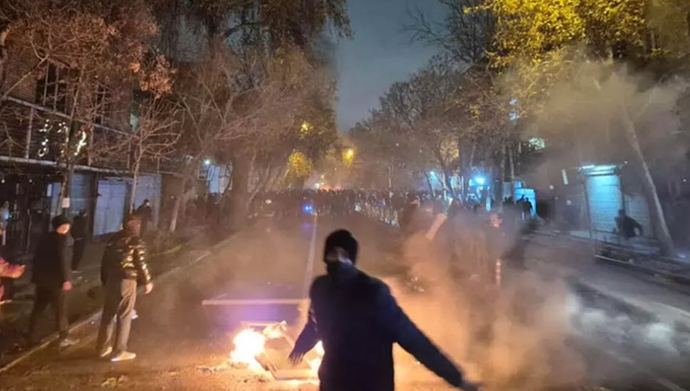

Six months after the historic January 2026 nationwide uprising, the Iranian regime is employing a dual strategy of brutal executions and psychological warfare against grieving families. In a desperate bid to project power and maintain its fragile grip on society, the regime is simultaneously fast-tracking death sentences for protesters and attempting to bribe the families of the martyrs. However, this systematic repression only exposes the regime’s deep-seated desperation, demoralization within its ranks, and profound fear of the Iranian people’s organized resistance.
The execution spree as a tool of terror
Terrified of a resurgent uprising, the regime is weaponizing its judiciary to fast-track death sentences against young protesters, denying them basic due process to instill fear in a restive population.
In the fabricated “Ali Khani Square” case in Isfahan—stemming from the nationwide protests of January 8, 2026—the regime’s Supreme Court confirmed the death sentences of 12 protesters on July 5, 2026. The cases have already been forwarded to the execution branch of the Isfahan Revolutionary Court, sparking widespread alarm.
Many of these condemned individuals are young, with some born in 2006 and 2007. During their sham trials, overseen by prosecutor Mohammad Nakhjavan and judges Mohammad Barati-Dorcheh and Mohammad Tavakoli, the defendants were systematically denied the right to independent counsel. Instead, they were forced to rely on state-appointed lawyers who lacked full access to the case files. Furthermore, 23 other detainees were handed heavy prison sentences ranging from five to 10 years, despite evidence showing some had no involvement in the deaths of the Basij forces used as the pretext for the case.
Psychological warfare and exploiting the martyrs’ families
While the regime’s judiciary hands out death sentences, its security apparatus is engaged in a sinister campaign to silence the families of the martyrs and falsely claim the victims as their own loyalists. Following the massacres, state security forces have relentlessly pressured grieving families. In one documented case, a 45-year-old protester killed by regime snipers was denied a burial in a public cemetery; authorities forced his family to bury him in a remote, isolated village.
Yet, the cruelty does not end there. The Islamic Revolutionary Guard Corps (IRGC) and the Foundation of Martyrs subjected the grieving family to relentless, round-the-clock phone calls, offering bribes such as special financial quotas and monthly salaries. The ultimate goal of this extortion is to force families to register their murdered loved ones as “Basijis.” By doing so, the regime hopes to wash its bloody hands and fabricate fake martyrs to boost the morale of its demoralized and depleting forces.
Despite facing severe poverty and relentless threats, these bereaved families are bravely rejecting these dirty deals, proving that the regime’s billion-dollar propaganda machine has completely failed to break the conscience of the Iranian people.
The perils of international impunity
The regime’s ongoing atrocities are directly fueled by the international community’s failure to hold the ruling clerics accountable for their massacres. Diana Eltahawy, Deputy Regional Director for the Middle East and North Africa at Amnesty International, warned on the six-month anniversary of the January uprising that a “systemic impunity crisis” has emboldened the regime’s “trigger-ready” security forces to carry out further mass killings and arbitrary executions.
During the height of the uprising between January 8 and 9, 2026, the regime slaughtered thousands of protesters. While the regime’s Supreme Council of National Security admitted to 3,117 deaths, UN Special Rapporteur Mai Sato estimated that over 5,000 people were killed by security forces.
Furthermore, Amnesty International warned of at least 44 politically motivated executions have taken place recently under the guise of “wartime conditions” following the February 2026 attacks on Iran. Human rights organizations are deeply concerned that Western governments are allowing the pursuit of international justice to be overshadowed by the recent US-Iran memorandum of understanding signed on June 18, 2026, which failed to center human rights.
“With no prospect of justice in Iran amid a systemic impunity crisis, avenues for international criminal justice must be pursued as an urgent and non-negotiable priority,” Eltahawy said. “Amnesty International renews its calls on the international community and UN member states to place Iran’s human rights and impunity crisis firmly high on their agenda, support the creation of an independent international justice mechanism for Iran and urge the UN Security Council to refer the situation in Iran to the International Criminal Court.”
The inevitability of the regime’s downfall
A regime that resorts to hawking the blood of its own victims to artificially inflate the ranks of its loyalists is a regime in its terminal phase. The steadfast refusal of the martyrs’ families to yield to the regime’s bribes and threats proves that the Iranian people will neither forgive nor forget the horrific crimes of the past 47 years.
Despite the rampant executions and international inaction, the regime cannot escape the wrath of the people. The rage of the Iranian people and their organized resistance will ultimately overthrow this dictatorship, ensuring that the next uprising arrives sooner rather than later. This determination can be seen in the relentless operations by PMOI/MEK Resistance Units against regime centers, which have only intensified in wake of the regime’s brutal executions.