

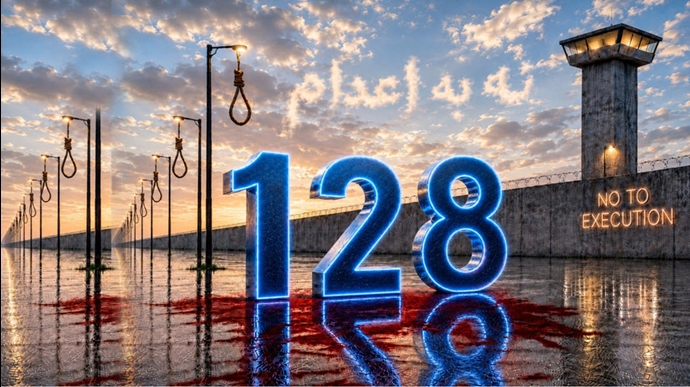

Political prisoners in 57 facilities across Iran held hunger strikes on July 7, marking the 128th week of the “No to Executions Tuesdays” campaign. The strike coincides with the upcoming anniversary of the July 9, 1999, student protests, a landmark event in Iran’s modern history when security forces violently suppressed peaceful pro-democracy demonstrations at the Tehran University dormitories.
“The ‘No to Executions Tuesdays’ campaign, on the eve of July 9, the anniversary of the students’ deaths in 1999, honors the memory of those who died for freedom and equality. A day when the students’ protests were suppressed by the government, turning the university dormitory into a bloodbath,” the prisoners wrote in their statement.
The campaign warned of an accelerating rate of executions, documenting at least 15 hangings since late June. The prisoners highlighted the increasing use of the death penalty against political detainees and those arrested during the massive December 2025 to January 2026 nationwide uprisings.
“Last week, Judge Salavati issued a medieval death sentence for the female political prisoner held in Evin’s women’s ward, Arghavan Fallahi,” the statement read. “This sentence was issued by this notorious judge while the case process took place under unfair conditions and under the pressure of security institutions.”
On July 1, Branch 15 of Tehran’s Revolutionary Court sentenced the 25-year-old PMOI supporter to death. Following her arrest in January 2025, Fallahi was held in solitary confinement for five months in Evin Prison’s Ward 241—operated by the Judiciary’s Intelligence Protection Unit—where she was subjected to severe physical and psychological torture. She was later moved to Fashafuyeh Prison and subsequently returned to Evin. Her father, Nasrollah Fallahi, a political prisoner from the 1980s, is currently serving a five-year sentence in Evin’s Ward 7.
The prisoners’ statement also cited death sentences issued for detainees of the January 2026 uprisings, specifically naming Kamal Khan-Babaei in Qazvin’s Choobindar Prison and Vahid Khan-Sanami in Greater Tehran Prison, who were sentenced “in an unfair process and to intimidate society.”
The statement condemned the July 4 reappointment of Gholamhossein Mohseni Ejei as the head of the judiciary by Mojtaba Khamenei, who was installed as the regime’s supreme leader in March 2026. Ejei has held senior intelligence and judicial roles for nearly four decades, including serving as the judiciary’s representative in the Intelligence Ministry during the 1988 massacre of political prisoners. He was sanctioned by the US in 2010 and the EU in 2011 for his role in suppressing protests.
“These inhumane sentences are issued while recently Gholamhossein Mohseni Ejei, the head of the regime’s judiciary, was reappointed to his position by the autocratic ruler Mojtaba Khamenei,” the prisoners stated. “Ejei has a record full of human rights violations and in the last four years holds the record for the most execution sentences in the last three decades.”
The striking inmates urged global human rights organizations and the international community to intervene and press for fair, public trials, characterizing the ongoing wave of executions as a crisis engineered inside interrogation rooms.
“The ‘No to Executions Tuesdays’ campaign… calls on all international bodies and awakened consciences to react to the human tragedy unfolding in Iran’s prisons,” the statement concluded. “Death sentences are essentially issued behind closed doors and with physical and mental torture in interrogation rooms. Therefore, it is imperative for everyone to take serious action in any way possible to pressure the government to respect the principles of a fair trial, especially holding public trials for charges that lead to the deprivation of life and the death penalty.”