

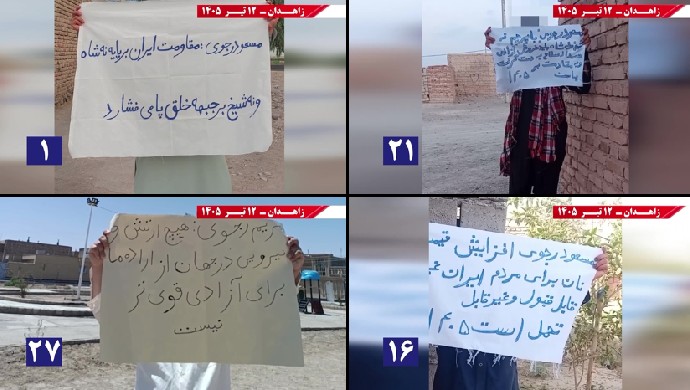

On July 3, the PMOI/MEK Resistance Units in Zahedan, southeast Iran, resumed their weekly activities, boldly defying the regime’s apparatus of repression. In public spaces across the city, these courageous activists held placards with messages of resistance, demonstrating that the organized resistance remains the vanguard for democratic change in Iran. They issued a direct call to students and educators, stating: “To the students: the only way to achieve your demands is solidarity, continuity, and the expansion of protests.”
Economic collapse as a political weapon
The Resistance Units are directly addressing the regime’s systemic economic failures, transforming the daily struggle for survival into a rallying cry for the regime’s overthrow. Placards in Zahedan declared that “the stolen bread and water of our enchained nation must be turned into a hail of fire and fury to bring this regime down.” They noted that skyrocketing bread prices are “utterly intolerable.”
July 3—Zahedan, southeast Iran
PMOI/MEK Resistance Units resume their weekly activities, defying the regime's apparatus of repression and rejecting all forms of dictatorship, whether the rule of the mullahs or the shah. pic.twitter.com/jNsGPV7JqI— People's Mojahedin Organization of Iran (PMOI/MEK) (@Mojahedineng) July 4, 2026
This resonates deeply with the current reality in Iran. According to state-affiliated media, the official minimum monthly wage for 2026 was set at approximately 166 million rials, while the minimum cost of living exceeds 450 million rials. Families are surviving on bread, cheese, eggs, and tomatoes, yet bread prices have seen an inflation rate exceeding 140 percent. The Resistance Units highlighted the root cause: “The plundering mullahs steal even the water in order to fund suppression and anti-patriotic nuclear, missile, and foreign warmongering projects.” State-affiliated voices acknowledge that this economic devastation has evolved into a political crisis of governance.
The dying regime vs. the organized resistance
The ruling theocracy is weaker and more desperate than ever before, creating a vacuum that only an organized resistance can fill. Following the end of Ali Khamenei’s uncontested rule, his son has proved incapable of taking the helm, with nearly half the members of the Assembly of Experts refusing to support him. Politically, the regime has reached a dead end.
"Down with the rule of the mullahs, long live the National Liberation Army" pic.twitter.com/IKhIB8ckor
— People's Mojahedin Organization of Iran (PMOI/MEK) (@Mojahedineng) July 4, 2026
Against this weakened state, the Resistance Units assert that regime change is “our duty, our mission, and the sole responsibility of our people and their revolutionary vanguard.” They constitute the most important organized force within the uprisings. This dedication requires absolute sacrifice, exemplified by young rebels like Vahid Bani-Amerian and his heroic unit, who were executed in April 2026. Offered their lives in exchange for a single word against the PMOI, they proudly told their executioners: “We do not bargain with you over our ideals, our beliefs, or our lives.”
The democratic vision: “Neither Shah nor mullahs”
As they lead the charge, the Resistance Units are making it unequivocally clear that the Iranian people reject all forms of dictatorship. Slogans displayed in Zahedan proudly declared that “the people of Iran will consign both the colonial puppet monarchy and the reactionary clerical regime to the dustbin of history,” firmly anchoring the movement in the principle of “Neither Shah nor the mullahs.”
"Under the banner of 'Neither Shah nor mullahs,' we must raise the battle cry of freedom, take up arms, and rise in organized resistance." pic.twitter.com/pWacLhZ9Kf
— People's Mojahedin Organization of Iran (PMOI/MEK) (@Mojahedineng) July 4, 2026
This distinction is critical, as the remnants of the Shah’s dictatorship act as a destructive force. A newspaper affiliated with the ruling clerics even called monarchist activities a “blessing” and an “opportunity” because they sow division and help “ensure the survival of the Islamic Republic.” The Shah’s heir himself openly declares that change should be achieved with the assistance of the Revolutionary Guards (IRGC) and the intelligence apparatus, and he has described the shah’s notorious SAVAK police as a source of “pride.”
Rejecting this false alternative, the Resistance Units in Zahedan emphasize that the true democratic popular front says “No to mullahs, no to shah. Yes to freedom and a democratic republic.” They reaffirm that the future of Iran, along with its peace and freedom, lies exclusively in the establishment of a democratic republic.