

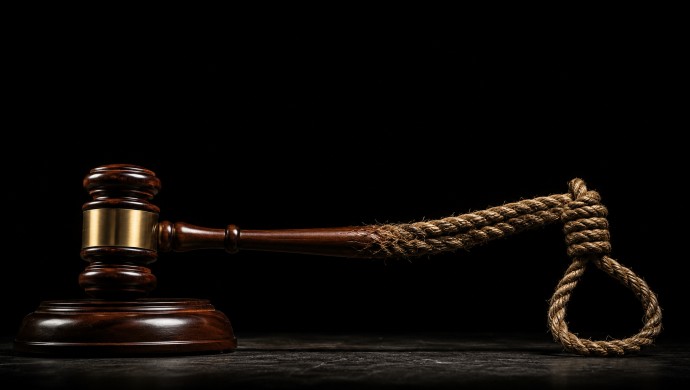

Political uncertainty has become the defining characteristic of Iran’ regime. Internal power struggles, conflicting signals over negotiations with the West, mounting economic crises, and growing public dissatisfaction have created a political system that appears increasingly unstable. Yet amid this volatility, one state policy has remained remarkably consistent: the systematic use of executions, judicial intimidation, and repression to preserve the regime’s survival.
The recent message issued by Mojtaba Khamenei, the regime’s new supreme leader, to mark the regime’s “Judiciary Week,” followed almost immediately by Judiciary Chief Gholamhossein Mohseni Ejei’s pledge of complete loyalty, offered another reminder that the regime’s leadership views repression not as a temporary response to crisis but as the central pillar of its governing strategy.
Executions Continue Despite Religious Rhetoric
Even during the holy month of Muharram—a period in which regime officials publicly invoke themes of mourning and justice—the machinery of execution has shown no sign of slowing.
According to recent reports, prisoners were executed in Sari, Ahvaz, Qom, Kermanshah, Semnan, Yasuj, and Gorgan in just a matter of days. Behind each execution lies another family forced into grief, adding to the thousands already devastated by decades of state violence.
This pattern exposes a familiar contradiction. While the regime attempts to portray itself as a guardian of religious values and compassion, it continues to employ capital punishment as one of its primary instruments of political control and social intimidation.
Torture Remains Embedded in the Judicial System
The continuation of executions coincided with the observance of June 26, the International Day in Support of Victims of Torture, commemorated by countries that have committed themselves to the prohibition of torture under international law.
Iran’s regime, however, remains one of the governments most consistently accused of employing both physical and psychological torture against prisoners.
Recent reports illustrate the human cost of this policy. In Evin Prison, authorities recently fabricated a new case against PMOI supporters Shiva Esmaeili and Elaheh Fouladi, sentencing them to an additional six months behind bars for “insulting the Supreme Leader.” Their actual “crime” was protesting the death of 42-year-old Somayeh Rashidi, who was martyred under torture in Varamin’s Qarchak center on September 25, 2025.
To break the inmates’ morale, regime torturers are also weaponizing family visitations. Seven female political prisoners—Zahra Safaei, Forough Taghipour, Marzieh Farsi, Elaheh Fouladi, Arghavan Fallahi, Shiva Esmaeili, and Golrokh Iraee—were deprived of family visits simply for singing anthems and chanting “No to execution” in solidarity with the “No to Execution Tuesdays” campaign.
Meanwhile, in Yazd Prison, guards are using the pretext of wartime conditions to deny vital medication and hospital transfers to 40-year-old PMOI supporter Parisa Kamali. Kamali, who is slated to be exiled to Khash Prison, faces life-threatening conditions but remains unbroken.
These are not isolated incidents. They reflect a judicial system that increasingly functions as an extension of the security apparatus rather than an institution of justice.
Punishment Extends Beyond Death
Perhaps nothing better illustrates the cruelty of the regime’s methods than its treatment of the families of executed prisoners.
Thousands of Iranian families continue searching not only for justice but even for the burial places of their loved ones.
The heartbreaking question asked by the father of political prisoner Vahid Bani Amerian—”Where is my son’s grave?”—has become symbolic of a much broader national tragedy. Bani Amerian was executed alongside five other political prisoners in Ghezel Hesar Prison earlier this year, yet their families have reportedly not even been allowed to receive their bodies or learn their burial locations.
Denying families the right to bury and mourn their relatives is not merely administrative cruelty. It represents the continuation of punishment after death itself—a deliberate effort to inflict psychological suffering on surviving family members while erasing evidence of state violence.
Such practices violate the most fundamental principles of human dignity and illustrate how repression in Iran extends well beyond prison walls.
A Judiciary Devoted to Security, Not Justice
While executions continue, senior judicial officials have also released revealing statistics about the expanding scope of political prosecutions.
Judiciary spokesman Asghar Jahangir announced that, within fewer than four months, authorities had arrested 3,292 individuals on accusations of “collaboration with the enemy.”
According to the judiciary, 684 detainees allegedly participated in operational activities, while another 1,258 individuals were prosecuted for what officials described as political, media, or propaganda activities. Prosecutors have already issued indictments in more than one thousand cases, while authorities continue identifying and confiscating the assets of some defendants.
Meanwhile, the head of the Hamedan provincial judiciary announced that approximately 2,000 cases connected to the nationwide protests of January 2026 have already been processed and ruled upon. Judicial authorities have simultaneously confirmed the opening of additional security-related cases connected to the recent military conflict, insisting that there will be “no leniency” toward those accused of threatening state security.
Even broader judicial statistics reveal the scale of state control. Tehran’s provincial judiciary reports that more than 14 million cases entered the capital’s court system between 2021 and 2025, representing an increase of over twenty percent compared to the previous five-year period.
Far from demonstrating an efficient legal system, these figures reveal an increasingly securitized state that relies heavily on criminal prosecution to regulate political and social life.
Mojtaba Khamenei’s Message: Making Fear Visible
Against this backdrop, Mojtaba Khamenei’s Judiciary Week message deserves careful political interpretation.
Officially, the message called for implementing judicial reforms and improving public confidence in the courts. It spoke of justice becoming visible in everyday life, faster legal proceedings, greater judicial integrity, and stronger protection of citizens’ rights.
Yet the political context suggests a very different meaning.
Read alongside the regime’s accelerating executions, expanding political prosecutions, and increasingly aggressive security policies, the message functions less as a call for judicial reform than as an instruction to deepen the judiciary’s role in enforcing political control.
Its underlying objective appears straightforward: the effects of state power should become increasingly visible throughout society, with the judiciary serving as one of the regime’s principal instruments for generating fear, suppressing dissent, and discouraging future protest.
Mohseni Ejei’s immediate endorsement of the message underscored that the judiciary fully embraces this mission.
Repression Is the Regime’s Last Remaining Strategy
The regime faces one of the most difficult periods in its history. Economic deterioration, international isolation, deep factional disputes, and widespread public disillusionment have steadily eroded its legitimacy.
These pressures have generated visible disagreements inside the regime over issues such as nuclear negotiations, foreign policy, and relations with Western governments. Yet there is one issue on which the regime’s competing factions continue to converge: preserving power through coercion.
The escalation of executions, the expansion of politically motivated prosecutions, the continued torture of prisoners, and the systematic intimidation of society all point toward the same conclusion.
As the regime grows weaker politically, it relies ever more heavily on violence institutionally.
History, however, repeatedly demonstrates that governments sustained primarily through fear ultimately expose not their strength, but their insecurity. The increasing dependence on executions and judicial repression is therefore not a sign of confidence. It is evidence that the regime has few remaining tools with which to confront a society that continues to demand accountability, justice, and fundamental political change.
For the international community, this reality carries important implications. Diplomatic engagement that overlooks the regime’s systematic human rights violations risks reinforcing the very institutions responsible for these abuses. Sustainable stability cannot be achieved by accommodating a regime whose principal instrument of governance has become repression. Instead, international policy should place human rights at its center by holding perpetrators accountable and recognizing the Iranian people’s legitimate right to seek democratic change and resist institutionalized tyranny.