

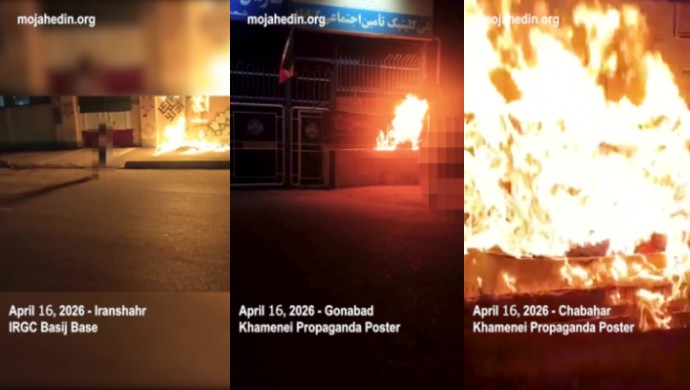

For years, the Iranian regime has tried to portray Iran’s protest movement as scattered, leaderless, and containable, while denying or downplaying the presence of PMOI/MEK Resistance Units. Yet recently revealed internal documents from the Security Councils of Tehran and Alborz Provinces expose a very different reality. Covering the years 2020 to 2025, these classified minutes and audio transcripts show that senior officials from the Intelligence Ministry, the IRGC, the police, and provincial authorities have repeatedly treated the Resistance Units not as a marginal issue, but as a persistent and expanding strategic threat.
This contradiction goes to the heart of Iran’s current political crisis. Since the December 2017 uprising, repeated nationwide revolts have shown the Iranian people’s rejection of both clerical rule and any return to dictatorship under another name. But experience has also shown that popular anger alone is not enough to overcome a regime built on organized repression. The Resistance Units have emerged as the organized force capable of giving protests direction, continuity, and staying power. The leaked documents themselves acknowledge that their activities have grown in both quantity and quality, that they have become more organized, and that they are able to rebuild, replace personnel, and move operations from one province to another despite arrests and crackdowns.
The regime’s recent execution of eight PMOI members who were part of the Resistance Units network—Mohammad Taghavi, Akbar Daneshvarkar, Babak Alipour, Pouya Ghobadi, Vahid Bani Amerian, Abolhassan Montazer, Hamed Validi, and Mohammad “Nima” Massoum Shahi — must be understood in this context. These executions were intended to intimidate society and break the organized resistance. Yet the final messages, videos, and prison testimonies of several of these prisoners circulated widely inside Iran, abroad, and across social media. In this sense, the regime’s own internal documents confirm the deeper reality: executions are used as tools of fear, while the Resistance Units seek to break that fear and turn repression into a catalyst for further resistance.
The internal record begins as early as February 2020, when the Tehran Provincial Security Council discussed actions attributed to the MEK around the District 10 Revolutionary Court, the Martyrs Foundation, EIKO (the institution for Execution of Khomeini’s Orders) facilities, and the Ministry of Interior. Officials noted that those responsible had recorded and distributed footage, and one security assessment concluded that some participants appeared to have been brought from other provinces. This early reference already points to two recurring concerns: media impact and inter-provincial mobility.
By November 2020, the issue had become far more central. In the 16th Tehran Provincial Security Council meeting, officials stated that within the provincial intelligence community, the “primary issue at the top of the agenda” was the MEK. They said approximately 144 cases had been addressed over the previous two years, “generally” concerning Resistance Units. The same meeting warned that the MEK had shifted toward more serious operations and that this was “a critical issue that demands everyone’s attention.”
In June 2021, Tehran Intelligence chief Reyhani told the council that the MEK viewed June 20 as a security milestone and that officials had to “preempt any situation that trends toward crisis and disorder.” This is revealing because the regime was not merely reacting to isolated incidents; it was preparing around political dates, anniversaries, and protest-sensitive moments.
The February 2022 Tehran Provincial Security Council meeting was even more direct. Its security assessment warned of intensified MEK recruitment inside Iran, “especially in Tehran,” and stated that the strategy regarding Resistance Units was the formation of “one thousand units.” The same meeting recorded 91 publicity activities and operations in Tehran Province in January 2022 alone, including the broadcast of anti-regime slogans via audio systems in Tajrish, Varamin, and Shahriar.
The Alborz Provincial Security Council’s September 2022 audio document, recorded during the nationwide uprising, shows the regime’s anxiety in still sharper form. Naeimi, the head of Alborz Intelligence, said that the MEK had sent instructions to its internal elements and quoted the line: “the fire must never leave the streets.” He also warned that the next agenda was the disarmament of officers, bases, and police stations, adding that the protection of police stations and bases was an “absolute necessity.”
This is one of the most important parts of the file. It shows that, at the height of the 2022 uprising, the regime did not view the Resistance Units as an inconvenience. It viewed them as a force capable of influencing the direction, tempo, and organization of street confrontation.
The 2023 documents continue the same pattern. In October 2023, Kamal Sadat, Secretary of the Tehran Provincial Security Council, warned that the MEK had introduced alternative communications tools and methods to replace widely used messaging platforms. In the same meeting, Beigi, the commander of the IRGC Intelligence Organization in Tehran Province, stated that the “movements” of the MEK showed that they were “expanding their plans,” including designs against police headquarters, IRGC command headquarters, and Basij centers.
A November 2023 meeting recorded further concern over attacks on sensitive sites and the media reflection of those actions. Kamal Sadat said that launching projectiles at classified or sensitive locations and publicizing them through MEK-affiliated media “remains a current agenda,” and therefore identifying key individuals involved was essential. Another senior official in the same meeting said the MEK was seeking “a major propaganda move” to show that it held the upper hand among anti-regime forces.
By December 2023, the internal tone had become openly alarmed. Rastegar, head of the Tehran Intelligence Organization, told the council that for about two years, law enforcement, judicial, and military institutions had been facing “security disturbances” from the MEK. He said the number of such incidents had increased and that the situation reached a point where then–IRGC commander Hossein Salami personally ordered that the matter be brought to an end. But Rastegar then admitted the key point: after arrests and crackdowns, the operational teams had been “reconstructed” and their numbers had increased again.
He said that after two teams were arrested the previous year, officials had again witnessed “the reconstruction and renovation of their operational teams,” and that the number of actions had increased. He also stated that some of those arrested had previously been imprisoned, exiled, or even pardoned, but had returned to operational activity. The regime’s own internal discussion therefore confirms the central conclusion: repression had not destroyed the network.
The January and February 2024 meetings show another escalation in the regime’s fear. In one meeting, Rastegar stated that after recent arrests, “it hasn’t even been a month” and a “strong and capable” team had already been reconstituted. He then revealed that, in the confessions of a previously arrested team, officials had discovered a plan involving the Office of the Supreme Leader from six different points. “We have never seen this before,” he said, adding that the sites had been scouted for security gaps.
Days later, Kamal Sadat repeated the warning that the MEK had formed a strong new team after the previous blow. He listed planned actions including an assault on the Supreme Leader’s residence and other points where security gaps had been identified, as well as intensification of Resistance Unit activities through attacks on government and military premises, graffiti, destruction of regime symbols, and the burning of banners bearing the images of Qasem Soleimani, Khamenei, and Khomeini.
The February 2024 electoral period also shows how the Resistance Units intersect with political legitimacy. In a classified meeting, Sadat reported hostile campaigns such as “My Vote is Overthrow,” “No to Voting,” “We Will Not Vote,” and “Boycott the Election Circus.” The document includes images of burning election posters and banners, visually reinforcing what the written text describes: the regime’s fear that boycott campaigns, symbolic acts, and street actions could converge against its staged elections.
The 2024 and 2025 records show that this concern did not fade. In August 2024, Kamal Sadat warned of “the growth of movements by Resistance Units” to plan “100 daily operations across the entire country.” In October 2024, Rastegar said the MEK had the capacity to mobilize operational teams from other provinces into Tehran. In November 2024, he warned that the MEK had prepared training clips on organization, target identification, attacks on patrols, and urban confrontation, concluding: “they have prepared themselves for that moment.”
In January 2025, Tehran Intelligence officials referred to a plan called “The Conquest of Tehran,” describing neighborhood-oriented cells and the objective of seizing key institutions. The same section records Governor Motamedian’s concern that international discussion of “organized resistance” could reconnect the MEK to future unrest.
The March 2025 meeting provides perhaps the clearest quantitative snapshot. Tehran IRGC Intelligence reported more than 1,050 cases of slogan-writing in Tehran during one month, followed by a 50 percent increase to 1,560 cases the next month. The same meeting recorded an increase in attacks on locations, including Basij bases, banks, and municipal buildings. Rastegar added that from January 17 to February 9, Tehran saw 25 explosive disruptive actions and 23 publicity actions attributed to the MEK, placing Tehran at twice the national average in that category. He also said intelligence services had identified 60 to 70 individuals who were part of Resistance Units.
These numbers matter. They show continuity, growth, and organization. They also show why the regime is so determined to censor news of Resistance Unit activity. If the public sees that anti-regime actions are continuous and nationwide, the psychological balance changes. The regime’s claim of total control weakens. The fear barrier begins to crack.
The June and July 2025 meetings add a strategic dimension. In June 2025, a deputy of the Tehran Intelligence Organization acknowledged Maryam Rajavi’s “Third Way” — neither war nor appeasement — and summarized the MEK’s position as one based on internal uprising rather than foreign intervention. In July 2025, the council again warned that the MEK continued to operate extensively inside the country and referred to its preparation for “Hour Zero.”
This is politically significant. The regime’s own internal analysis distinguishes the MEK and its Resistance Units from currents that look to foreign war or monarchist restoration. The documents show that the regime understands the danger of an organized internal alternative: a force that rejects both appeasement and foreign intervention and insists that change must come through the Iranian people and their organized resistance.
This is why the recent executions should be understood not as isolated acts of cruelty, but as part of a broader strategy. The regime is trying to destroy the human infrastructure of resistance: activists, organizers, political prisoners, families, networks, and symbols of defiance. But the documents show that the regime’s own officials are not confident this strategy is working. They speak repeatedly of reconstitution, replacement, recruitment, media reflection, and the persistence of activity after arrests.
The Resistance Units therefore represent more than a tactical network. They represent a political and psychological challenge to the regime’s claim that society is defeated. Each act of defiance, each slogan written on a wall, each boycott campaign, each publicized message from prison, and each refusal to surrender chips away at the image of an all-powerful state.
Iran is approaching another decisive historical moment. The past uprisings have shown that society is ready for change. The executions of political prisoners have shown the regime’s fear. The final messages of those executed have shown that repression has not broken the spirit of resistance. And the regime’s own classified discussions now show that the Resistance Units are not a marginal issue, but a central factor in the struggle over Iran’s future.
The conclusion is unavoidable: what the regime tries hardest to hide is often what it fears most. And what it fears most today is the spread of organized Resistance Units across Iran — a network capable of linking popular anger to a disciplined strategy for democratic change.
Confidential Meetings Revealed