

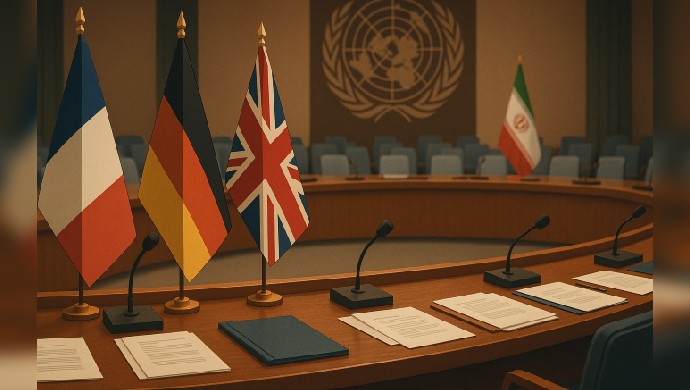

In a letter, the foreign ministers of France, Germany, and the United Kingdom have issued an ultimatum to the Iranian regime regarding its nuclear program: return to the diplomatic table by the end of August 2025 or face the full reimposition of United Nations sanctions. The joint letter, delivered to the UN Security Council on August 13, formally declared the E3’s readiness to trigger the “snapback” mechanism, a provision of the 2015 nuclear deal that would restore all international sanctions against Iran.
This declaration has cornered the crisis-ridden regime, trapping it in its ultimate dilemma: a choice between suicide or death. It can either capitulate and accept a humiliating diplomatic retreat—a move it equates with political suicide—or it can continue its defiant pursuit of a nuclear weapon, which will inevitably trigger the snapback mechanism and the fatal consequences of complete international isolation.
A two-faced response: public bravado vs. internal panic
The regime’s public response has been a predictable mix of hollow threats and bluster. On August 13, Manouchehr Mottaki, a member of the regime’s parliament, threatened that Tehran would withdraw from the Non-Proliferation Treaty (NPT), boasting that parliament’s “hand is on the trigger.” Foreign Minister Abbas Araghchi echoed this defiance, telling the Financial Times that the E3 had “no legal or moral grounds” for their actions and warning that snapback would be “the end of the road for them.”
But behind this facade of strength, the regime is fracturing. In a moment of sheer desperation on August 10, regime president Masoud Pezeshkian asked, “If we don’t negotiate, what should we do? They will come and strike again!” His terrified admission was met with a swift rebuke from Supreme Leader Ali Khamenei’s mouthpiece, the Keyhan newspaper, which attacked him the next day, declaring, “This viewpoint is surrender!” This public clash reveals a deep and widening schism at the very top of the theocracy.
Insiders admit the regime cannot withstand more pressure
The panic is no longer confined to private conversations. High-level figures are now publicly admitting the system’s fragility. On August 12, Mohsen Hashemi, the son of former president Rafsanjani, confessed, “Even the leadership didn’t think there would be a war,” and warned, “We need active diplomacy to prevent the snapback mechanism! If it is activated, it will have destructive effects for the system.”
This sense of dread is mirrored in the regime’s own state-run media. The Etemad newspaper wrote on August 9 that if snapback is triggered, “the pressure on the system will increase significantly,” adding the crucial admission that “the system’s resilience to sanctions decreases over time.”
Economic collapse and desperate spin
The mere threat of snapback is already ravaging Iran’s economy. A report on August 8 from Tabnak, a website affiliated with Mohsen Rezaei of the Expediency Council, noted that “the capital market… is going through turbulent days; stocks have crashed and an atmosphere of uncertainty prevails.” The economic reality has become so dire that even state media like Jahan-e Sanat openly concluded on August 12: “The snapback mechanism is near; we must enter the field of negotiation.”
Facing this unfolding catastrophe, the regime has resorted to pathetic attempts at spin. On August 12, the government’s spokesman, Fatemeh Mohajerani, tried to downplay the crisis by claiming, “The psychological burden of the snapback mechanism is greater than its economic one!”
This statement is a stunning, albeit unintentional, confession. The “psychological burden” is the existential terror gripping a decrepit ruling machine that has stalled at a dead end, perched over a dangerous precipice. And making it worse for the regime is the simmering rage of the Iranian people, which is intensifying everyday with protests across the country as the regime fails to address their most basic demands and continues to crack down on the most basic freedoms.