

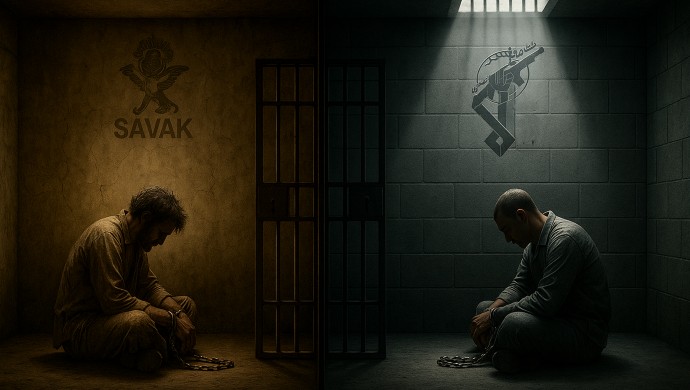

In a move that reeks of desperation and historical irony, the Iranian regime is doubling down on a lie as old as its predecessor’s tyranny: the complete denial of the existence of political prisoners. On Sunday, August 10, the judiciary chief, Gholam-Hossein Mohseni-Eje’i, brazenly declared, “We have absolutely no political prisoners… whatever there is, is security-related.” To make the farce even more absurd, an aide to regime president Masoud Pezeshkian, Elyas Hazrati, added that after asking journalists and intellectuals for names, they could only identify a total of five.
This claim comes amidst a fresh wave of savage repression. The regime recently executed political prisoners and PMOI members Behrouz Ehsani and Mehdi Hassani, and reports have emerged of the brutal beating and transfer of other political prisoners from Evin and Fashafuyeh to Ghezel Hesar prison, including five who are currently on death row. For the people of Iran, this sinister tactic of denying reality while inflicting it is all too familiar, a stark reminder of why their chants echo with, “Theocracy, Monarchy; One Hundred Years of Crime.”
A page torn directly from the shah’s SAVAK
The mullahs’ current script is a direct plagiarism of the deposed Shah’s. Forty-seven years before Eje’i’s statement, on September 17, 1978, the infamous chief of the Shah’s SAVAK secret police, Parviz Sabeti, wrote a letter to the falling dictator with an identical argument: “As you are aware, according to legal definitions, prisoners who act against national interests and the country’s security… are known as ‘anti-security prisoners,’ and applying the term ‘political prisoner’ to them is against the law.”
Just as Sabeti tried to sanitize the Shah’s dungeons, which were notorious for torturing dissidents like PMOI co-founder Ali Asghar Badizadegan with electric stoves and irons, the Shah himself told NBC News in May 1975 that such individuals “cannot be considered political prisoners, because they are all terrorists.” The language is the same. The lie is the same. The objective—to dehumanize dissent and legitimize state terror—is the same. This proves the core conviction of the Iranian people: the crown and the turban are merely different masks for the same face of oppression.
Growing international alarm
The carbon copy of the Shah’s tactic to change the name of political prisoners to security prisoners is a sign of extreme fear of revealing the real statistics, which, after executions and massacres, currently stands at more than 3,700 people. If the regime’s claims are true, it must immediately open its prisons to the UN Special Rapporteur, the International Committee of the Red Cross, and Amnesty International.
The international community is also taking note. A group of 13 Argentine parliamentarians, including the heads of the foreign affairs and human rights commissions, condemned the recent executions of PMOI members as a “crime against human dignity” and noted that 14 other political prisoners are awaiting execution for supporting the PMOI. Their alarm is echoed by 300 international jurists and experts who have warned that the regime is on the verge of repeating the 1988 massacre, in which over 30,000 political prisoners, mostly PMOI members, were executed on Khomeini’s fatwa.
The truth is that the regime’s denials are not convincing anyone. As one state-run media outlet admitted on August 13, “Denying the existence of political prisoners does not change the reality.”
This cynical repetition of history has laid bare the fundamental truth for Iranians. The choice is not between the past dictatorship and the current one. Both are illegitimate and have built their rule on the blood and suffering of the Iranian people. The only path forward, as chanted in the streets and championed by the organized Resistance, is the complete rejection of both: “No to the Shah, no to the Mullahs,” and yes to a free, democratic republic.