

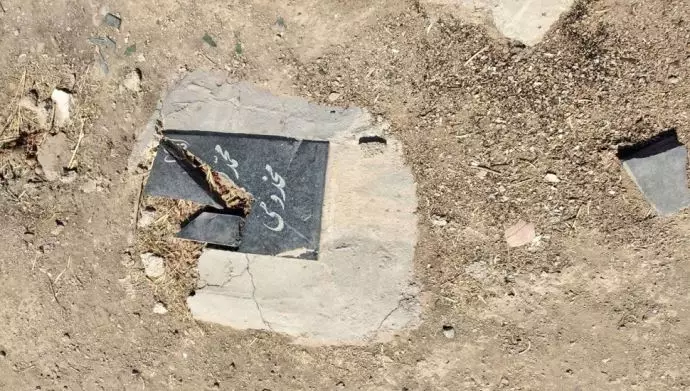

In a move that reeks of desperation, the Iranian regime has dispatched heavy machinery to Behesht-e Zahra, Tehran’s largest cemetery. But this is no urban development project. On the direct orders of Supreme Leader Ali Khamenei, bulldozers are working to completely level Section 41, the hallowed resting place of thousands of members of the People’s Mojahedin Organization of Iran (PMOI/MEK) who were systematically executed in the 1980s.
This is not an act of strength by a confident government. It is the frantic work of a criminal cabal terrified of its past, haunted by its victims, and desperate to bulldoze the evidence of its crimes against humanity before its inevitable day of reckoning arrives.
The crime in progress: Demolishing section 41
Since August 11, the regime has been engaged in a criminal operation to erase the physical evidence of its genocidal acts. Heavy machinery is systematically destroying and leveling the ground in Section 41, while agents from the notorious Ministry of Intelligence (MOIS) swarm the site, preventing anyone from approaching.
This demolition is the brutal culmination of a 40-year campaign of desecration. For decades, this section has been under the tight control of repressive forces, with agents repeatedly smashing or defacing the gravestones of the PMOI martyrs. Now, facing total collapse, the regime seeks to obliterate the site entirely, hoping to bury the truth under tons of rubble and earth.
https://twitter.com/jvmifoundation/status/1955174835564294232
Motive for destruction: Fear of international justice
The timing of this destruction is no coincidence. It is a direct and panicked response to mounting international legal pressure. In a landmark report in July 2024, Professor Javaid Rehman, then the UN Special Rapporteur on human rights in Iran, officially categorized the 1980s executions as constituting “crimes against humanity as well as genocide.”
Crucially, the report urged UN member states to use universal jurisdiction to investigate and prosecute the individuals responsible for these “atrocity crimes,” noting that many of those who ordered and carried out the massacres “have remained in government.” With the noose of international law tightening, the regime is desperately trying to destroy the crime scene. As the Iranian Resistance has stressed, destroying evidence of genocide is, under international law, a continuation of and participation in that very crime.
What is section 41?
Section 41 is a permanent scar on the conscience of the clerical regime. Known to Iranians by grim nicknames like “The Burned Section” and “Damned-land,” it is the final resting place for thousands of PMOI members and other political prisoners executed in the early years of the mullahs’ rule. Research indicates the section has a capacity of approximately 9,500 graves. Yet, about 4,000 names have been deliberately purged from the official cemetery database, a testament to the scale of the regime’s hidden massacres. The current destruction aims to erase the physical proof of these missing victims for good.
A four-decade war on memory
The regime’s current bulldozing operation is merely the final, desperate phase of a 45-year war against the memory of its victims. Detailed forensic research and satellite imagery analysis reveal a systematic campaign of erasure. Methods included smashing headstones with sledgehammers, pouring thick paint or tar over names, and completely removing the broken pieces from the site.
Between June 2005 and July 2007, the regime leveled an area of approximately 3,500 square meters—large enough for 1,700 to 1,800 graves—and converted it into a parking lot. Furthermore, the entire section is under intense surveillance by IRGC-affiliated units, with at least eight cameras positioned at its four corners and dozens more monitoring all surrounding access points. This paranoia demonstrates the regime’s profound fear of what this sacred ground represents.
A desperate regime digging its own grave
The mullahs believe that by destroying stone, they can destroy a legacy. They are profoundly mistaken. This act of desecration is a confession broadcast to the world. It reveals a regime so weak and brittle that it is terrified of the memory of its victims. It fears that these graves are not just markers of past crimes, but signposts to future justice.
The international community must not stand by while the evidence of a genocide is bulldozed into oblivion. The United Nations and all relevant human rights bodies must take immediate action to halt this destruction and support the Iranian people’s four-decade quest to hold the perpetrators of these atrocities accountable.