

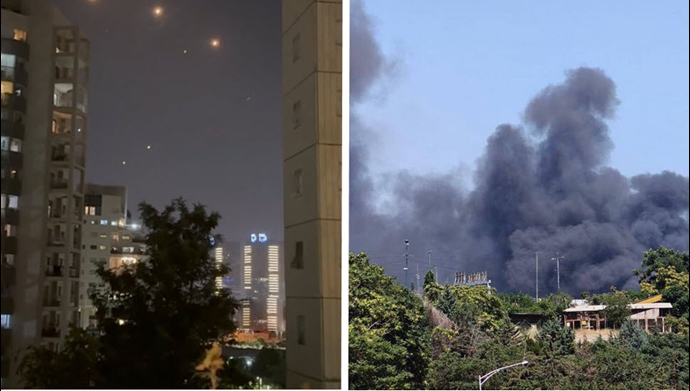

The sixth day of the conflict between Iran and Israel, unfolding on June 18, marked a significant escalation with direct military strikes deep inside both countries, a hardening of international positions, and severe disruptions for civilians in Iran.
As Israeli warplanes targeted strategic military and nuclear-related sites in Tehran and other cities, Iran’s regime retaliated with waves of missile attacks.
Concurrently, the United States signaled a potential shift in its stance, while the regime’s leaders issued defiant threats to both Israel and the U.S.
Israeli military operations against Iran
On Wednesday, the Israeli army announced it was actively conducting attacks on military targets within Tehran, according to Reuters. These operations were extensive and aimed at crippling the regime’s strategic capabilities, according to Israeli officials. Israel’s Defense Minister, Israel Katz, confirmed that the Israeli air force had successfully destroyed the headquarters of the regime’s Internal Security organization.
The attacks appeared to focus heavily on the regime’s nuclear and missile programs. According to Reuters, Israeli strikes dealt “serious blows” to Tehran’s nuclear program. One of three uranium enrichment plants was reportedly destroyed, another was damaged, and bomb-related nuclear technology also sustained damage, according to Reuters. The International Atomic Energy Agency (IAEA) separately reported information that two centrifuge production centers—the Karaj workshop and the Tehran research center—had been destroyed (Reuters). UN inspectors have been unable to access the sites to verify the extent of the damage since the attacks began (Reuters).
The IAEA has information that two centrifuge production facilities in Iran, the TESA Karaj workshop and the Tehran Research Center, were hit. Both sites were previously under IAEA monitoring and verification as part of the JCPOA.
— IAEA – International Atomic Energy Agency ⚛️ (@iaeaorg) June 18, 2025
Further reports indicated that the Khojeir missile development complex, located near the Parchin military site east of Tehran, was a primary target (Reuters). Israeli military statements also mentioned attacks on a centrifuge manufacturing center and several weapons production facilities (Reuters). The scope of the attacks extended beyond the capital, with Israeli aircraft targeting facilities in the cities of Tabriz and Shiraz (Al Arabiya). In a direct warning to civilians, the Israeli army issued a notice for the evacuation of Zone 18 in Tehran, an industrial area near Mehrabad Airport.
Iranian military operations against Israel
The Iranian regime responded with multiple missile attacks directed at Israel. In the hours after midnight on Tuesday, Tehran launched approximately 30 ballistic missiles in two separate waves (Times of Israel). The Islamic Revolutionary Guard Corps (IRGC) claimed its “Fattah” missiles successfully bypassed Israel’s air defense systems, giving it “complete dominance” over Israeli airspace.
The Times of Israel reported that most of the missiles were intercepted by Israeli air defense systems. The Israeli army confirmed it had also intercepted three drones that were launched from Iran (Reuters). According to Israeli emergency and rescue services, no immediate casualties or injuries were reported from the missile attacks (Euronews). One missile strike caused a fire that burned about 20 cars in a parking lot in central Tel Aviv (Israel Channel 12), and another missile fell in the “Hasharon” area in central Israel (Al Arabiya).
In a direct threat, Abdolrahim Mousavi, the Chief of Staff of the Iranian regime’s armed forces, warned residents of the “occupied territories,” specifically Tel Aviv and Haifa, to evacuate these areas to “preserve their lives.”
The situation and impact inside Iran
The escalating conflict has taken a heavy toll on the civilian population and daily life inside Iran. According to the Associated Press, the death toll since the beginning of Israeli attacks has reached 585, with more than 1,300 people injured. The regime’s Nour News website and Chand Sanieh Telegram channel described Tehran as a city under siege, with heavy explosions shaking eastern districts and large plumes of smoke visible over areas like Lavizan and Hakimieh.
The danger and disruption have led thousands of people to flee the capital, according to Reuters. Daily life has been paralyzed, with a significant reduction in activity in downtown Tehran and many shops, including those in the historic Grand Bazaar, remaining closed on Tuesday morning. The regime extended the mandate for government employees in Tehran to work remotely until June 22, according to Tasnim News Agency.
Fatemeh Mohajerani, the government spokesperson, stated that the country was experiencing a cyberattack on its infrastructure, which necessitated a reduction in internet speeds. Amid the turmoil, the regime’s police commander, Ahmadreza Radan, announced the arrest of an alleged Mossad spy and four “terrorists,” according to Tasnim News Agency.
International reactions and diplomatic posture
The escalating conflict prompted significant reactions from world powers, most notably the United States. President Donald Trump stated “it’s very late to be talking,” and warned, “nobody knows what I am going to do,” per Reuters. The White House, along with numerous U.S. officials, reiterated the long-standing U.S. position that the Iranian regime must never be allowed to acquire a nuclear weapon.
In a potentially major development, Washington Post reported on Tuesday that senior U.S. officials believed the U.S. position had changed and that Trump was considering joining the attack. In line with this tougher stance, the U.S. military has begun moving additional fighter jets, including F-16s, F-22s, and F-35s, to the Middle East (Reuters). The U.S. State Department also announced the closure of its embassy in Jerusalem from Wednesday, June 18, to Friday, June 20, due to the security situation.
In a statement, the Ministers of Foreign Affairs of France, Germany, and the United Kingdom, together with the High Representative of the European Union, expressed concern “with regards to the escalation of tensions in the Middle East, and expressed their view that all sides must show restraint, refrain from taking steps which lead to further escalation in the region, and return to diplomacy.” They reiterated their “longstanding concerns about Iran’s nuclear programme which largely exceeds any credible civilian purpose, and Iran’s ongoing non-compliance with its legally binding safeguards obligations.”
Meanwhile, Russia’s Deputy Foreign Minister Sergei Ryabkov said that Moscow was urging Washington to refrain from direct involvement in the conflict between Iran and Israel.
“This would be a step that would radically destabilise the entire situation,” Interfax cited Ryabkov as saying, and criticising such “speculative, conjectural options.”
Statements from Iranian regime officials
The regime’s leadership responded to the attacks with defiant and threatening rhetoric. The regime’s Supreme Leader, Ali Khamenei stated in a video message that the “Iranian nation is not one to surrender” and warned that any U.S. military entry would be met with “irreparable harm.” In tweets, he vowed to “deal severely with the Zionist terrorist entity” and declared, “We will not be lenient with the Zionists.”
The regime’s President, Masoud Pezeshkian called on the public to “stand with strength.” The regime’s ambassador to the UN labeled the targeting of Iran’s nuclear facilities a “war against humanity” and warned of a decisive response if the U.S. becomes directly involved in the attacks. Meanwhile, a former economy minister, Ehsan Khandouzi, proposed a de facto blockade, stating that for 100 days, no oil or LNG tanker should be allowed to pass through the Strait of Hormuz without Iran’s approval, framing it as a way to end the war.