

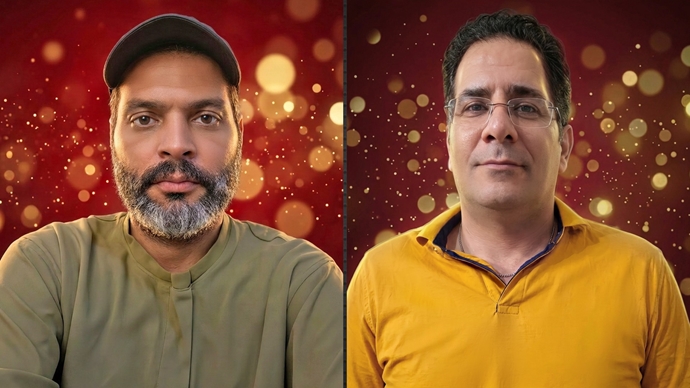

In the early hours of Monday, April 20, 2026, the Iranian regime carried out the brutal execution of two heroic members of the People’s Mojahedin Organization of Iran (PMOI/MEK). Hamed Validi, a 45-year-old civil engineer, and Mohammad (Nima) Massoum Shahi, a 38-year-old technical worker were hanged in a desperate crime by a decaying regime.
Facing an existential threat from an arisen population, the ruling clerics are utilizing the cover of external crises and recent conflicts to eliminate their most steadfast political opponents and extinguish domestic threats.
In the early hours of Monday, April 20, 2026, in a brutal crime, the Iranian regime’s executioners hanged two heroic members of the People’s Mojahedin Organization of Iran (PMOI/MEK), Hamed Validi and Nima Shahi.
Hamed and Nima had been sentenced to death in October… https://t.co/1D0DkIWwyJ pic.twitter.com/s7L7ET6cyg
— People's Mojahedin Organization of Iran (PMOI/MEK) (@Mojahedineng) April 20, 2026
Arrest, torture, and a flawed judicial farce
The state murder of these two political prisoners was the culmination of a deeply flawed judicial farce. Hamed and Mohammad were arrested in Tehran on May 13, 2025, alongside their relatives, and subsequently subjected to severe interrogation and physical torture.
The absurdity of the regime’s judicial process was laid bare on September 27, 2025, when the Chief Justice of Alborz province absurdly accused them of espionage connected to a 12-day war. This allegation contained a glaring chronological flaw: the two men had been arrested a full month before that war even began.
Nevertheless, after extensive torture, the Karaj Revolutionary Court sentenced them to death in October 2025 on fabricated charges that included “Moharebeh” (waging war against God), “cooperation with hostile groups and the Zionist regime,” and “assembly and collusion against national security.”
Hiding the truth of PMOI’s appeal
To justify these executions, state-run media outlets like Tasnim and Mizan have falsely labeled the two PMOI members as elements of a “spy network linked to Mossad.”
Regarding the reason for the execution of these two PMOI members Mizan, the news agency of the regime’s judiciary, wrote: “Hamed Validi and Mohammad Shahi, after constructing explosive projectiles and transferring them to launch sites, were arrested along with 10 ready-to-fire explosive projectiles; subsequently, ammunition, ready explosive projectiles, and mortar-making equipment were discovered at their residences in Karaj and Isfahan, as well as their safe house in Tehran.”
The regime deliberately paints political prisoners as foreign spies to conceal their true identity as PMOI members. The mullahs are deeply terrified of the growing gravitation of Iranian youth toward the PMOI and its nationwide network of Resistance Units.
Acknowledging that these brave fighters are native dissidents shatters the regime’s long-standing propaganda that the Iranian Resistance lacks domestic support. Furthermore, this “foreign spy” narrative is a worn-out, repetitive trick. The terminology used in the judiciary’s declarations and the specific details of the charges closely mirror the exact fabrications the regime has consistently used to justify the execution of other PMOI members.
Despite the regime’s efforts to conceal their identities and their affiliation with the MEK, the regime-affiliated English-language website WANA had already acknowledged this connection in a report published on September 27. In that report, WANA stated that Iran’s judiciary had announced the preliminary verdict in the case of a four-member “espionage network” allegedly linked to Israel’s Mossad and “the opposition group known as the Mujahedin-e Khalq (MEK).” This makes clear that, contrary to the official attempt to hide the political identity of the two prisoners, WANA had explicitly admitted their connection to the MEK in its own coverage.
Ignored warnings and the price of international silence
The executions occurred despite relentless efforts by the Iranian Resistance to save their lives. The PMOI had submitted the names and details of Hamed and Mohammad to the United Nations and human rights organizations in May 2025, shortly after their arrest. Their detention was also publicly announced on Simay-e Azadi (INTV) on September 7, 2025.
When their death sentences were announced in late 2025, the Secretariat of the National Council of Resistance of Iran (NCRI) explicitly warned the international community, calling for the case to be examined by an International Fact-Finding Mission.
#Urgent: Iranian political prisoners at risk of execution
Political prisoners Hamed Validi and Nima Shahi, affiliated with the PMOI/MEK, have been hastily transferred from Karaj Central Prison to an unknown location on the afternoon of Sunday, April 19, 2026, raising serious… pic.twitter.com/SQvyqCFJ6L
— People's Mojahedin Organization of Iran (PMOI/MEK) (@Mojahedineng) April 19, 2026
Most recently, on April 19, 2026—just hours before they were hanged—the NCRI issued a final, urgent warning to the UN High Commissioner for Human Rights after learning the men had been hastily transferred from Karaj Central Prison to an unknown location. The international community’s continued silence and lack of action in the face of these abuses embolden the regime to shed more blood.
A broader wave of executions
The murders of Hamed Validi and Nima Shahi do not happen in a vacuum. These brutal executions come directly on the heels of the recent executions of six other PMOI members: Mohammad Taghavi, Akbar Daneshvarkar, Babak Alipour, Pouya Ghobadi, Abolhassan Montazar, and Vahid Bani Amerian.
Furthermore, the regime recently executed seven young protesters who were arrested during the massive December-January nationwide uprisings: Saleh Mohammadi, Mehdi Ghassemi, Saeed Davoudi, Amirhossein Hatami, Mohammad Amin Biglari, Shahin Vahedparast, and Ali Fahim. The crumbling apparatus is systematically wiping out a generation of dissidents who speak to the regime only in the language of resistance and uprising.
History is repeating itself in Iran. In 1988, Ruhollah Khomeini carried out a genocide and massacre of imprisoned PMOI members and other dissidents, issuing a fatwa that they must be “quickly annihilated.” Today, paralyzed by the fear of another nationwide uprising similar to the one seen in December and January, and exploiting the fog of external wars, the moribund regime is preparing to carry out another massacre of political prisoners.
These rapid-fire executions are not a projection of state strength; they are a desperate smokescreen designed to hide the regime’s profound domestic weakness and decay. However, just as the 1988 massacre failed to destroy the PMOI, the blood of martyrs like Hamed Validi and Mohammad Massoum Shahi will only fuel the flames of future uprisings, strengthening the Resistance Units and the National Liberation Army, and paving the overthrow of a collapsing regime that is trying to keep its sinking ship afloat through sheer brutality.
At dawn this morning, Hamed Validi and Nima Masoom Shahi, were executed in Karaj Central Prison by the clerical regime ruling Iran. The two members of the People’s Mojahedin Organization of Iran (PMOI/MEK) join a growing number of heroic members executed this month under the rule… pic.twitter.com/xozMPptV5X
— Maryam Rajavi (@Maryam_Rajavi) April 20, 2026
“Just as the Shah could not save his rule through repression and bloodshed, the criminal mullahs cannot escape the rising anger of the people of Iran and the determination of the rebellious youth,”Mrs. Maryam Rajavi, the president-elect of the National Council of Resistance of Iran (NCRI), wrote. “We call on the United Nations, the European Union, their member states, and all human rights organizations to strongly condemn these executions and take urgent action to halt the wave of executions and secure the release of political prisoners.”