

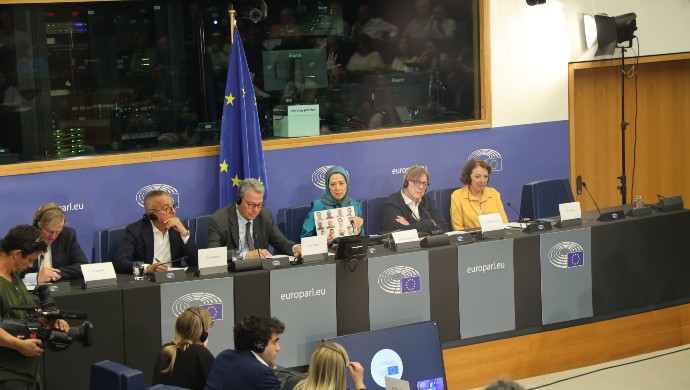

The war that erupted in the region on June 13, 2025, may have surprised onlookers, but it was a tragedy foretold. For over two decades, the President-elect of the National Council of Resistance of Iran (NCRI), Maryam Rajavi, has stood before world leaders and warned them of this exact outcome. Speaking once again at the European Parliament on June 18, her message was not one of shock, but of somber vindication. She reminded the elected representatives of Europe that their governments’ long-standing policy of appeasing the clerical regime would not lead to moderation or peace, but would inevitably “impose war upon Western nations.”
That prophecy has now been fulfilled. As Mrs. Rajavi stated, “Twenty-one years ago, I stood in this very parliament and declared that the solution for Iran lies neither in appeasement nor in war, but in a third option: regime change by the people of Iran and the organized resistance.”
Speech at the European Parliament- Strasbourg
Today, from the home of the peoples of Europe, a unified voice was heard in support of the people of Iran, the Iranian Resistance, and the network of Resistance Units in Iran. That voice declared that the only solution to this crisis… pic.twitter.com/CyF5WJtcnk— Maryam Rajavi (@Maryam_Rajavi) June 18, 2025
Today, with the region engulfed in flames born from the regime’s belligerence, she reiterated the grim result of ignoring that warning: “And today, we see that appeasement has indeed led to the imposition of war.” The only path to lasting peace, now as then, requires regime change brought about by the Iranian people and their organized Resistance.
The unchangeable nature of the theocracy
For decades, Western policymakers have operated under the delusion that the theocracy could be reformed or moderated. The NCRI has consistently maintained that this is a fatal miscalculation, reminding the world that “a viper never gives birth to a dove.”
In her speech, Mrs. Rajavi stressed that the regime is structurally dependent on exporting terrorism and pursuing nuclear weapons; these are not policies to be negotiated away, but pillars of its existence. History proves this. It was the Iranian Resistance that, in August 2002, exposed the regime’s secret nuclear program to an unsuspecting world, single-handedly preventing the mullahs from quietly obtaining a nuclear bomb. All subsequent negotiations have served only to buy the regime more time. The regime’s internal brutality also remains unchanged.
Despite the façade of a new administration under President Pezeshkian, the state’s killing machine has accelerated, with more than 1,350 prisoners executed since he took office in August 2024. This grim statistic proves the regime’s nature is fixed and violent.
Our people—fathers and mothers, sons and daughters, and the children of our homeland—as well as prisoners, the displaced, and the vulnerable—are enduring harsh and painful days. Yet, amid this crisis, the brave and defiant youth, alongside the people, are rising up to fulfill… pic.twitter.com/T6eNCqJ3B0
— Maryam Rajavi (@Maryam_Rajavi) June 18, 2025
The real conflict: the people vs. the mullahs
While the world is fixated on the regime’s nuclear ambitions and regional warmongering, it continues to miss the central conflict: the 44-year struggle between the Iranian people and the ruling religious fascism, which began on June 20, 1981, when the regime put a brutal end to all peaceful forms of political dissent and carried out mass execution of all political opponents.
Mrs. Rajavi highlighted the relentless domestic opposition, noting that over the past year alone, PMOI Resistance Units have carried out more than 3,000 operations against the regime’s machinery of repression. This is a legitimate, organized, and resilient national struggle for freedom. It is an authentic movement, unlike the foreign-imposed dictatorships of Iran’s past. The Iranian people have made their demand clear: “neither the Shah nor the mullahs.”
They will accept no form of dictatorship and demand a democratic republic. The NCRI, with its 44-year history, represents this democratic alternative, with a clear platform for a future Iran based on the separation of religion and state, gender equality, and the abolition of the death penalty.
A call to action—recognize the resistance
With the policy of appeasement having collapsed into open warfare, the path forward is clear. The international community, and particularly Europe, must fundamentally change its approach. The time for sacrificing human rights and demonizing the opposition in the futile hope of curbing the regime’s aggression is over.
In her address, Mrs. Rajavi issued a direct and powerful call to action: “The time has come for the European Parliament to call on the European Union and its member states to recognize the Iranian people’s struggle to overthrow the regime.”
This is not a request for intervention, but for solidarity and political recognition. As she plainly stated: “We do not seek money, nor do we ask for weapons… We only ask that this Resistance be recognized. Nothing more.”
This recognition must be coupled with concrete action, beginning with the long-overdue terrorist designation of the Islamic Revolutionary Guard Corps (IRGC). By standing with the Iranian people and their organized Resistance, the world can help secure not only a free Iran but also lasting peace and security for the entire region.