

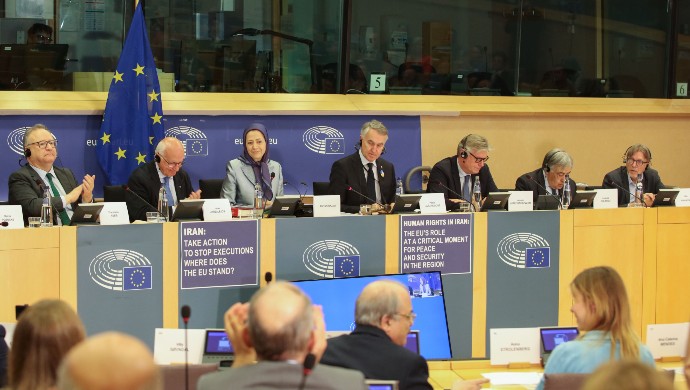

On April 22, 2026, the European Parliament hosted a pivotal conference titled “Iran: Take Action to Stop Executions, Where Does the EU Stand?” The event took place against the backdrop of an extraordinarily volatile period in Iranian history. Following the massive nationwide uprisings of December 2025 and January 2026—which originated in the Tehran bazaar and rapidly evolved into a fierce, nationwide demand for regime change—the clerical regime responded with unprecedented brutality toward dissidents.
The European Parliament conference aimed to refocus the world’s attention on a domestic crisis that international conflicts threatened to overshadow: the Iranian regime’s relentless and escalating war against its own people. Over the past month, the regime has exploited the geopolitical chaos to carry out a horrific execution spree, executing political prisoners and detained protesters at an alarming rate.
Conference:
Iran: Take Action to Stop Executions
Where Does the EU Stand?#StopExecutionsInIranhttps://t.co/iUTtBcOQeS— People's Mojahedin Organization of Iran (PMOI/MEK) (@Mojahedineng) April 22, 2026
Lawmakers from across the political spectrum gathered to demand a decisive shift in European policy. The consensus among the Members of the European Parliament (MEPs) and prominent European leaders in attendance was clear: appeasement has failed, external military action alone cannot bring democracy, and the only viable path to a free Iran lies in the hands of the Iranian people and their organized Resistance.
The Path to a Democratic Republic: Maryam Rajavi’s Vision
At the center of the conference was the keynote address by Mrs. Maryam Rajavi, the President-elect of the National Council of Resistance of Iran (NCRI). Her speech underscored that despite the death of Ali Khamenei and the changing geopolitical landscape, the core nature of the religious dictatorship remains fundamentally unchanged.
“The system of Velayat-e Faqih, even under Khamenei’s son, remains the same regime, with the same identity and nature, and it possesses no capacity for reform or change,” Mrs. Rajavi stated. “Despite any maneuvering, it will not abandon its nuclear weapons program or its network of proxy forces, and its survival depends on the brutal repression of the people.”
Mrs. Rajavi painted a picture of a regime pushed to the brink not by foreign adversaries, but by its own citizens. Referencing the massive December-January protests, she noted, “The regime does not view external war as the primary threat to its existence, but rather deep-seated popular outrage and organized resistance. Its leaders fear the consequences of peace and the eruption of another uprising.”
Flanked by members of the European Parliament for the Conference on Human Rights in Iran
Role of the European Union in a Crucial Juncture for Peace and Security in the Middle East#FreeIran10PointPlan pic.twitter.com/SddFFhIBFT— Maryam Rajavi (@Maryam_Rajavi) April 22, 2026
She highlighted the heavy toll and profound courage of the Resistance Units. During the January uprisings alone, these units carried out 630 operations against centers of the Revolutionary Guard (IRGC) and the Basij to defend unarmed demonstrators. Furthermore, she noted that on February 23, days before the recent external military strikes, 250 fighters of the People’s Mojahedin Organization of Iran (PMOI/MEK) launched a daring attack on Khamenei’s heavily guarded headquarters in Tehran, resulting in approximately 100 fighters killed or arrested.
Mrs. Rajavi officially reiterated the NCRI’s February 28 announcement regarding the establishment of a provisional government aimed at transferring sovereignty to the Iranian people. “This provisional government is tasked with organizing, within a maximum of six months after the overthrow of the regime, free elections for a Constituent Assembly,” she declared, directly challenging Mojtaba Khamenei to allow free elections under UN supervision if he truly believes he has popular support.
An Escalating Spree of Executions and Human Rights Abuses
A primary catalyst for the conference was the horrific wave of executions systematically carried out by the regime under the shadow of recent external conflicts. The speakers presented a stark picture of a state apparatus utilizing the cover of war to eliminate its most determined domestic opponents.
Over the last month alone, the regime has executed eight PMOI members: Hamed Validi, Mohammad (Nima) Massoum-Shahi, Vahid Bani Amerian, Abolhassan Montazer, Mohammad Taghavi, Ali Akbar Daneshvarkar, Pouya Ghobadi, and Babak Alipour. Furthermore, the regime exacted lethal revenge on those who took to the streets during the recent winter uprisings, executing eight youth who had taken part in the anti-regime rallies.
Mrs. Rajavi specifically named Commander Hamed Validi and Mohammad Massoum Shahi, noting they were hanged at dawn just days prior to the conference. She warned that “11 political prisoners accused of membership in the Mojahedin are under sentence of death, and urgent action must be taken to save their lives.”
European lawmakers expressed profound outrage at both the regime’s barbarity and the international community’s muted response. Lithuanian MEP Petras Auštrevičius framed the crisis in stark numbers, noting that “In the space of one month, it executed… 15 political prisoners. Eight were members of the People’s Mojahedin Organization of Iran, and seven were young protesters who played a significant role in last January’s uprising.” He warned that the regime “kills its own people every day and does not hesitate to carry out terrorist attacks against us.”
.@petras_petras: To recognize and stand with the Iranian people, we must act differently. Inviting backers of the former Shah effectively turns our backs on the people of Iran and their desire for #freedom. We must not waste time with sessions against the interests of the Iranian…
— NCRI-FAC (@iran_policy) April 22, 2026
Spanish MEP Antonio López-Istúriz White highlighted the regime’s tactical use of the broader Middle Eastern conflict. “Now more than ever, the regime is profiting from an external war to take action against democrats, against people who are fighting for the same things that we have,” he explained.
Portuguese MEP Francisco Assis expressed severe disappointment in the failure of European leaders to speak out. “I would first like to deeply deplore the deaths of tens of thousands of Iranian men and women massacred by a regime that had declared war on its own people,” Assis stated. He further challenged his own political sphere: “As a man of the left, of the center-left, I regret the great silence of the European left in the face of this true human tragedy.”
The scale of the regime’s recent domestic massacres was brought into terrifying focus by Italian MEP Carlo Ciccioli. He referenced the brutal crackdown during the December 2025 and January 2026 uprisings, providing devastating estimates of the death toll. “Probably the victims of the repression of peaceful popular demonstrations… were about 42,000. Some agencies say 30,000; some independent observers even speak of 75,000 people killed,” Ciccioli reported. “There is no regime on the entire planet that has killed such a large number—tens of thousands—of protesters. It is not a matter of guerrilla warfare or an internal war, but of defenseless protesters killed.”
.@CICCIOLICARLO: I recognize the crucial role of the NCRI and @Maryam_Rajavi’s program: separation of religion and state, abolition of the death penalty, and gender equality. Now is the time for maximum unity of the Iranian people to achieve democratic change. #NCRIAlternative…
— NCRI-FAC (@iran_policy) April 22, 2026
Former Belgian Prime Minister and MEP Guy Verhofstadt condemned the diplomatic quietness in Brussels as unacceptable. “I find it nearly criminal that we say nothing about the executions. Nothing about the executions,” Verhofstadt stated emphatically, demanding that the European Council make an immediate halt to executions an absolute precondition for any future diplomatic engagement with Tehran.
The Solution: The People and Their Organized Resistance
As the conference analyzed the recent April 7 ceasefire and the broader geopolitical situation, a recurring theme emerged: external military conflicts and airstrikes will not solve the Iranian crisis. The consensus among the European representatives was that true democratic change can only originate from within Iran, driven by its people and their organized Resistance.
“Airstrikes cannot overthrow the regime, but an Iranian Resistance can,” asserted MEP Francisco Assis. “No level of bombardment can substitute for this force on the ground, the force of the Iranian people.” Assis warned that the regime uses the cover of war to present itself as a victim internationally while continuing to wage war on its citizens.
.@guyverhofstadt: We must officially recognize the organized resistance and the Iranian people as their own true representatives. Furthermore, every member of the #IRGCTerrorists must fall under the sanctions regime. Designating the IRGC as a terrorist organization must have real…
— NCRI-FAC (@iran_policy) April 22, 2026
MEP Petras Auštrevičius echoed this sentiment, stating firmly, “The Iranian question will not be solved by foreign war or appeasement. I have been convinced for a long time that real change can come only through the Iranian people, their action, their Iranian Resistance, and from the organized Iranian Resistance.”
Guy Verhofstadt provided a scathing critique of the decades-long Western policy toward Iran. “The appeasement policy has led to nothing at all. It has led to enormous proxy wars, to a further nuclearization of the mullahs’ regime, and especially to further oppression,” he stated. Conversely, he observed that the alternative approach of external bombardment has also fallen short of resolving the crisis at its root. Verhofstadt introduced the concept of “active engagement” as a necessary new European strategy. This approach would entail Europe formally recognizing the Iranian opposition and the Resistance as the legitimate representatives of the Iranian people.
Furthermore, several MEPs pointed out the inherent absurdity and hypocrisy of the international system’s current engagement with the regime. Belgian MEP Kris Van Dijck expressed disbelief at the United Nations’ recent actions, noting, “A few weeks ago, the Economic and Social Council nominated the Islamic Republic of Iran to the UN’s Committee for Programme and Coordination to shape policy on women’s rights, on human rights, on disarmament, and terrorism prevention. How is that possible?”
The future of Iran belongs to the iranian people, and only they must decide their destiny.
We continue to stand for a democratic and peaceful Iran.
A pleasure to welcome @Maryam_Rajavi today at the European Parliament. pic.twitter.com/my5MiSOmpm
— Javier Zarzalejos (@zarzalejosj) April 22, 2026
Lawmakers heavily underscored the threat the regime poses beyond its borders. Spanish MEP Nicolás Pascual de la Parte labeled the Iranian government “the most criminal and bloody regime on earth,” insisting that “Iran can never have the nuclear weapon. As simple as that.” Carlo Ciccioli pointed out that the Revolutionary Guards (IRGC) function as a “state within a state” and act as a global menace by establishing and funding proxy militias like Hezbollah, Hamas, and the Houthis.
The recognition of the IRGC as a terrorist entity by the European Parliament in a February resolution (passed with 562 votes) was celebrated as a milestone, but speakers demanded further action. Verhofstadt argued that the terrorist designation must be accompanied by massive, sweeping sanctions against all IRGC members, not merely those involved in foreign wars, but strictly punishing those executing the regime’s domestic repression.
Rejection of Dictatorships: Neither the Mullahs Nor the Shah
An essential component of the discussions in the European Parliament was the nature of the alternative to the current regime. European lawmakers systematically rejected any return to the monarchical dictatorship of the Shah, aligning with the Iranian people’s demands for a forward-looking, democratic republic.
Mrs. Rajavi dedicated a portion of her speech to dismantling the “fabricated alternative centered on the remnants of the former monarchical dictatorship.” She noted that the mullahs do not view the Shah’s remnants as a genuine threat; rather, “its theorists argue that these remnants actually help sustain the regime.” Rajavi pointed out that the actions of the monarchists during the 2022 and 2026 uprisings actively caused division among the people, directly paving the way for the regime’s brutal crackdowns. She reminded the audience of the dark history of the Shah’s era, marking the anniversary of the April 19, 1972 execution of PMOI Central Committee members by the Shah’s regime.
European leaders expressed deep frustration with elements in the West that entertain the notion of a return to the monarchy. Petras Auštrevičius heavily criticized his own colleagues in the EP Foreign Affairs Committee for recently hosting the Shah’s son. “When we hold hearings in the Foreign Affairs Committee and invite the backers of the former Shah and his son, we are effectively turning our backs to the people of Iran,” Auštrevičius declared. “That recent session was far from the interest of the people of Iran and against their desire for freedom.”
Herta Däubler-Gmelin: It is concerning to see political powers attempting to reinstitute the former Shah’s son, especially given his recent press statements praising his father's rule. As someone who remembers the Shah’s era well, I recall the brutal reality of the SAVAK security…
— NCRI-FAC (@iran_policy) April 22, 2026
MEP Francisco Assis was equally unequivocal. “It belongs even less to the Union to yield to pressures aimed at promoting the heirs of the pre-1978 monarchy, which was marked by persecution led by the sinister secret police SAVAK, by executions, torture, and the dissolution of political parties,” he stated. Assis pointed out that the regime’s decades-long, obsessive mobilization against the PMOI proves that the PMOI is “the most plausible alternative and the organization with the best chance of overthrowing the mullahs.”
Herta Däubler-Gmelin, the former German Federal Minister of Justice, provided a personal historical perspective. “As a student in Berlin, during the Shah’s time, I remember quite well the SAVAK security police and their oppressive tools, not only in Iran, but towards young people who were demonstrating in Berlin against the Shah,” she recounted. Däubler-Gmelin condemned recent press statements by the Shah’s son, calling his defense of his father’s legacy and discriminatory remarks against minorities “not only a disaster, it’s a crime.”
Rallying Behind the Ten-Point Plan and the Resistance Units
With the rejection of both religious and monarchical dictatorships, the conference participants threw their full political weight behind the democratic platform offered by the NCRI: Maryam Rajavi’s Ten-Point Plan. The plan, which calls for free elections, gender equality, the separation of religion and state, the abolition of the death penalty, and a non-nuclear Iran, was lauded as the definitive roadmap for Iran’s future.
“We have always defended a simple but fundamental idea: the future of Iran belongs to the Iranian people,” stated Spanish MEP Javier Zarzalejos. “We stand for an Iran that is open to the world and built on a fair political system grounded in respect for fundamental freedoms.” He formally thanked Mrs. Rajavi for basing her commitment on the Ten-Point Plan, describing it as the foundation for a democratic republic.
MEP Nicolás Pascual de la Parte agreed wholeheartedly. “I think that the Ten-Point Plan of the National Council of Resistance of Iran is the best possible program that we have,” he said. “Here you defend all the clear ideas and the values we share in Europe. I think that here we can identify ourselves with this program, and we have to do our best in order to bring it forward.”
Italian MEP Leoluca Orlando framed the Resistance’s struggle through the lens of fundamental human rights, specifically the “freedom from fear.” He praised Mrs. Rajavi as an embodiment of this freedom, noting that the Ten-Point Plan’s call for the separation of religion and state is vital because “this confusion between religion and state is an attack, is an injury against the state and against religion.” Orlando warned that the current ceasefire must not become an excuse for Western complicity with the mullahs, but rather “a prelude to an Iranian path for democracy.”
The vital role of Iranian women in the struggle for regime change was highlighted by Dutch MEP Anna Strolenberg. Having spoken with numerous Iranian women over recent months, she paid tribute to their fighting spirit. “You are brave,” Strolenberg said, addressing the women of Iran directly. “You can make change to create freedom, to create a democratic Iran free of executions, where you can have the freedom to express your opinions… know that we as Europeans stand beside you.”
The conference concluded with a unified call for immediate, tangible policy shifts in Brussels. Lawmakers demanded that the European Union officially recognize the provisional government announced by the NCRI, close the Iranian regime’s embassies across Europe, expel its agents, and condition any future relations strictly on an end to executions.
As the clerical regime desperately tries to execute its way out of an inevitable downfall, and as the Middle East grapples with the fallout of the June 2025 and February 2026 military strikes, the European Parliament delivered a resounding message. The future of Iran will not be dictated by bombs from above, nor by appeasement from abroad, but by the relentless, organized resistance of the Iranian people on the ground.