

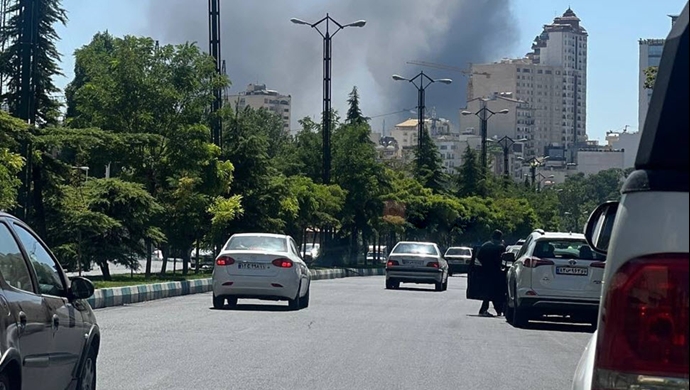

On the fifth day of the escalating conflict, the Iranian regime faced a deepening crisis on multiple fronts. Reports from Tuesday, June 16, detail a series of Israeli military strikes hitting targets deep within Iran, including near the capital and sensitive nuclear facilities. The attacks have fueled widespread public panic and a harsh internal crackdown by security forces.
Military strikes penetrate deep into Iran, targeting sensitive sites
Throughout Tuesday, reports confirmed that Israeli military operations had struck numerous locations across Iran, demonstrating a significant reach into the country’s territory. At approximately 3:04 PM, state-affiliated media reported explosions in central Tehran, with Al-Mayadeen’s correspondent claiming Israeli aircraft had attacked the Andarzgoo area in the city’s north. The Israeli military later confirmed it had completed a wave of attacks in west Tehran.
The strikes were not limited to the capital. Heavy explosions were reported at 3:30 PM in the Alavijeh industrial town in Isfahan province. Other reports indicated that Israel had targeted the fighter airbase in Isfahan. In Tabriz, the IRGC Telegram channel confirmed that two personnel from the Second Fighter Air Base were killed in an attack.
Crucially, the conflict has directly impacted Iran’s nuclear program. On Tuesday, the International Atomic Energy Agency (IAEA) stated it had “identified additional elements that indicate direct impacts on the underground enrichment halls at Natanz.”
Iran: Based on continued analysis of high resolution satellite imagery collected after Friday’s attacks, the IAEA has identified additional elements that indicate direct impacts on the underground enrichment halls at Natanz.
No change to report at Esfahan and Fordow.— IAEA – International Atomic Energy Agency ⚛️ (@iaeaorg) June 17, 2025
Regime launches missile barrages against Israel
While facing attacks on its own soil, the Iranian regime launched multiple waves of missiles toward Israel. On Tuesday morning, air raid sirens sounded across Israel as the attacks unfolded, according to Washington Post. The state-run IRNA news agency reported that a new wave of 20 to 30 missiles had been fired, and the Islamic Revolutionary Guard Corps (IRGC) announced that its “ninth wave of attacks” had begun on Monday night and would continue until dawn. The IRGC also claimed it had struck an Israeli military intelligence directorate and a Mossad operations center early Tuesday.
An IRGC spokesman described the offensive as a joint operation that would use “all capacities” to ensure the “enemy will not have a moment of peace.” The attacks caused damage in Israel, with the municipality of Bat Yam, south of Tel Aviv, reporting that 80 buildings were damaged as a result of Iranian bombing, 22 of which were at risk of collapse.
The Israeli military confirmed it had identified the incoming missiles and, after the immediate threat passed, announced that it was safe for citizens to leave protected shelters.
Domestic situation worsens with public panic and internal repression
The military strikes have triggered significant panic among the civilian population. News outlets reported heavy traffic on routes leading out of Tehran and on the Karaj-Chalus road, with images showing people packing their belongings into vehicles to flee the capital. This exodus contributed to long queues at gas stations, prompting the National Oil Products Distribution Company to deploy 17 mobile fuel tankers in Tehran.
In response to the growing unrest, the regime has intensified its internal security measures. Fatemeh Mohajerani, the government spokesman, urged the public to cooperate with the heavy presence of security forces and to ignore independent media. She stated, “We have witnessed a stronger presence of security forces… People should cooperate with them more. Take the national media seriously and do not listen to non-national media.”
This was accompanied by direct threats from officials. The head of the parliament’s security commission declared that sending photos or videos to “hostile networks” that “weaken public morale or create division” is a threat to national security and “will be met with severe judicial action.” The judiciary’s spokesman, Asghar Jahangir, reinforced this, warning, “all elements that disturb the security and peace of the people will be quickly identified and will receive the necessary punishment.” These statements coincided with reports of arrests by the IRGC-run Fars News Agency, including 18 people in Lorestan for creating “psychological insecurity” and an individual in Ilam accused of ties to Israel.
International community isolates Tehran, demands nuclear reversal
The crisis has drawn a sharp and unified response from world leaders, further isolating the Iranian regime. In a formal statement, the leaders of the Group of Seven (G7) nations labeled the regime the “the principal source of regional instability and terror.”
“We have been consistently clear that Iran can never have a nuclear weapon,” the statement adds.
The European Union echoed these concerns at the UN Human Rights Council, condemning systemic rights violations and noting a significant increase in executions in Iran.
U.S. President Donald Trump issued a series of stark warnings on Tuesday, demanding the “unconditional surrender” and cautioning, “Our patience is running out.”
— Donald J. Trump (@realDonaldTrump) June 17, 2025
He also posted a message on Truth Social urging residents to evacuate Tehran immediately. “We’re looking at better than a ceasefire,” Trump said after leaving early the G7 summit in Canada. “A real end. Not a ceasefire. An end.”
EU Foreign Policy Chief Kaja Kallas said “A diplomatic solution is the best way to address Iran’s programme in the long run, and Europe stands ready to play its part” but added that “We cannot be lenient when Iran accelerates its nuclear programme.”
A report by Axios suggested the U.S. was exploring a potential meeting with Iranian officials.
Meanwhile, a report by Reuters on Monday indicated that Tehran has asked Qatar, Saudi Arabia and Oman to press Trump to use his influence on Israel to agree to an immediate ceasefire with Iran in return for Iranian flexibility in nuclear negotiations.