

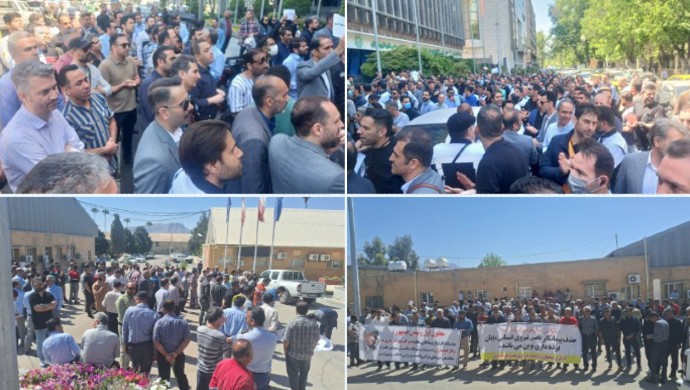

On April 20, various cities across Iran have witnessed a noticeable surge in public protests. These demonstrations, involving retirees, workers, and traders, reflect widespread discontent caused by worsening economic conditions, systematic repression, and the plundering of national wealth by institutions tied to the Supreme Leader. The protests—taking place in Ahvaz, Tehran, Shush, Isfahan, Kerman, Varzaneh, and Tehran’s Grand Bazaar—show an expanding social rage, with slogans increasingly targeting the regime’s top leadership and policies.
April 20—Ahvaz, southwest Iran
Retirees of the Social Security Organization protest low pensions and other problems with their livelihoods. Protesters chant slogans against government officials who only give promises and don't uphold them.#IranProtestspic.twitter.com/a01HEsRt4s— People's Mojahedin Organization of Iran (PMOI/MEK) (@Mojahedineng) April 20, 2025
In Ahvaz, retirees from the Social Security Organization held a protest in front of the provincial government building, denouncing the administration of the Supreme Leader-appointed president, Bezhskian. With chants like “This much injustice has never been seen by any nation!” and “Shame on those who claim justice!”, demonstrators expressed their fury over broken promises and the systemic erosion of their rights.
April 20—Shush, southwest Iran
Retirees of the Social Security Organization hold protest rally, reiterating their demands for higher pensions and basic services.#IranProtestspic.twitter.com/s6M4QTjwwy— People's Mojahedin Organization of Iran (PMOI/MEK) (@Mojahedineng) April 20, 2025
In Shush, retirees gathered again, declaring in unison: “We are retirees… hungry and exhausted!” They rallied in front of government offices to protest against worsening living conditions and humiliating poverty. Many stated that their pensions fall far below the poverty line and that minor salary adjustments do nothing to address soaring inflation and prices.
In Kerman, retired steelworkers organized a protest decrying the government’s repeated broken promises. The slogan “Lying government, where are your promises?” captured the frustration of a segment of society that no longer trusts official narratives.
April 20—Isfahan, central Iran
Retirees of the steel and mining industry resume rallies to protest low pensions and lack of access to basic services for decent living conditions.#IranProtestspic.twitter.com/akOwy5qZeT— People's Mojahedin Organization of Iran (PMOI/MEK) (@Mojahedineng) April 20, 2025
In Isfahan, two separate protests were held. One involved retired steel and mining workers; the other erupted in the town of Varzaneh, where citizens protested the arrest of farmers demanding water rights. These demonstrations highlighted the disastrous impact of water transfer projects and mismanagement that threaten entire communities. Protesters chanted against the authorities’ continued repression and environmental destruction.
April 20—Tehran, Iran
Retirees of the Social Security Organization hold protest rally, reiterating their demands for higher pensions and basic services that the government is denying them.#IranProtestspic.twitter.com/4lMGFG2yuQ— People's Mojahedin Organization of Iran (PMOI/MEK) (@Mojahedineng) April 20, 2025
In Tehran, retirees gathered once more in front of the Social Security Organization building, demanding the release of imprisoned workers. The main slogan, “Imprisoned workers must be freed,” reflected a shared demand for justice and freedom of expression. Another protest, held by metro operation staff, included the powerful chant: “Enough with the promises—our tables are empty!” in response to delayed wages and deteriorating working conditions.
April 20—Tehran, Iran
Tehran market traders striking and protesting the Endowment Organization's interference in their business and the appointment of a new overseer.#IranProtestspic.twitter.com/VeUzSNDX17— People's Mojahedin Organization of Iran (PMOI/MEK) (@Mojahedineng) April 20, 2025
A significant protest also erupted in Tehran’s Grand Bazaar, where traders went on strike in response to the appointment of a new administrator by the Endowments Organization without consultation. Demonstrators closed their shops and chanted: “Grabbing the market means playing with people’s livelihood—enough!” accusing the regime of attempting to seize control of commercial assets after having already plundered the country’s major resources.
A common thread among all these protests is the deepening poverty that cuts across social classes. From retirees to workers and small business owners, Iranians are struggling to meet even the most basic needs. The regime’s economic policies, rooted in the systematic looting of the country’s oil, mining, and agricultural wealth, have plunged millions into destitution. Institutions directly under the Supreme Leader’s office—such as the Execution of Khomeini’s Order (EIKO), the Mostazafan Foundation, and the IRGC’s financial empires—are at the heart of this economic exploitation.
While the Iranian people suffer under skyrocketing inflation, power outages, and water shortages, the regime continues to channel national resources into foreign wars, ballistic missile programs, and internal repression.
Amid this dire backdrop, a new wave of uprising appears to be taking shape. These protests are no longer limited to sectoral demands; they are transforming into a broad-based social movement holding the regime accountable for systemic failure and calling for radical change. Each chant in a marketplace, each demonstration in the streets, brings the country one step closer to a national uprising the regime can no longer contain.