

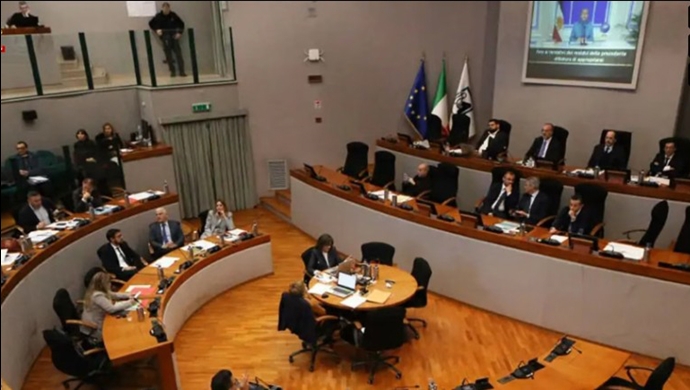

A recent official conference at the Marche Regional Council in Italy showcased strong international solidarity with the Iranian people and their organized resistance movement. The assembly, which took place amid a decisive and unprecedented moment for Iran and the Middle East, condemned the regime’s violent suppression and surging executions. Participants urged the international community to formally recognize the National Council of Resistance of Iran (NCRI) and its provisional government to support the Iranian people’s transition to democracy.
Iran stands at a critical juncture following a massive wave of nationwide uprisings in January 2026 across all 31 provinces, which brought the regime to its knees. The ruling mullahs responded to the January uprisings with a brutal crackdown, killing thousands of youths and teenagers. Instead of silencing the public, this violence has only strengthened the Iranian people’s determination to bring an end to the religious dictatorship.
Maryam Rajavi’s address: A roadmap for peace, freedom, and a democratic republic
Mrs. Maryam Rajavi delivered a compelling message to the council, drawing a profound parallel between the Iranian people’s current struggle and the region of Marche’s historic resistance against fascism and Nazi occupation during the Second World War. Highlighting that “Marche and Ancona have demonstrated that no system built on fear can endure,” she noted that the Iranian Resistance Units have similarly expanded into organized elements of a liberation army inside Iran. This operational power was proven on February 23, 2026, when they successfully carried out a major operation targeting Ali Khamenei’s heavily protected headquarters.
Noting that the clerical regime is on the brink of collapse, Mrs. Rajavi pointed to a new wave of executions as a clear sign of its desperation. Between March 19 and April 6, 2026, 13 political prisoners were executed, including seven youths involved in the January uprisings and six PMOI members who are regarded as heroes in the struggle. Because the regime cannot be reformed from within, she emphasized that “the solution lies in regime change carried out by the people, through resistance and organized uprising.”
Message to the meeting of the region of Marche, Italy:
Your long experience has shown that the standing of Marche and Ancona is not only due to their history. It also comes from their resistance to dictatorship and their struggle for freedom. Marche and Ancona have demonstrated… pic.twitter.com/f1Zw1PgkxJ— Maryam Rajavi (@Maryam_Rajavi) April 14, 2026
Mrs. Rajavi also responded to claims by Khamenei’s son that the regime commands 17 million devoted supporters, challenging him to allow free elections for a constituent assembly or presidency under United Nations supervision. Furthermore, she reiterated the Resistance’s support for the temporary ceasefire to the war that erupted on February 28, stressing that the abolition of executions must be included in any international agreements. Rejecting foreign military intervention and the failed policies of Western appeasement, she assured the international community that “in the face of this regime, the National Council of Resistance of Iran (NCRI) offers a credible alternative that enjoys sufficient social support” to establish a secular, non-nuclear, and democratic republic.
Italian officials pledge support for the NCRI and the Iranian people
Members of the Marche Regional Council warmly received Mrs. Rajavi’s Ten-Point Plan and emphasized the global community’s responsibility to back the Iranian people’s quest for a democratic republic.
Micaela Vitri, a member of the Marche Regional Council, stressed that the situation in Iran is unacceptable and urged immediate political action from Italy. “We cannot remain indifferent and must ask the national government to stand alongside the Iranian resistance,” she stated, adding that “no one should remain silent and pass by indifferently.”
Council member Valeria Mancinelli highlighted the critical importance of having a structured, capable alternative to the current theocracy. She noted: “There is a political-institutional movement, namely the National Council of Resistance of Iran, which is capable of representing the Iranian people not only in the struggle against the mullahs’ regime but also in the transition toward a democratic government and free elections.”
Massimo Seri framed the support for the Iranian people as a moral obligation to uphold fundamental rights like freedom, dignity, and justice. Condemning the regime’s human rights abuses, he declared, “Silence means complicity. Therefore, we must give a voice to this Council, to this government in exile, and to those people who fight but whose voices go unheard.”
Furthermore, Maurizio Mangialardi reaffirmed the full solidarity of the legislative assembly, promising actionable steps at a national level. “Recognizing the provisional government is the first step,” Mangialardi emphasized. “Through our assembly, we will strive to ensure that our national government can support this legitimate demand; to give hope for a democratic future to a nation that deserves it.”
A unified call to action
The firm stance taken by the Marche Regional Council is a powerful testament to the growing international momentum behind the Iranian Resistance. As the Iranian regime resorts to rampant executions to maintain its fragile grip on power, Western governments must abandon the failed policy of appeasement, close the regime’s diplomatic missions, and recognize the Iranian people’s right to fight for freedom against the tyranny of the mullahs.