

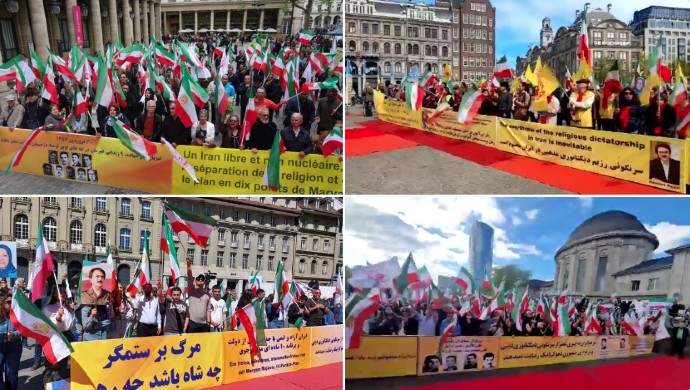

In a powerful display of unity and historical remembrance, supporters of the Iranian Resistance held coordinated rallies over the weekend in more than a dozen cities across four continents to mark the anniversary of political executions carried out by the Shah’s regime in April 1972 and 1975. From Washington, D.C. to Amsterdam, Paris, Sydney, Vancouver, and beyond, demonstrators called for justice for Iran’s fallen dissidents while delivering a clear political message for the present: “No to Shah, No to Mullahs.”
The commemorations centered around April 19, a date seared into the nation’s collective memory. On April 19, 1972, four prominent members of the People’s Mojahedin Organization of Iran (PMOI/MEK) — Ali Bakeri, Nasser Sadegh, Mohammad Bazargani, and Ali Mihan-Doust — were executed by firing squad after enduring months of torture. Three years later, on April 19, 1975, nine more political prisoners, including PMOI and Fedayeen members, were taken from prison and gunned down in a covert operation by the Shah’s secret police, SAVAK. The regime falsely claimed they were “killed while escaping.”
Rallies were held in at least 14 cities — Amsterdam, Paris, Berlin, Cologne, Stockholm, Bucharest, Sydney, Washington, D.C., Toronto, Vancouver, Bern, London, Oslo, and Brussels — reflecting a global call for democratic change in Iran. The rallies united Iranian diaspora communities under one banner: a secular, democratic republic with no return to monarchic or religious tyranny.
In Amsterdam, demonstrators filled Dam Square, joined by Dutch civil society leaders and young Iranian activists voicing support for Maryam Rajavi’s Ten-Point Plan, which outlines a vision for a free, non-nuclear Iran with gender equality and an independent judiciary. “As long as tyranny exists, the cry for freedom will be heard,” declared one speaker.
On April 19, 1972, the Shah’s regime executed @Mojahedineng leading members Nasser Sadegh, Mohammad Bazargani, Ali Mihandoost & Ali Bakeri—arrested, tortured, and killed by SAVAK. On the same date in 1975, it massacred 9, incl. Fedayi members & PMOI’s Kazem Zolanvar and Mostafa… pic.twitter.com/tf1myXW1Br
— SIMAY AZADI TV (@en_simayazadi) April 19, 2025
In Paris, French MP Pierre-Yves Bournazel addressed the gathering at Place Colette: “The Iranian people deserve freedom and they are deprived of it. We call for the immediate release of political prisoners in danger.”
Events in Berlin and Cologne featured banners warning against the danger of restoring autocratic rule under any guise. In Stockholm, the message was resolute: “From Shah to Mullahs — the message is clear: the Iranian people reject them all.”
In Washington, D.C., supporters erected a photo exhibition on Capitol grounds, highlighting five decades of repression under both regimes. A statement from the Organization of Iranian American Communities (OIAC) declared: “Images of the brave souls who sacrificed their lives remind us that darkness will soon end.”
Similar themes echoed in Toronto and Vancouver, where participants reminded onlookers that figures like Parviz Sabeti, the former SAVAK official involved in the 1975 executions, remain politically active today. A shared statement called the massacre “one of the Shah regime’s most shameful crimes.”
https://twitter.com/IDA_Canada/status/1913746577534910552
A powerful message to the rallies, Maryam Rajavi, the President-elect of the NCRI, saluted the martyrs of 1972 and 1975, calling them “fallen heroes of the highest stature.” She condemned the Shah’s regime for the “disgraceful crime” of executing revolutionary prisoners, including Kazem Zul-Anvar and Mostafa Javan Khoshdel, under the orchestration of SAVAK’s Parviz Sabeti. “Nothing represents the regimes of both the Shah and the mullahs more clearly than these very executioners,” she said.
Rajavi emphasized that this bloodshed cannot be erased by the passage of time or by attempts to whitewash history. “Khomeini was the Shah’s true heir,” she stated, reaffirming that Iranians will settle for nothing less than a democratic republic and that their 60-year resistance is the greatest asset of contemporary Iranian history.
Message to the Rally of Iranians Honoring the Heroes of April 19, 1972, and 1975
No to the Shah, No to the Mullahs — Yes to a Democratic Future for Iran
The people of Iran are standing firm. Through a democratic revolution, they are determined to build a future where there’s no… pic.twitter.com/BmMcsWdyaj— Maryam Rajavi (@Maryam_Rajavi) April 19, 2025
Inside Iran, despite ongoing repression, PMOI Resistance Units commemorated the fallen in over 60 locations — including Tehran, Mashhad, Isfahan, Zahedan, and Tabriz — by placing flowers on graves, hanging posters, and spray-painting slogans denouncing both regimes.
In Theran, they honored the martyrs of April 19 with banners that read, “We salute the pioneers of armed resistance against the treacherous Shah.”
At Tehran University, students declared: “Dictators before and after 1979 proved their incompetence. We stand by the blood of our comrades until the end.”
Graffiti in Sari, Chabahar, and Tehran read: “We want neither a Shah nor a Mullah — down with all dictators.”
In Isfahan, slogans condemned the 1975 executions on the hills of Evin. In Ilam, Ardabil, and Bandar Abbas, banners read: “No Shah, No Sheikh — hail to Iran’s democratic revolution.”
Tehran
Photos of political prisoners murdered by the Shah regime on April 19 pic.twitter.com/nfG4jIut8h— People's Mojahedin Organization of Iran (PMOI/MEK) (@Mojahedineng) April 19, 2025
In Yasuj and Shiraz: “Monarchy and theocracy mean a century of crimes. Down with Khamenei, hail to Rajavi.”
A banner in Karaj declared: “The remnants of the Shah’s SAVAK now collaborate with the IRGC.”
In Amol: “Shah and Sheikh are criminals, enemies of the Iranian people.”
In Kermanshah, Boushehr, Zahedan, and Yazd, wall slogans and bridge banners proclaimed: “Down with the oppressor — be it Shah or Supreme Leader.”
And in Izeh: “Neither Khamenei’s crimes nor the Shah’s atrocities can be erased from memory.”
These global actions, rooted in the memory of past sacrifices, point to an unwavering demand: freedom, justice, and a democratic future for Iran.