

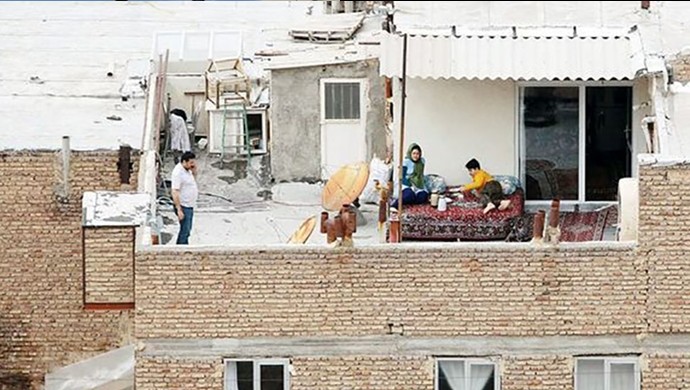

While homelessness and the high cost of housing and rent inflict immense suffering on millions of Iranian families, especially workers, laborers, and fixed-income earners, a regime-affiliated media outlet recently reported: “The waiting time to buy a house with a worker’s housing allowance has reached 580 years.” It added: “Bank loans are not even sufficient to buy 6 to 7 square meters of land. The government has become the largest land hoarder” (Tejarat News, April 1, 2025).
This occurs while, according to regime sources and experts, there are 6 million vacant homes in Iran, yet millions are homeless, resorting to sleeping in graves, on rooftops, in buses, or multiple families sharing a single unit.
The average price per square meter of housing in Tehran has reached 1.1 billion rials. Recently, continuous reports about new housing price hikes in the Persian calendar year 1404 (starting March 2025) have been published with headlines like: “Severe inflation on the way?”, “Severe housing market inflation,” “Municipalities and banks are the cause of high prices”… These are outcries from within the ruling system that point to a devastating crisis hurting the people, without naming the main culprit.
Housing prices increased more than 90-fold between 2006 and 2024, rising from 8.3 million rials per square meter in 2006 to about 760 million rials in 2024. Simultaneously, the number of vacant homes in the country grew from 633,000 units to 6 million units. The contradiction is stark: on one hand, exploding prices and lines of homeless people; on the other, a stockpile of unused houses. Who is behind this deadly game?
According to the state-run Kayhan newspaper on May 7, 2024, “Half of the vacant homes in Iran belong to banks.” These banks, either by foreclosing on debtors’ homes or through rent-seeking, large-scale construction projects like the controversial Mehr Housing initiative, now hoard vast numbers of houses to control the market.
Banks—institutions that are supposed to use people’s deposits to provide loans for production—have now turned into real estate speculators. Why? Because housing guarantees a risk-free annual profit of 30%. Investors who have bought or built thousands of units not only refuse to lower prices but also systematically obstruct the implementation of taxes on vacant homes.
Municipalities also take their share of this plundering cycle by increasing construction fees. According to the state-run ILNA news agency, municipalities are one of the main factors driving up the final cost of housing. This means that from production to supply, every part of this chain is controlled by institutions dependent on the central power structure of the regime.
The result of this mafia-like policy is clear: an ever-growing line of homeless people.
A shocking report from the Research Center of the regime’s Majlis (parliament) on August 14, 2023, detailed: “The prevalence of eight types of homelessness in the country… rooftop sleeping, engine-room sleeping, car sleeping, grave sleeping, bus sleeping, constant moving (nomadic housing), shelter-seeking employment choices, and cohabitation of two or more families in a single residential unit.”
Who manages this vicious cycle? Looking at the main owners of the banks provides a clear answer: the government, the Islamic Revolutionary Guard Corps (IRGC), and Astan Quds Razavi (a massive religious-economic conglomerate owned by the regime), all connected pyramid-style to one point: Khamenei’s office, the center of the Supreme Leader’s financial and political power.
Thus, the plundering Supreme Leader, through the organizations and institutions under his control, and using tools like banks and municipalities, holds the housing market hostage.
On one side, millions are homeless; on the other, houses are deliberately kept vacant to manipulate prices. This isn’t “market management”; it’s the crippling of a nation using housing as a tool.