

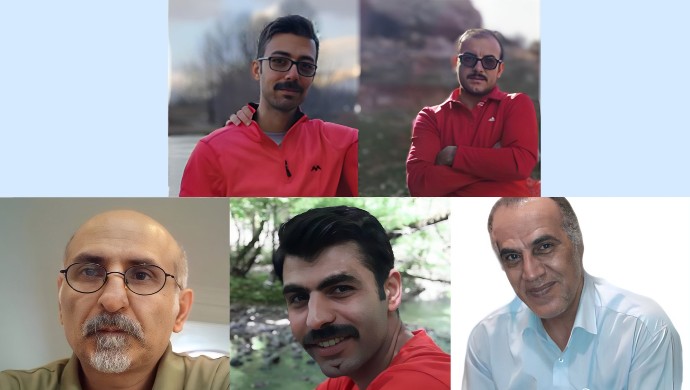

The United Nations Special Rapporteur on the human rights situation in Iran, Dr. Mai Sato, and Amnesty International have issued urgent warnings over the fate of five political prisoners at risk of imminent execution by Iranian authorities. The five men—Vahid Bani Amerian, Mohammad Taghavi Sangdehi, Babak Alipour, Pouya Ghobadi, and Akbar (Shahrokh) Daneshvarkar—were sentenced to death following what Amnesty described as a “grossly unfair trial marred by allegations of torture to extract forced confessions.”
According to both organizations, the Iranian judiciary has issued an order to transfer the men from Evin Prison’s Ward 4 to Ghezel Hesar Prison in Karaj, a facility notorious for mass executions. Amnesty warned on April 17 that the prisoners “could be moved at any time,” emphasizing that such transfers often precede executions. The organization has called for Iranian authorities to immediately halt the planned executions and to “quash their convictions and death sentences.”
https://twitter.com/AmnestyIran/status/1912874932557558006
Dr. Sato echoed these calls, writing on social media: “Very concerned by reports of five political prisoners being forcibly transferred from Evin Prison’s Ward 4 to Qezel Hesar Prison. All five men are on death row.” She also drew attention to the broader human toll of executions in Iran, noting, “The cost of executions extends far beyond those executed—devastating families, traumatising fellow prisoners, affecting prison staff, and creating cycles of anguish throughout communities.”
Tensions inside Evin Prison escalated on April 16 when the five men were summoned for transfer under orders from prison director Heydatollah Farzadi and the Ministry of Intelligence. The attempted transfer was met with protest by fellow political prisoners, prompting a violent crackdown by prison guards. All five detainees have been sentenced to death on charges of supporting the People’s Mojahedin Organization of Iran (PMOI/MEK), the main opposition to the mullahs’ regime.
I've raised alarm about conditions in Evin prison in my last HRC report. I remain concerned by reports of the prison being in a volatile situation following prisoner transfers, creating a dangerous environment.
— Mai Sato (@drmaisato.bsky.social) (@drmaisato) April 17, 2025
The developments come amid a broader surge in executions across Iran. Amnesty International has reported at least 20 executions of Baluch prisoners in recent days alone and warned of an accelerating use of capital punishment as a tool of repression.
“These cases highlight ongoing concerns about the Islamic Republic of Iran’s use of the death penalty,” Dr. Sato said. “I will be monitoring this situation closely. The international community must not remain silent.”
Previously, on January 27, 2025, and April 2, 2025, three other political prisoners—Behrouz Ehsani Eslamloo, Mehdi Hassani, and Seyed Abolhassan Montazer—who were also sentenced to death on similar charges, were suddenly transferred from Evin to Ghezel Hesar Prison.
Fearing uprisings and growing support for the Iranian Resistance, the mullahs’ regime has resorted to ratcheting up repression and executions to quell dissent and maintain its hold on power.
In a statement on Wednesday, April 16, 2025, the National Council of Resistance of Iran (NCRI) called on the United Nations High Commissioner for Human Rights, the Special Rapporteur, the UN Independent Fact-Finding Mission, as well as the European Union and its member states, to take immediate action to save the lives of political prisoners sentenced to death.