


In her Nowruz (Persian New Year) speech, delivered on March 18, 2025, Maryam Rajavi, the president-elect of the National Council of Resistance of Iran (NCRI), said: “The year 1404 [2025–2026] heralds a new era in Iranian society, history, and the destiny of Iran and Iranians. It is a time of change. The year 1403 [2024–2025] was marked with blows and defeats for the Velayat-e Faqih regime. May 1404 be a year of progress and victory for the people of Iran. Yes, the time for a great housecleaning in Iran has come. The turbaned tyrant and the entirety of his regime, with 1,142 recorded executions this year, represent the gloom and antiquity of winter. Instead, a blessed era is dawning—the era of the people’s sovereignty, a flourishing garden of freedom and justice, the spring of silenced talents, and a season where a hundred flowers, and a thousand flowers, will bloom in defiance.”
Mrs. Rajavi added: “At the start of last year, we declared that 1403 would be the year of besieging the mullahs’ regime —and, indeed, we witnessed that during the year its stronghold in the region was toppled, Khamenei’s hegemony suffered a crushing blow, its main proxy forces were crippled, and its already fragile social base fractured and collapsed. Now, the regime stands at a dead end—caught between the choices of suicide or demise.”
Acknowledging this unprecedented weakness, regime Supreme Leader Ali Khamenei—who had once referred to appointing Ebrahim Raisi’s presidency as the “sweetness of the year”—spoke at the start of the new year about the “bitter events” of 1403 and compared the regime’s current condition to the tumultuous year 1360 (1981), a time of internal crises for the regime following the revolution.
The regime’s Supreme Leader said: “The year 1403 was an eventful one. The incidents that happened successively throughout the year were similar to those of 1360 [1981] and were full of hardships and difficulties. Early in the year, the martyrdom of the late Mr. Raisi occurred. Before that, the martyrdom of several of our advisors in Damascus took place. After that, various incidents occurred in Tehran and later in Lebanon—these were bitter events that happened.”
Notably, Khamenei made no mention of the massive blow dealt by the fall of the Assad regime in Syria—his regime’s most important regional ally for the past fifty years. This omission stems from the fact that such a loss is more bitter to him than poison, and it casts a dark shadow over the future of his regime.
Khamenei is witnessing, on a daily basis, the consequences of the collapse of his regime’s strategic depth in the region—such as the evaporation of vast investments in Lebanon, the banning of his planes from landing in Beirut, the curbing of his proxies’ rampage in Iraq, and heavy strikes against his proxy forces in Yemen. All this is happening while the President of the United States has declared: “Let nobody be fooled! The hundreds of attacks being made by Houthi, the sinister mobsters and thugs based in Yemen, who are hated by the Yemeni people, all emanate from, and are created by, IRAN. Any further attack or retaliation by the ‘Houthis’ will be met with great force, and there is no guarantee that that force will stop there.
Khamenei, who had invested in regional warfare and nuclear bomb development to preserve his regime and suppress uprisings, now enters 1404 (2025–2026) facing the collapse of his strategic depth in the region and the return of maximum U.S. pressure against his bomb-making project—amid a shattered balance of power.
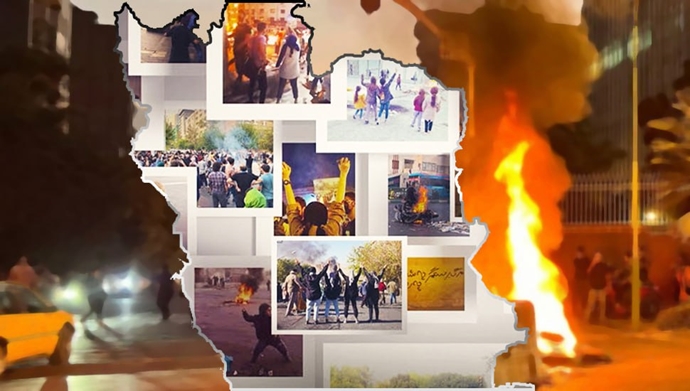
In contrast, as Maryam Rajavi stated in her Nowruz speech: “on the side of the people, on the frontlines of resistance, uprising and overthrow, a new ear has begun— an era of expanding Resistance Units, of struggle and defiance in rebellious cities, and of an organized uprising is at hand. Truly, what greater news could there be than the revolutionary fervor rising within our society, ready to overthrow this regime?”