

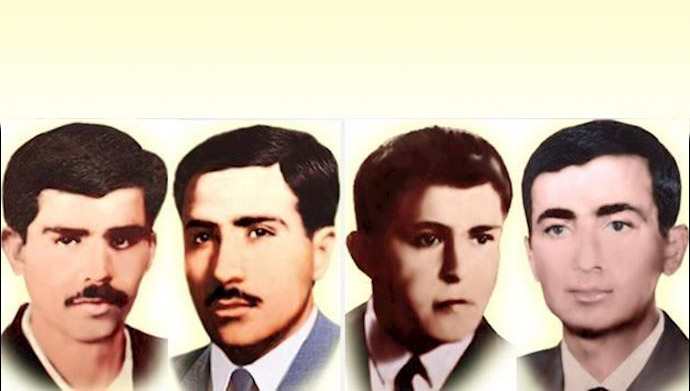

Today marks the anniversary of some of the most brutal crimes committed by the Shah’s dictatorship against Iran’s political dissidents. On April 19, 1972, and exactly three years later on April 19, 1975, Mohammad Reza Pahlavi’s regime executed and assassinated pioneering political prisoners who had raised the banner of revolutionary struggle against tyranny.
While we commemorate the immense sacrifices of these martyrs, it is crucial to recognize the contemporary context. Today, the remnants of the Shah’s regime are actively attempting to rewrite history, whitewash a legacy of torture, and create the false impression that Iranians yearn for a return to monarchical tyranny. However, after a century of shedding blood for freedom, the Iranian people will not trade one dictator for another.
The blood on the hills of Evin: Remembering the atrocities of April 19
The cruelty of the Shah’s regime was fully unmasked on April 19, 1972, when military courts, following sham trials, sent a group of senior central committee members of the People’s Mojahedin Organization of Iran (PMOI/MEK) to the firing squad. Nasser Sadegh, Mohammad Bazargani, Ali Mihandoost, and Ali Bakeri were executed after enduring eight months of severe torture by SAVAK, the Shah’s notorious secret police. Around the same time, SAVAK murdered Asghar Montazer Haghighi in street clashes.
Three years later, on April 19, 1975, the Shah ordered another massacre. Nine prominent political prisoners—Kazem Zolanvar and Mostafa Javan Khoshdel of the PMOI, along with Bijan Jazani, Hassan Zia Zarifi, Aziz Sarmadi, Abbas Sourki, Mohammad Choopanzadeh, Saeed Kalantari, and Ahmad Jalili Afshar from the People’s Fedaiyan organization—were secretly gunned down.
Orchestrated by infamous SAVAK official Parviz Sabeti, these prisoners, who had humiliated their torturers with their resilience, were taken to the hills near Evin Prison. Blindfolded and handcuffed, they were machine-gunned with astonishing cruelty. SAVAK torturer Bahman Naderipour later confessed that guards were ordered to fire on the seated, tied inmates, after which another agent delivered a coup de grace to each. SAVAK then cowardly lied to the press, claiming the prisoners were shot while attempting to escape.
A hijacked revolution and the Pahlavi legacy of despotism
The Pahlavi monarchy was never born out of democratic aspirations. It emerged from a 1921 British-backed coup that brought Reza Shah to power, a man who violently crushed Iran’s early constitutional movement and forcibly seized tens of thousands of properties. His son, Mohammad Reza Pahlavi, similarly consolidated his rule through a 1953 foreign-backed coup against the democratically elected Prime Minister Dr. Mohammad Mossadeq.
What followed was the creation of a police state. SAVAK became the central instrument of terror. As Amnesty International reported at the time, the Shah’s system was defined by prolonged detention without legal safeguards, forced confessions, and systematic torture—including electric shocks, whippings, the extraction of nails and teeth, burns, and rape. The Shah mocked democratic rule entirely, imposing the one-party Rastakhiz system in 1975 and declaring that anyone who did not join should either go to prison or leave the country.
Unmasking the monarchist charade today
Today, the son of the deposed dictator, Reza Pahlavi, attempts to present himself as a modern democratic figure. However, a claim to democracy is hollow when one refuses to condemn a legacy of dictatorship. In recent interviews in Sweden on April 12 and 13, 2026, Reza Pahlavi explicitly stripped away his democratic facade. When asked at a Stockholm press conference if his father had done anything he disagreed with, he dismissed the question. The day prior, on Swedish state television, he stated clearly: “Regarding my family background, I am proud of my heritage and I support their actions.”
This open glorification of a brutal past explains the repulsive audacity of his supporters, who are openly expressing admiration for the SAVAK and the crimes it committed against political activists. A man who takes pride in hereditary despotism offers no credible guarantee of liberty.
On this anniversary of the April 19 massacres, it is clear that the stain of blood cannot be wiped clean from the Shah’s legacy, just as it cannot be erased from the mullahs’ record. The Iranian people have not endured a century of dictatorship to simply restore a deposed tyrant.
The blood spilled on the hills of Evin fuels the fire of today’s Resistance Units and echoes in the streets of Iran, where brave protesters advance a new democratic revolution under the definitive rallying cry: “Down with the oppressor, be it the Shah or the mullahs!”