

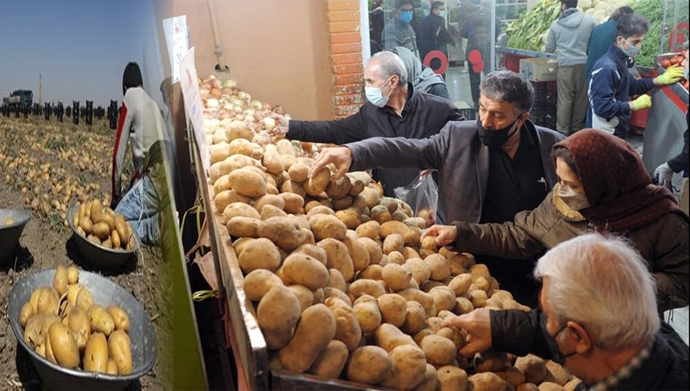

While Iran is one of the largest producers of agricultural products, such as potatoes, in the region, we are now witnessing a worrying phenomenon: the installment sale of this essential product.
How did it come to this?
The people of Iran have been enduring difficult times for decades due to the regime’s destructive policies, systematic corruption, the priority of military and security budgets for suppression, and finally, the rent-seeking economy.
Despite the bombastic propaganda of various governments in this regime, there is no plan to support producers and consumers.
Inflationary policies, lack of control over liquidity, and mismanagement in the agricultural sector have caused even domestically produced goods to face astronomical price increases.
Potatoes, which have always been one of the cheapest and most accessible agricultural products, have today become a luxury item that people are forced to buy on installment.
The regime’s plundering agents “for years, to reduce consumption and alleviate the pain of high prices, have been telling people that eating meat and chicken is harmful to their health and that they should consume more agricultural products, vegetables, and fruits during the week. But now, with the high price of potatoes, what new prescription have they prepared for the people?” (Source: Taze News, February 19, 2025)
Inflation and the Collapse of the National Currency
One of the main reasons for the installment sale of basic goods is the rampant inflation that has plagued Iran’s occupied economy in recent years.
The inflation rate is constantly increasing, and the government’s policies to control it have failed.
Printing unsupported money, ineffective price controls, and the inability to manage the exchange rate are factors that have contributed to the increase in the cost of living.
The Phenomenon of Installment Purchases of Food
Installment purchases usually make sense for expensive goods such as cars, appliances, or real estate, but when people are forced to pay in installments for everyday food items such as potatoes and onions, it indicates that the country’s economy is in serious crisis.
This situation not only indicates widespread poverty in society but also proves the decrease in food security and the spread of malnutrition among the poor and middle classes.
According to research, more than 55 percent of urban residents in Iran suffered from food poverty in 2022:
“According to Eghtesad 24, a recent research study examined the state of poverty and food insecurity in urban areas of Iran in 2022, and according to this study, only 45 percent of urban residents enjoy food security, and 55 percent of residents in these areas suffer from food poverty.
“According to experts, macroeconomic factors such as inflation and the low growth of the country’s economy in the last decade have been the most important factors affecting high food poverty in urban areas of the country.” (Ibid)
These statistics clearly show that a large segment of society can no longer afford their basic food and that this trend could lead to deeper social, health, and economic crises in the future.
The Collapse of Social Welfare and an Uncertain Future
While state media are trying to hide the cause of this situation, the truth is that the installment sale of food items like potatoes is a sign of the country’s economic collapse:
“When potatoes reach 800,000 to 900,000 rials per kilogram, how can a family of four buy three to four kilograms of potatoes a week according to their diet!
“That means they have to spend 4 million rials a week for a simple food product!
“Which livelihood basket of workers and low-income families is this figure recorded in!” (Ibid)
Economic instability, inflation, the decrease in the value of the national currency, the lack of support policies, and long-term planning for national production, including in the agricultural sector, have all combined to make the people of Iran unable to meet their most basic needs.
A Measure of Economic Collapse and Bankruptcy
The installment sale of potatoes and other food items is not a normal occurrence, but a serious warning for Iran’s economy.
This phenomenon shows that people’s purchasing power has decreased significantly and that the country is on the path to economic collapse.
While many countries are moving towards progress with careful economic planning and support for domestic production, Iran, due to wrong policies and economic corruption, is regressing.
In such circumstances, is there any other solution than to pour into the streets and overthrow the mullahs’ regime?