

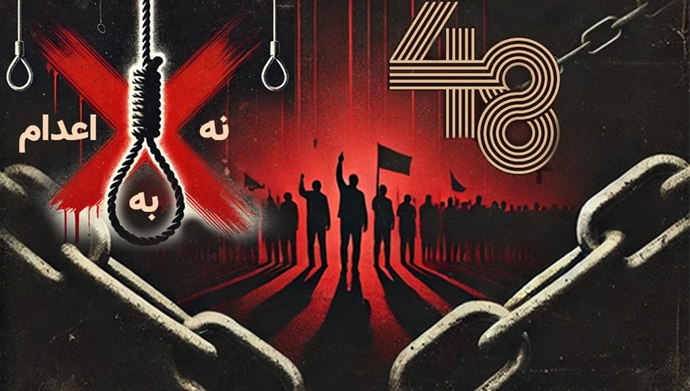

In the forty-eighth week of the “No to Executions Tuesdays” campaign, its members announced that with the participation of Rudsar Prison in Gilan province, they will stage a hunger strike in 28 prisons on Tuesday, December 24, 2024.
The “No to Executions Tuesdays” campaign is a coordinated protest movement initiated by political prisoners across Iran to oppose the regime’s extensive use of the death penalty. Since it began in early 2024, the campaign has involved weekly hunger strikes and statements condemning executions, aiming to raise awareness and mobilize both national and international support against capital punishment in Iran.
The latest statement from the prisoners in the “No to Executions Tuesdays” campaign reads:
“On the eve of the New Year, we celebrate the birth of Jesus Christ, the herald of peace and freedom, and wish a year free from oppression, executions, and killings for all the peoples of the world, especially Iranians suffering under the rule of the Velayat-e Faqih regime.
“In 2024, the oppressive regime ruling Iran has executed at least 953 individuals, of whom approximately 33 were women, with a total of eight political prisoners among them. Furthermore, around 96 Kurdish compatriots and 101 Baluchi compatriots have been executed over the past year.”
The statement by the hunger-striking prisoners of the “No to Executions Tuesdays” campaign further states:
“Out of the total executions in 2024, 158 were carried out in the Ghezel Hesar Prison in Karaj, dubbed the ‘execution field.’
“The ‘No to Executions Tuesdays’ campaign has sought to expose parts of the crimes and executions occurring in prisons across the country, amplifying the voices of nameless prisoners on death row. The exposure of these atrocities by the campaign and other political and human rights organizations has, after years of executions and killings, led to Ghezel Hesar Prison being added to the list of international sanctions.
“Last week, on Wednesday, December 18, 2024, the regime hanged a Kurdish political prisoner named Rahim Barin in Mahabad Prison after 19 years of torture.”
“Additionally, another political prisoner in Urmia Prison, Rezgar Bigzadeh Babamiri, who was arrested during the 2022 protests in Bukan, has been charged with ‘waging war against God’ and ‘rebellion’ by Branch 10 of the Revolutionary Prosecutor’s Office in Urmia, putting him at risk of receiving a death sentence.”
The hunger-striking prisoners’ statement also emphasizes:
“As we have repeatedly emphasized, it is evident that the regime resorts to suppression and executions to prevent public protests, and all executions in Iran have a political dimension. Therefore, the members of this campaign once again call on all grassroots and human rights organizations inside and outside the country to make serious efforts to stop executions in Iran. The key to victory and halting the execution machinery lies in collective solidarity and unity. We can and must stand against executions to put an end to this systematic killing.”
The 28 prisons participating in the “No to Executions Tuesdays” campaign on December 17, were: Evin (women’s ward, wards 4 and 8), Ghezel Hesar (units 3 and 4), Karaj Central Prison, Greater Tehran Prison, Arak Prison, Khorramabad Prison, Asadabad Prison in Isfahan, Dastgerd Prison in Isfahan, Sheiban Prison in Ahvaz, Nezam Prison in Shiraz, Bam Prison, Kahnuj Prison, Mashhad Prison, Qaemshahr Prison, Lakan Prison in Rasht Prison (men’s and women’s wards), Ardabil Prison, Tabriz Prison, Urmia Prison, Salmas Prison, Khoy Prison, Naqadeh Prison, Saqqez Prison, Baneh Prison, Marivan Prison, Kamyaran Prison, Tabas Prison, Khorin Prison in Varamin, and Rudsar Prison in Gilan.
The campaign entered its week while Iran’s regime continues to ramp up executions in its prisons.
According to the National Council of Resistance of Iran (NCRI), during the Persian calendar month of Azar (November 21 to December 20), the regime executed at least 141 prisoners, including seven women and two minor offenders.
“[Iranian regime supreme leader Ali] Khamenei, deeply fearful of meeting the same fate as Bashar al-Assad and the collapse of his regime, attempts to suppress uprisings through killings, executions, and the creation of an atmosphere of fear,” NCRI wrote. “However, these brutal crimes only further ignite the people’s rage. The religious fascism ruling Iran has no escape from eventual downfall.”