

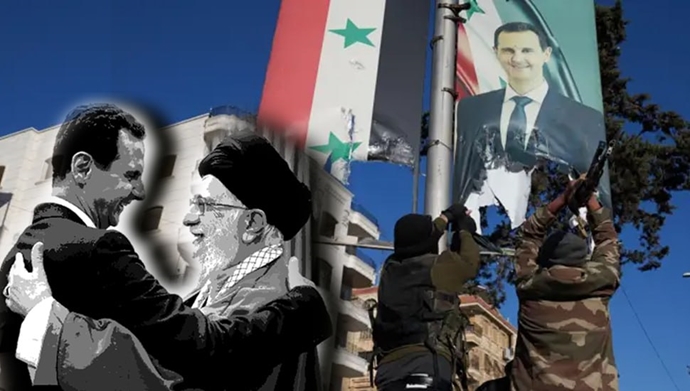

With the fall of Syrian dictator Bashar al-Assad, the Iranian regime’s 40-year presence in the region is unraveling. The state-affiliated newspaper Ham-Mihan, in its December 9 issue, wrote: “Within a week, all political, economic, and military investments went up in smoke.”
Hours before the fall of Damascus, the state-run Khabar Online website expressed concern, writing: “Their goal is to reach Sarpol-e Zahab in western Iran. Through our investigations, we realized that their plan is much more serious than Syria and Iraq… To prevent the war from reaching Iran, serious and comprehensive actions at a high level must be taken. We are witnessing the defensive pillars of the Syrian army collapsing one after another…”
Throughout the mullahs’ regime, from the reign of Hafez al-Assad during Khomeini’s war on Iraq to the criminal rampages of Qassem Soleimani in Iraq, Lebanon, and Syria, and up until the fall of Bashar al-Assad, the Assad family’s 50-year dictatorship remained the central axis of the regime’s regional policy.
The phrase “Syria, the tent pole” was used by Hezbollah leader Hassan Nasrallah in 2019, quoting Ali Khamenei. He said, “If I were to refer to Syria with one precise phrase, it is the one the Seyyed Leader [Khamenei] used about this country, saying: Syria is the tent pole. Today, without Syria, the resistance in Lebanon and Palestine would be marginalized. Syria is one of the main, significant, and essential parts of the body, intellect, culture, and will of resistance in the region” (Khamenei’s website, September 24, 2019).
It was no coincidence that the regime poured tens of billions of dollars from Iran’s oil and gas revenues, along with harshly imposed taxes on the Iranian people, and sent thousands of IRGC members and mercenaries to keep Bashar al-Assad in power, aiming to block uprisings and revolutions both in Syria and Iran.
The leader of the Iranian regime, justifying his costly interventions in regional countries—described as Iran’s strategic depth—has repeatedly stated that if we do not fight and spend in Syria, Lebanon, and Iraq, “we will have to fight in the streets of Kermanshah, Hamedan, and other provinces.”
He also justified the intervention of the terrorist IRGC Quds Force in Syria, saying, “Anyone who goes from here to Iraq or Syria to stand against these Takfiris in defense of the holy shrines is, in fact, defending their own cities” (Khamenei’s website, June 25, 2016).
According to this theory and the Iranian regime leader’s own admission, the effects of the collapse of Iran’s strategic depth and the breaking of the “tent pole” in Syria will first appear in Tehran. When Khamenei is unable to maintain his tent pole in Syria, he cannot sustain his rule in Tehran.
Previously, cleric Mehdi Taeb, head of the so-called Ammar Headquarters, expressed the same notion more explicitly and bluntly, stating, “If the enemy attacks us and wants to take Syria or Khuzestan, the priority is to keep Syria. Because if we keep Syria, we can retake Khuzestan. But if we lose Syria, we cannot even hold Tehran” (Asr Iran, February 15, 2013).
The removal of Bashar al-Assad was possible nine years ago under UN Security Council Resolution 2254, but Khamenei and his executioners prevented it. According to documented evidence, Khamenei spent at least $50 billion during the 2010s, taken from the Iranian people’s livelihoods to suppress and massacre Syrian dissidents and keep Bashar al-Assad in power. The impoverished people of Iran were shouting, “Leave Syria, think about us.” Truly, the overthrow of the Syrian dictator is fatal for Khamenei and his regime, and it is a sign of the inevitable victory of Iran’s democratic revolution.