

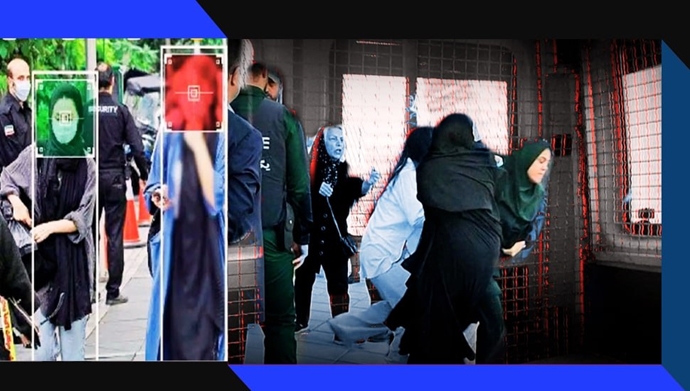

The so-called “Chastity and Hijab Law,” after months of back-and-forth between the Iranian regime’s Majlis (Parliament) and the Guardian Council (the body that oversees the elections), was finally published on November 30, with 74 articles across five chapters. This clerical-made law once again highlighted the essence and starting point of the religious, misogynistic fascism aimed at intensifying repression against society, particularly women.
The initial draft of this law, under the title “Support for the Culture of Chastity and Hijab,” was presented to the Parliament by the Judiciary, with the endorsement of former president Ebrahim Raisi, in the wake of the nationwide uprisings of 2022. These uprisings, which shook the pillars of the regime, compelled the regime to resort to medieval laws to impose more organized control over an explosive Iranian society.
It is worth noting that the repression of women under the pretext of hijab has been the cornerstone of the religious fascism’s policies since the early days of the 1979 Revolution.
Despite remarks of Parliament Speaker Mohammad Bagher Ghalibaf, this law does not target the despised Morality Police but rather reproduces it in a broader, more multi-layered framework. Various articles of this law assign precise duties to ministries, cultural and social institutions, municipalities, and even business owners.
Municipalities and rural councils are mandated to provide the necessary conditions for implementing the alleged principles of chastity and hijab in public spaces such as parks, public transportation, and cultural centers. This entails increased control over the daily lives of citizens and allows for the direct presence and intervention of regime forces in all public domains
The Ministry of Intelligence, State Security Forces Intelligence Branch, and the Islamic Revolutionary Guard Corps Intelligence Organization are tasked with directly confronting women. This article clearly indicates an escalation in the security and judicial dimensions of social control.
Under this law, business owners and employees of executive bodies face severe penalties if they fail to cooperate in enforcing the law.
The regime’s “Chastity and Hijab Law” is in stark contradiction with the principles of the Universal Declaration of Human Rights, the International Covenant on Civil and Political Rights, and conventions related to women’s rights. This law violates the right to freedom of dress, a fundamental human right, and imposes the ideological standards of the regime, effectively depriving women of their right to choose.
Instead of responding to the people’s demands for individual freedoms, women’s rights, and an end to discrimination, religious fascism has once again resorted to tools of repression and social control. This law is a clear example of a policy that intensifies, rather than alleviates, social pressures.
The emphasis of this law on employing diverse methods of repression—from monitoring public spaces to enforcing informant practices—demonstrates the regime’s determination to maintain its hold on power at any cost. Experience shows that such policies only amplify public anger and protests.
Even now, with the law not yet fully enacted, the state-run Entekhab news website, on December 1, wrote, “The provisions of this law are practically unenforceable, and the law is so at odds with our social conditions that even a small percentage of its implementation could foreseeably lead to severe social crises.”
Iranian women have repeatedly shown that they will not succumb to such laws. Women’s protest movements from past decades to the 2022 uprising symbolize resilience against oppressive and misogynistic policies. Iran’s revolutionary women, pioneers in the struggle for freedom and social justice, will not be deterred by such measures.
In a statement on December 1, 2024, Mrs. Maryam Rajavi, the president-elect of the National Council of Resistance of Iran (NCRI), stated: “The misogynistic “Chastity and Hijab” law is criminal and inhumane and is strongly condemned. Through this oppressive law and by employing repressive forces, Khamenei seeks to subjugate society, particularly women who are at the forefront of the struggle against religious fascism. Neither daily executions nor misogynistic laws will remedy this regime’s predicament.”
The Women’s Committee of the National Council of Resistance of Iran also called on all freedom-loving Iranian women to confront this criminal and anti-human law with the slogan “Woman, Resistance, Freedom.”
The disgraceful and repressive “Chastity and Hijab” law, like other repressive policies of the regime, is doomed to fail due to its contradiction with social realities and people’s demands. The passage of such laws proves that the regime has no strategy but repression, intimidation, and control when dealing with women and Iran’s explosive society in general.
The fight against this law and other oppressive clerical policies requires unity, solidarity, and persistent resistance. Iranian women, with the slogan “Woman, Resistance, Freedom,” are more prepared than ever to confront the regime’s repressive measures.
“No to compulsory hijab, no to compulsory religion, and no to compulsory government.”