

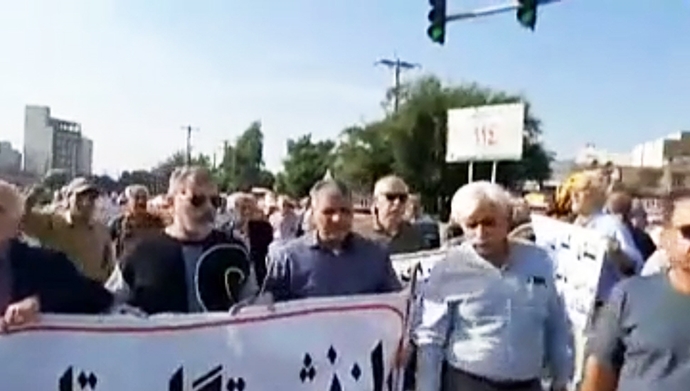

In recent days, Iran has witnessed a wave of protests across several cities, where workers, creditors of state-backed companies, and retirees have taken to the streets to demand better living conditions, the payment of overdue wages, and a response to their grievances. These protests reflect a growing anger among various segments of the Iranian society amidst a crippling economic crisis and governmental mismanagement.
On November 23, over 20,000 defrauded creditors of the state-backed carmaker Rezayat Khodro Taravat Novin rallied in Qazvin to protest the company’s fraud and corruption. The company, which reportedly holds investments from 40,000 individuals across 13 provinces, has faced widespread accusations of fraud, with 28,000 official complaints filed against it. The protest took place in front of court where the company’s dossier was being reviewed.
More footage of the protest rally by the creditors of Rezayat Khodro carmaker in Qazvin.#IranProtests #Iran pic.twitter.com/aDOo1eUacq
— People's Mojahedin Organization of Iran (PMOI/MEK) (@Mojahedineng) November 23, 2024
The company’s primary defendant, Mohammad Reza Ghaffari, a known member of the IRGC, is accused of embezzling funds from customers who paid for vehicles that were never delivered. Ghaffari leveraged his connections with influential figures, including MPs, judiciary officials, and clerics, to protect himself and stall legal proceedings.
Protesters chanted “Our tables are empty—no more hollow promises!” and other slogans that called out the regime’s corruption. Security forces, including special anti-riot units, were dispatched to the protest as the regime feared more widespread protests.
On November 24, in the southwestern city of Gachsaran, contracted workers in the oil and gas industry organized protests to call for wage increases and improved working conditions. These demonstrations highlight the struggles of workers who are vital to the country’s oil economy but feel overlooked by officials. Despite repeated demands, authorities continue to ignore these workers who are bearing the brunt of economic hardships.
More footage of protests by contract workers of Gachsaran Oil and Gas Company. #Iran #IranProtests pic.twitter.com/UjMsdmeKKU
— People's Mojahedin Organization of Iran (PMOI/MEK) (@Mojahedineng) November 24, 2024
On November 24, retirees of the Social Security Organization staged protests in several cities, including Kermanshah, Isfahan, Ahvaz, and Shush, demanding higher pensions and better basic services. In Kermanshah, protesters chanted: “Boundless taxes, catastrophic services,” indicating their frustration with rising living costs and poor government services.
In Isfahan, retirees from the steel industry gathered, criticizing the government for failing to meet their demands. They chanted: “They use Islam to ruin people’s lives,” in direct criticism of the regime’s policies. They also voiced another slogan reflecting their resolve: “We will only regain our rights in the streets.”
More footage of the protests by retirees of the steel industry in Isfahan.
Protesters chant, "We will only reclaim our rights in the streets"#Iran #IranProtestspic.twitter.com/WPU1Kgxdan— People's Mojahedin Organization of Iran (PMOI/MEK) (@Mojahedineng) November 24, 2024
In Ahvaz, retirees of the Social Security Organization condemned both the parliament and the government for their repressive policies, shouting: “Both the parliament and the government oppress the people” and “Social Security, what a misnomer.” In Shush, retirees from the Social Security Organization joined the wave of protests, emphasizing their demands for improved pensions and living standards.
More footage of protests by retirees of the Social Security Organization in Ahvaz.
Protesters chant, "Social Security, what a misnomer"#Iran #IranProtestspic.twitter.com/f8YamM644y— People's Mojahedin Organization of Iran (PMOI/MEK) (@Mojahedineng) November 24, 2024
In Ahvaz, staff at Apadana hospital organized a protest against delayed salaries and highlighted the suffering of patients due to long waiting times and poor services. These protests shed light on the crisis faced by Iran’s healthcare sector due to funding shortages.
These protests come amid accusations against the Iranian regime for neglecting the needs of its people in favor of excessive spending on regional interventions and nuclear projects. Estimates suggest that the regime has spent around $4 trillion on such activities in recent years. This massive expenditure has stirred resentment among the Iranian public, who are suffering from economic crises including inflation, unemployment, and poor social services.
In response to the escalating protests, the regime has resorted to brutal suppression. Within the first 100 days of the term of its new president, Masoud Pezeshkian, at least 500 people were executed, an 85% increase compared to the period under his predecessor, Ebrahim Raisi. This repression is widely viewed as an attempt to silence opposition voices rather than addressing the root issues.