

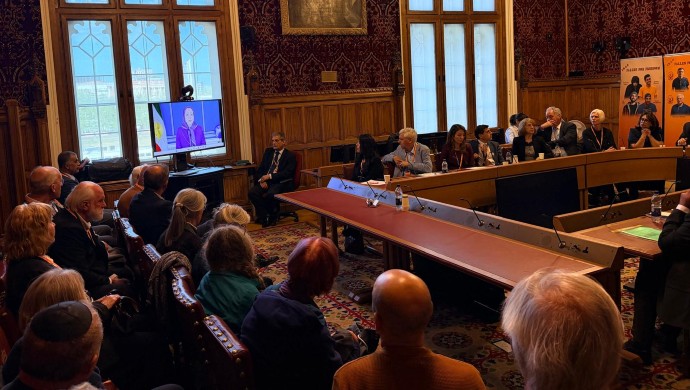

On April 28, 2026, the Palace of Westminster hosted a highly significant conference titled “Iran: Towards Peace and Freedom.” Bringing together a broad coalition of British parliamentarians, human rights advocates, and legal experts, the event occurred at an unprecedented juncture in Iranian history. Iran is still reeling from the massive, nationwide uprisings of December 2025 and January 2026—a nationwide revolt that spread to hundreds of cities and brought the ruling regime to the brink of collapse, only suppressed through the tragic massacre of thousands of protesters.
Furthermore, the geopolitical landscape of the Middle East has been altered after the recent war and the death of regime supreme leader Ali Khamenei. Against the backdrop of these seismic shifts, the crippled regime has responded to its extreme vulnerability by accelerating domestic executions.
It was within this context of a weakened, desperate regime that the UK parliamentarians convened. The conference focused on the need to reject the false dichotomy of past and present dictatorships, end the international community’s silence on executions, and fully support the National Council of Resistance of Iran (NCRI) as the sole democratic alternative.
Mrs. Maryam Rajavi’s Vision for a Free Iran
The conference was anchored by a keynote address from Mrs. Maryam Rajavi, the President-elect of the National Council of Resistance of Iran (NCRI). Speaking to the members of the House of Commons and the House of Lords, Mrs. Rajavi outlined the dire situation inside the country, pointing out that a “fragile and unstable” regime has intensified its campaign of repression in the wake of the recent wars and uprisings.
Highlighting the sheer brutality of the regime’s crackdown, Mrs. Rajavi revealed that since March 19, the ruling clerics have executed 18 political prisoners. “Eight of them were members of the PMOI, and the other ten were from among rebellious protesters,” she stated, noting that these victims were tried in unjust courts, deprived of basic rights, and subjected to severe torture. Addressing the regime judiciary’s own admission of adopting a “fully wartime position,” Mrs. Rajavi contextualized the executions as a desperate measure. “The regime is obviously concerned about future uprisings. Through these brutal executions, the regime seeks to terrorize young people and to prevent them from joining the Resistance Units that play a decisive role in organizing and expanding the uprising,” she explained.
Conference at the UK Parliament: Urgent Action to #StopExecutionsInIran
Today, our people and our country are facing very difficult conditions.
On one hand, they are confronted with the many hardships of war, caused by the regime’s nuclear and terrorist projects.On the other… pic.twitter.com/Ei6zDMbqNC
— Maryam Rajavi (@Maryam_Rajavi) April 28, 2026
Mrs. Rajavi firmly articulated that the solution to the Iranian crisis cannot be found in appeasement or foreign intervention, but through the Iranian people themselves. “The position of the Iranian Resistance can be summarized in the slogan of peace and freedom. The realization of both requires the overthrow of the religious dictatorship,” she declared. She pointed to the tangible impacts of the resistance network, noting that during the January uprising, “units of the Liberation Army carried out 630 operations against repressive forces in defense of protesters.” In a striking demonstration of vulnerability for the regime, she added that just days before the recent regional war, the PMOI targeted Khamenei’s headquarters and other heavily fortified government centers.
Concluding her address, Mrs. Rajavi warned European governments against silence, urging them to condition relations with Tehran on a halt to executions, to bring regime leaders to justice under universal jurisdiction, and to formally recognize the provisional government declared by the NCRI.
Condemnation of Executions of Dissidents
The sharp rise in executions following the installation of Mojtaba Khamenei drew fierce condemnation from the speakers, who viewed the hangings not as judicial acts, but as political assassinations designed to project strength in a time of profound weakness.
Azadeh Zabeti, co-chair of the Committee of Anglo-Iranian Lawyers, highlighted the “escalating human rights crisis occurring inside of Iran” under the shadow of the recent regional war, condemning the “sharp and deliberate rise in executions” aimed at silencing dissidents.
Sammy Wilson MP directed the audience’s attention to portraits of recently executed protesters. “A week ago this young man was alive; today he is dead because he stood up for what he believed in,” Wilson stated. Similarly, Lord Empey characterized the executions as a desperate act of a dying regime. “What they are doing is an expression of fear. They are afraid of young men like this,” he observed.
The People and Political Prisoners Pay the Price of Silence against Executions in Iran#StopExecutionsInIranhttps://t.co/OpLI6BWX1n pic.twitter.com/LxirWftJ30
— Maryam Rajavi (@Maryam_Rajavi) April 28, 2026
Christina Blacklaws, former President of the Law Society of England and Wales, provided a stark legal analysis, defining the Iranian judiciary as a “state repression apparatus.” She noted that the regime’s new directive for a “war posture” proves executions are a “political tool.” She argued that because domestic justice is impossible, the UK must push for a UN Security Council referral. Echoing this sentiment, former judge Dr. Jocelyn Scott called each execution a “massacre in itself” and castigated the international community for historically failing to shut down embassies or expel ambassadors in response.
Support for PMOI Resistance Units and the Iranian Uprisings
While acknowledging the devastating loss of life during the December-January protests, parliamentarians expressed immense admiration for the resilience of the Iranian people and the organized PMOI Resistance Units driving the push for regime change.
Bob Blackman MP emphasized that true liberation cannot be delivered by foreign air strikes, a pertinent point following the February 28 US-Israel military action. “To change the regime in Iran is not going to be done from the air… It’s got to be done by the Iranian people themselves,” Blackman stated. He paid tribute to the Resistance Units who “risk their lives every day in the streets.”
Lord Steve McCabe specifically honored the “heroic resistance members” who were recently executed by the regime, including Hamed Validi and Nima Shahi, emphasizing the heavy price paid by activists on the ground. Baroness Redfern added that despite pervasive censorship and internet blackouts, the networks and Resistance Units ensure the Iranian people know they are not alone.
Baroness Verma delivered a moving tribute to the activists fighting inside the country, vowing that parliamentarians would continue amplifying the voices of the “great people in Iran” who are “taking the fight on every single day.”
Rejection of Both the Shah and Mullahs’ Regimes
A recurring theme of the conference was the explicit rejection of any return to monarchical dictatorship. Following the recent instability of the regime, remnants of the deposed Pahlavi dictatorship have attempted to position themselves as an alternative—a move universally dismissed by the speakers.
Jim Shannon MP lambasted Reza Pahlavi for labeling ethnic communities as separatists and banking on defecting IRGC commanders, describing the Pahlavi agenda as a “wolf in sheep’s clothing.” Bob Blackman MP was equally dismissive, noting the Shah’s son had been “in total hibernation” for decades. He called claims that Pahlavi could unite Iran “absolute nonsense” and condemned his outreach to the IRGC.
Dr. Leyla Hannbeck systematically dismantled the myth of nostalgia for the monarchy, reminding the audience that the Pahlavi era was characterized by “massive inequalities, oppression, and one-party rule” enforced by the SAVAK secret police. Councilor Robert Ward, drawing on his experience in pre-revolutionary Iran, rejected the Shah’s son due to his lack of “grassroots support inside the country.”
Naghmeh Rajabi, an Iranian Resistance supporter, eloquently summed up the sentiment of the diaspora: “We don’t want to replace a dictator with another dictator and to centralize power in one person, one individual who’s just going to repeat this cycle.”
A Tough Policy on the Regime and the IRGC
With the regime’s supreme leader dead and power shifting dynamically, speakers stressed that Western governments must stop accommodating Tehran and immediately proscribe the Islamic Revolutionary Guard Corps (IRGC).
Former Minister for the Armed Forces, Lord Hamilton of Epsom, noted that the international community must recognize that the IRGC are now the primary power brokers in Iran, calling them “just as ruthless” as the clerics. Lord Empey expressed outrage that successive UK governments have allowed a “nest of vipers” to operate from the Iranian embassy in London, demanding the expulsion of diplomats and the banning of the IRGC.
Lord Carlile of Berriew CBE KC supported proscription but warned that an official ban must be accompanied by persistent attrition against the IRGC to enable a “civil uprising.” Baroness Verma did not mince words regarding the severity of the threat, characterizing the IRGC’s activities as “terrorism at a global scale” and comparing Western silence to the appeasement that preceded World War II.
Support for the NCRI, the Ten-Point Plan, and the Third Option
Ultimately, the speakers coalesced around a unified solution: the “Third Option” championed by Maryam Rajavi since 2004, which advocates for democratic change driven by the Iranian people and their organized resistance, rather than through foreign military intervention or diplomatic appeasement.
Lord Alton of Liverpool reaffirmed his commitment to this approach, insisting that any international agreement with the post-Khamenei regime must be contingent on “verifiable improvements” in human rights. He praised the Ten-Point Plan as the definitive blueprint for transferring power to an elected parliament within six months.
Lord McCabe characterized the Ten-Point Plan as the only mechanism to “bring about meaningful change” and a “peaceful transfer of power.” Baroness Redfern highlighted that the NCRI’s provisional framework guarantees a transition strictly “free from foreign intervention,” while Dr. Leyla Hannbeck urged the UK to engage actively with the NCRI, recognizing it as the entity representing the “true democratic aspirations” of the Iranian people.
The April 28 conference at Westminster made it unequivocally clear that the events of late 2025 and early 2026 have irreversibly altered the Iranian political landscape. The nationwide uprising, the subsequent executions of thousands, and the geopolitical fallout resulting in the death of Ali Khamenei have left a fragile regime desperately clinging to power under Mojtaba Khamenei through sheer terror.
As the parliamentarians demonstrated, the time for Western appeasement has long passed. The path to a free Iran does not lie in foreign wars or the resurrection of a discredited monarchy, but in the hands of the Iranian people and their organized resistance. By recognizing the NCRI’s provisional government and endorsing the Ten-Point Plan, the international community has a concrete roadmap to help usher in a secular, democratic, and non-nuclear republic in Iran.