

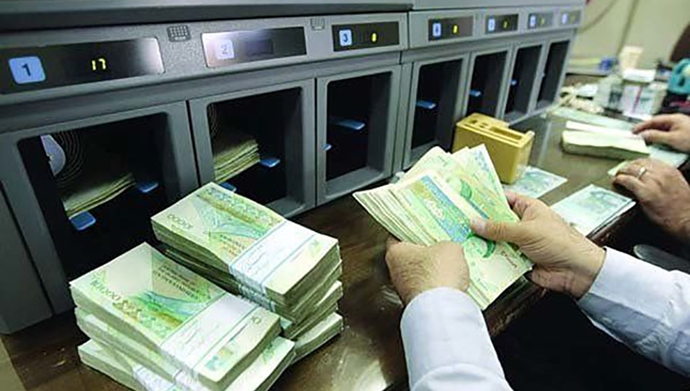

The bankruptcy and imbalance in Iran’s banking system are the result of years of mismanagement, interference by rent-seeking networks, and structural corruption tied to the regime. This crisis has occurred while regime officials have been establishing banks and exploiting public resources for personal, factional, and regime interests, deepening the country’s economic crisis.
Banking under the clerical regime has not only failed to finance production units but has also ventured into unproductive markets such as trading profitable assets, land, currency, gold, and multiple properties, paving the way for exploitative speculation. The result has been a liquidity shortage for production and service units.
What should we do with banks that act like enterprises?
In a gathering involving Mohammad Bagher Ghalibaf, Speaker of Majlis (Parliament); Abdolnasser Hemmati, Minister of Economy; and Mohammad-Reza Farzin, Governor of the Central Bank, a glimpse of the insurmountable banking crises and enterprise-driven corruption within the regime’s network was revealed, leaving officials perplexed about possible solutions.
The main issue currently is securing the liquidity needed to prevent production halts in industrial and service centers. State and semi-private banks, in addition to being required to cover part of the budget deficit by printing unbacked money, do not offer facilities to non-affiliated production units. Meanwhile, the government lacks funds to pay its employees’ salaries and pensions for retirees protesting in the streets, let alone providing loans to production units. Consequently, apart from issuing threats and drawing lines for the plundering factions dominating the banks, there seems to be no other option to compel some degree of flexibility and avert the imminent collapse of the economy into bankruptcy.
The Minister of Economy emphasized that the era of banks engaging in enterprise ownership must come to an end and stated that this will be achieved by March 2025.
On November 17, Tejarat News website wrote, “Abdolnaser Hemmati, Minister of Economic Affairs and Finance stressed the complex economic conditions of the country and the difficulty of emerging from it, stating that exchange rate surges and external factors have caused problems for the economy. This situation has led to a liquidity shortage for production units. On the one hand, increasing liquidity fuels inflation, and on the other, reducing liquidity through banking restrictions leads to a decline in production growth.”
On the other hand, Mohammad-Reza Farzin, the Governor of the Central Bank, admitted that the primary and fundamental challenge facing the country’s economy is financing. He stated, “Currently, over 92% of the country’s financing rests on the banking network, yet banks lack the necessary capital adequacy, and their financing is inflationary in nature. In other words, the banking network dips into the Central Bank’s resources, making inflation control extremely difficult.”
Eleven quadrillion rials for minimum capital adequacy in banks
However, his even more alarming admission revealed the inadequacy of banks in terms of the capital required for credit operations. Farzin stated: “The capital adequacy ratio for banks’ credit is 8%, and banks must reach this figure. To comply with the law and bring banks’ capital adequacy ratio from negative 1% to 8%, we need 11 quadrillion rials” (Source: the state-run Donya-ye Eghtesad newspaper, November 18).
Farzin stated: “Currently, 14 banks have accumulated losses, and to cover these losses, we need precisely 4.7 quadrillion rials in new resources. Non-governmental banks face approximately 7 quadrillion rials in capital inadequacy, while about 3.1 quadrillion rials pertain to state-owned non-commercial banks. For this year, it was decided to create 15 quadrillion rials in new money, but despite all efforts, there is a deficit of about 4 quadrillion rials. These figures indicate the imbalances present in the banking system.”
The financial statement for 2023 for 27 banks in the country reveals that out of the minimum capital adequacy ratio of 8%, 10 banks are above 8%, eight banks fall between 1% and 7%, and nine banks have a ratio between negative 1% and negative 360%.
On November 17, Jahan-e Sanat news website reported that the country’s monetary and banking system has suffered a “credit collapse,” meaning that banks are unable to provide adequate credit to economic actors. This issue has turned the banking system into the Achilles’ heel of Iran’s economy.
Shamseddin Hosseini, Chairman of Parliament’s Economic Commission, commented on this situation, stating: “Iran’s economy is trapped in a web of compound imbalances caused by inefficient governance.”
Iran’s banking crisis is the product of decades of mismanagement and structural corruption. Many of the current officials are the same individuals who, in previous administrations, promised to reform the banking system. Experience has shown that these rent-seeking networks and corrupt managers are incapable of addressing the issues. For instance, Hemmati, during Hassan Rouhani’s tenure (2013-2021), was the Governor of the Central Bank and had promised to eliminate enterprise ownership by banks.
Regime loyalists dominate the banking network, serving as centers of control over the country’s banks. Thus, they are all interconnected. The dismantling of this oligarchic mafia is only possible through the removal of the ruling regime in Iran.