

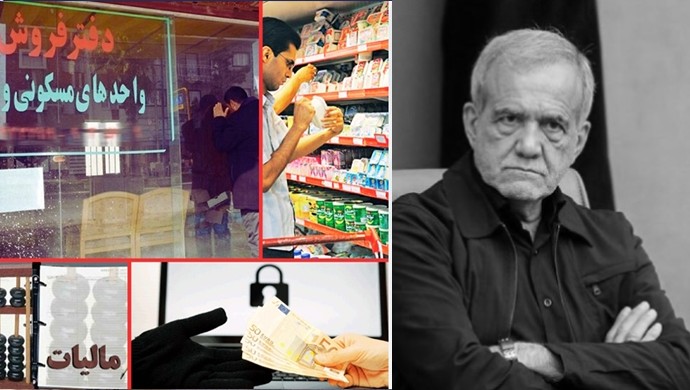

The unchecked rise in prices in Iran sparked heated debates among members of the regime’s parliament on Sunday, November 24, 2024. Some members ridiculed the empty promises of regime president Masoud Pezeshkian and warned about the potential eruption of public anger over the situation.
Several members of parliament highlighted the sudden 38% increase in electricity prices. One of them, Mohammad Pakmehr, said, “Can’t you see the blackouts and the 38% electricity price hike? Don’t you notice the soaring inflation impacting basic goods like eggs, meat, and other essentials? Can’t you see the multiple-fold increase in inflation? Where is the voice of justice? What happened to supporting the underprivileged segments of society?”
Another MP, Gholamhossein Rezvani, remarked, “We can no longer describe high prices, inflation, stagnation, and imbalances as merely a wound or even a disease. They have become a cancerous tumor, and it’s already too late to treat them, let alone tomorrow. People can no longer endure additional price hikes, and this will result in severe social consequences.”
On the same day, Kayhan, the newspaper that reflects the views of regime supreme leader Ali Khamenei, published an article titled “The Tightening of People’s Livelihoods,” voicing concerns about its consequences. It wrote, “The first economic action of the 14th government during its initial 100 days was a 40% to 66% increase in bread prices without increasing subsidies. The height of poor decision-making by a government is when, as its first measure, it raises the price of bread — the most basic food item (a survival commodity) and a public right meant to prevent even the poorest from going hungry — by several dozen percent. Yet, this so-called ‘expert government’ did just that.”
As people are being crushed under the weight of rising prices and economic hardships, the bankrupt clerical regime continues to devise new schemes to extract even more from the populace.
On November 18, the government-affiliated newspaper Jahan-e Sanat pointed to an exploitative measure it described as “astonishing and unbelievable,” stating, “A new line item has been added to household electricity bills under the name of ‘power plant fuel costs,’… in some cases, this amount is several times higher than other arbitrary charges invented by the Ministry of Energy, such as ‘electrical appliance insurance’ and ‘universal subscriber insurance,’ also seen on these bills.”
Thus, the regime not only charges exorbitant fees for electricity consumption but also adds other amounts, such as “power plant fuel costs,” “electrical appliance insurance,” and “universal subscriber insurance,” to the bills it sends to citizens, effectively extorting money from the public.
The newspaper further adds that similar charges “under names such as levies and value-added tax have long appeared on household gas, water, and telephone bills (both landline and mobile). In reality, collecting such funds means nothing but the government and state institutions taking money from people’s pockets and increasing the financial pressure on them.”
In another astonishing instance, Hassan Ghashghavi, a member of the Majlis Security Committee, stated on regime television on November 18 that imbalances in the budget must be eliminated and proposed reducing costs as the solution. He said, “We should all decide, for the sake of ‘resistance’ [i.e., the regime’s regional warmongering and terrorist proxies in the region], to cut one-third of the expenses of all institutions, including parliament, the judiciary, and the executive branch. We can do this: reduce one-third of current expenses, one-third! I’m not asking for more! People should also get used to cutting one-third of their wastefulness, reduce electricity usage — one-third! Then you will become like Haj Qasem [Soleimani], then you will become supporters of resistance.”
It is clear that cutting the budgets of parliament and the judiciary is mere lip service and a diversion. The real issue is that this individual brazenly proposes cutting one-third of current expenses, which primarily comprise the salaries of government employees. He also suggests reducing one-third of people’s consumption, arrogantly labeling it “wastefulness,” so that the regime can pool these funds to finance the regime’s regional warmongering efforts.
Although the remarks of this member of the Majlis are highly outrageous and anti-people, they openly and bluntly reveal the extortion and plundering policies of the regime.