

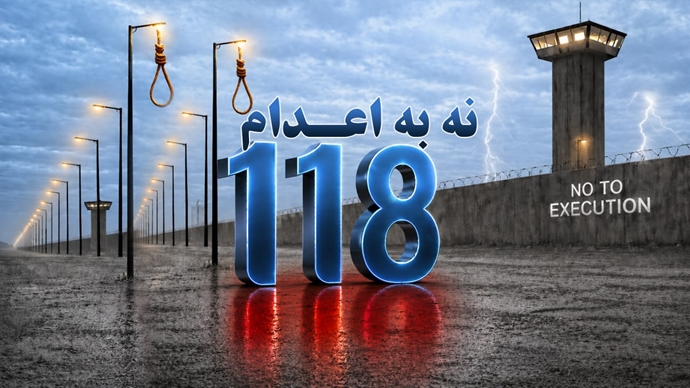

On April 28, 2026, political prisoners across 56 facilities in Iran launched the 118th week of the “No to Executions Tuesdays” campaign by going on a hunger strike. The strike proceeds despite intense security pressures and severe restrictions imposed by prison authorities attempting to break the campaign’s momentum. The defiance inside the prisons comes at a highly volatile time for the regime, following the devastating nationwide uprisings of December 2025 to January 2026, the death of Supreme Leader Ali Khamenei in February, and the recent April 7 ceasefire ending the regime’s direct military conflict with the US and Israel.
Fast-tracked executions and “enforced disappearances”
To consolidate power under newly installed Supreme Leader Mojtaba Khamenei, the regime’s judiciary has officially declared a “war footing.” According to the prisoners’ statement, this militarized approach serves to fast-track heavy sentences, bypass fair trials, and severely violate the rights of those detained during the massive December 2025–January 2026 protests, a nationwide uprising the regime only survived by massacring thousands of citizens.
As a direct consequence of this policy, the regime executed three political prisoners last week who were detained during those very uprisings. The prisoners—Amir-Ali Mir-Jafari from Tehran, Erfan Kiani from Isfahan, and Amer Rameshh from Sistan and Baluchestan—were hanged following judicial processes the campaign described as “unfair.” Authorities subsequently refused to hand over the bodies of two of these men to their families. The campaign’s statement condemned this withholding of remains as an “enforced disappearance” and a “crime against humanity.”
To suppress the ongoing strikes, prison officials have escalated violence and punitive measures. The campaign reported that striking inmates face threats of solitary confinement, the severing of phone calls, denial of family visits, and tightened welfare restrictions. Recent detainees and political prisoners also face violent transfers between facilities. Reports indicate prisoners have been subjected to beatings, physical torture, forced head shaving, verbal abuse, and humiliation by security agents seeking to intimidate them into submission.
The regime’s true enemy and a call to the global community
Highlighting the regime’s use of state-sanctioned murder to maintain its grip following domestic uprisings and foreign conflicts, the striking prisoners emphasized that the regime’s primary target remains the Iranian populace.
“The illegitimate Velayat-e Faqih regime, out of fear of popular uprisings and protests, by confiscating the streets of cities and creating terror in society, as well as carrying out daily executions in prisons, has shown that in truth its main enemy is the people, not any foreign country,” the prisoners wrote in their statement.
The campaign urgently called on the international community and human rights organizations not to remain silent, particularly as the regime frequently imposes internet blackouts to conceal its crackdowns. They specifically urged the UN Fact-Finding Mission to take immediate action to inspect Iranian prisons and detention centers.
The inmates participating in the 118th week of the “No to Executions Tuesdays” hunger strike are from Evin Prison (women’s and men’s wards), Ghezel Hesar Prison (units 2, 3, and 4), Karaj Central Prison, Fardis Prison in Karaj, Greater Tehran Prison, Qarchak Prison, Khorin Prison in Varamin, Chobindar Prison in Qazvin, Ahar Prison, Arak Prison, Langarud Prison in Qom, Khorramabad Prison, Borujerd Prison, Yasuj Prison, Asadabad Prison in Isfahan, Dastgerd Prison in Isfahan, Sheiban Prison in Ahvaz, Sepidar Prison in Ahvaz (women’s and men’s wards), Nezam Prison in Shiraz, Adelabad Prison in Shiraz (women’s and men’s wards), Firuzabad Prison in Fars, Dehdasht Prison, Zahedan Prison (women’s and men’s wards), Borazjan Prison, Ramhormoz Prison, Behbahan Prison, Bam Prison, Yazd Prison (women’s and men’s wards), Kahnuj Prison, Tabas Prison, Birjand Central Prison, Mashhad Prison, Gorgan Prison, Sabzevar Prison, Gonbad-e Kavus Prison, Qaemshahr Prison, Rasht Prison (men’s and women’s wards), Rudsar Prison, Haviq Prison in Talesh, Azbaram Prison in Lahijan, Dizel Abad Prison in Kermanshah, Ardabil Prison, Tabriz Prison, Urmia Prison, Salmas Prison, Khoy Prison, Naqadeh Prison, Miandoab Prison, Mahabad Prison, Bukan Prison, Saqqez Prison, Baneh Prison, Marivan Prison, Sanandaj Prison, Kamyaran Prison, and Ilam Prison.