

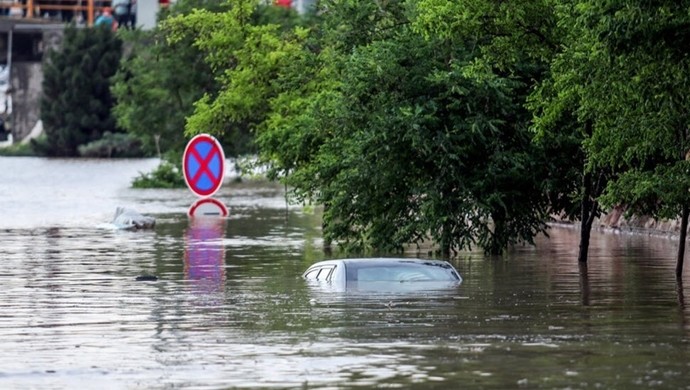

Destructive floods, which since early spring of this year have affected at least 23 provinces of Iran, from Sistan and Baluchestan to Azerbaijan, and from Khuzestan to Isfahan and Semnan, reached northeastern parts of the country, including Khorasan and the major city of Mashhad, this week.
The shocking reports and images released from these floods depict a situation that almost every year, especially in the spring season, recurs in various regions and cities of Iran, affecting millions of people either directly or indirectly, exacerbating existing wounds.
Government officials, following their usual pattern, do their best to either deny or downplay the severity of the disasters and damages. Even in the recent flood, the crisis manager of Mashhad city, in an unbelievably audacious manner, claimed in an interview published in several government-affiliated media outlets: “There is no flood, it’s just minor waterlogging.” In response to a journalist who insisted they saw the flood crushing and sweeping away cars, he arrogantly remarked that those were cardboard cars, not made of iron! These remarks are not accidental or exceptional. They reflect a facet of the nature of this regime; since it neither wants nor can resolve any of the crises it has caused and exacerbated, it is inevitable for them to deny them.
Interior Minister Ahmad Vahidi, who went to Mashhad to control the situation, refrained even from committing to a specific plan for addressing the crisis and compensating the affected people. During a staged appearance among a limited number of affected citizens, he told provincial authorities to “handle it” without making clear recommendations. His only appalling and insulting promise was to give free burial and funeral arrangements for three of the victims.
The perennial question that arises is why spring rains, which should herald blessings and prosperity, turn into tragedies and curses in Iran every year? The answer is a single word: plundering, rapacious plundering by ruling mafia gangs, led by the Revolutionary Guards.
The cause of the flood in Mashhad, as stated by a member of the City Council, was “illegal construction, building the southern beltway in Koohshad.” According to him, “They’ve cut the mountains and built a road in the mountains. We’ve warned numerous times…”. Another member of the Council also said, “The issue of water blockages in the path of rainfall. This issue was not addressed in the southern heights, and there was no obstacle to prevent the speed of the water” (Source: Entekhab website – May 16, 2024).
This catastrophe repeats itself every year. In March 2019 in Shiraz, a ten-minute downpour turned the people’s Nowruz celebration into mourning, because the Revolutionary Guards had constructed a road in a natural watercourse at Darvazeh Quran, engaged in construction, and sold lands at astronomical prices. As a result, dozens of people became flood victims in broad daylight and in front of people’s eyes.
The floods of March 2019 were not limited to Shiraz. About 10 million people were directly and indirectly affected by the floods of that year. 235 cities and more than 4,300 villages in 25 provinces of Iran were affected by flood damages, with more than 40,000 residential units destroyed and more damages incurred.
Each of these so-called natural (and in fact unnatural) disasters leads us to a single point: the rapacious plundering by ruling mafia gangs, led by the Revolutionary Guards, who with reckless and profit-driven construction in waterways and the destruction of natural barriers such as forests and pastures, directly pave the way for floods.