

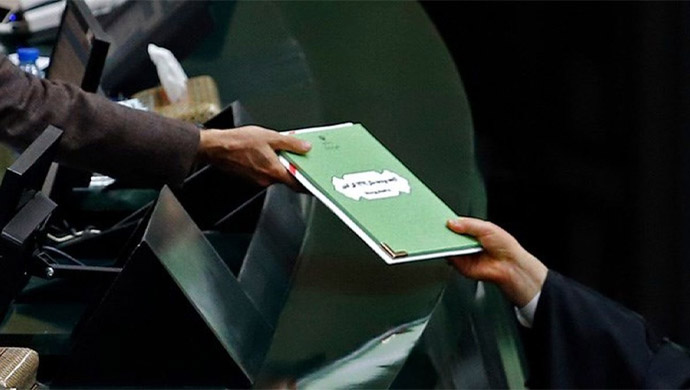

The inherent problems surrounding Iran’s upcoming 2024 budget bill was one of the crises that regime supreme leader Ali Khamenei wished to sweep under the rug in the mayhem caused by the war in Gaza. But the budget crisis is so deep that the regime cannot hide it and it has resurfaced to haunt the cabinet of Iranian regime president Ebrahim Raisi.
On December 6, the state-run Ham-mihan newspaper wrote, “Yesterday, after the President’s statements about balancing many imbalances in the next year’s budget, which have caused distress to everyone, Abdolnasser Hemati, the former governor of the Central Bank, wrote on his personal page, ‘How can a budget, which is itself exposed to imbalances in terms of revenues, balance the multi-trillion-rials imbalances of the banking system, pension funds, government debt, and state-owned companies?!”
According to regime experts, one of the problems with the budget bill is that many private companies and entities connected to the Khamenei’s office receive budget allocations from the government. Repressive entities such as the Islamic Revolutionary Guard Corps (IRGC) and its affiliate Basij forces, the Ministry of Intelligence, and the law enforcement forces have significantly strengthened with increased budgets. Meanwhile, some of them have also enjoyed special privileges. For example, the IRGC, with its affiliated companies and astronomical revenues, not only benefits from increased budget allocations and tax exemptions but also has permission to sell oil. This allows them to further increase their income for the purpose of suppression and warmongering.
Another problem with the budget is the unrestricted privatization and looting of national wealth under the guise of generating revenue. This issue had been somewhat forgotten under the shadow of warmongering by Khamenei, but has resurfaced once again. It involves the auctioning off and plundering of people’s capital and national assets.
On December 6, the state-run Ham-mihan newspaper quoted Gholamreza Nouri Qazaljeh, a member of the parliament, as saying, “The government is seizing public resources. They have adopted a mechanism under the guise of revenue generation that has very low oversight, and they have also considered strange and peculiar immunities for those involved, allowing them to make any decision they want.”
According to regime-affiliated media, the main portion of the government’s budget is funded through taxes imposed on hardworking people. In this program, a minimum taxable income of 100 million rials has been considered. It means that if a worker’s income, including all overtime pay, child benefits, housing allowances, bonuses, and so on, reaches 100 million rials (one-third of the poverty line), they would have to pay approximately 18% in taxes. Meanwhile, the financial empire of Khamenei, with its 14 financial giants and hundreds of holdings and companies earning billions, is exempt from any form of taxation.
Even the state-controlled media started mocking the 2024 budget with titles such as “The 2024 Budget is Based on Political Slogans,” “A Look At the Promises of the 2024 Budget,” “More Corruption,” “Worse than Corruption,” “The People Have the Right to Know Where the Tax Money is Being Spent,” and “It is Time to Prepare for Famine.”
On December 6, the state-run Jahan-e Sanat newspaper, in an article titled “The Decline of Livelihood in the Thirteenth Government,” wrote, “As the tenure of the thirteenth government progresses, not only does the livelihood of the people not improve, but it is deteriorating, and the middle and lower classes are falling into the pit of poverty. It seems that this pit is calling upon the entire society towards itself, and there is no hope for better conditions.”
Some media outlets within the regime have also warned about the eruption of societal anger among the people due to heavy taxes and policies that lead to currency devaluation and alarming price increases.
On December 7, the state-run Jomhouri newspaper, wrote, “The government has resorted to illegal measures of ‘money creation’ to address the budget deficit, but for the next budget, it has reduced income from oil sales and instead imposed heavy taxes and pressure on the society, and it is unclear how long the society can tolerate such pressures.”