

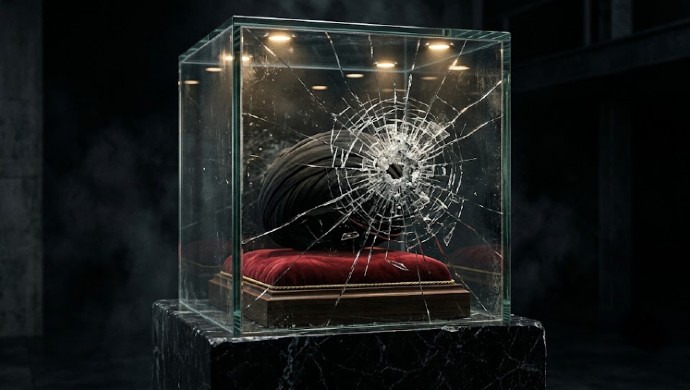

For months, Iran’s ruling establishment tried to bury one of the most consequential security breaches in its modern history: the major operation carried out by the People’s Mojahedin Organization of Iran (PMOI/MEK) against Ali Khamenei’s heavily fortified headquarters in central Tehran on February 23, 2026. Now, a regime-affiliated Telegram channel, Didban-e Enghelab, has effectively broken that silence. But in typical fashion, its admission has come wrapped in conspiracy, factional score-settling, and a desperate attempt to shift responsibility onto rival factions inside the regime.
The significance of this admission lies not in the channel’s fabrications, but in what it was forced to concede. The regime had previously sought to minimize or obscure the scale of the clashes around Khamenei’s compound. Yet Didban-e Enghelab now refers to the events of that night and acknowledges that an operation took place shortly before the outbreak of the 40-day war. In doing so, it confirms the very reality the regime had tried to suppress: that the PMOI was able to strike at the heart of the system’s most protected centre of power.
According to the PMOI/MEK’s own announcements at the time, the operation began in the early hours of Monday, February 23, 2026, around the Motahari Complex, the compound that includes Khamenei’s headquarters and a cluster of strategic institutions of the regime. These include the office and residence of Mojtaba Khamenei, the Guardian Council, the Assembly of Experts, the central office of the judiciary, the Ministry of Intelligence, the Supreme National Security Council, and the Expediency Council. The compound is not an ordinary government site; it is the regime’s inner fortress, both symbolically and operationally.
The PMOI/MEK reported that approximately 250 PMOI fighters participated in the operation. Heavy clashes took place with IRGC protection forces, and more than 100 PMOI fighters were reported martyred, wounded, arrested, or missing. More than 150 others, according to the PMOI/MEK’s Command Headquarters inside Iran, withdrew safely to their bases by midnight Tehran time. The PMOI later announced that the names of the martyrs, detainees, and missing fighters had been sent to the UN Special Rapporteur and international human rights bodies, and called for access to detainees and inspection of the bodies of the martyrs.
What made the operation extraordinary was not merely the location, but the depth of the security penetration it exposed. Khamenei’s headquarters is surrounded by multiple security rings, concrete barriers, anti-drone and anti-projectile structures, surveillance systems, and thousands of personnel from the IRGC Vali-e Amr Protection Corps, Ansar al-Mahdi Corps, and other military and intelligence units. Yet despite this apparatus, the clashes reached the zone around the regime’s supreme command center. Reports at the time referred to explosions, gunfire, ambulance traffic, school closures around Pasteur Street, heavy restrictions, and the visible deployment of security forces across the area.
The regime’s Telegram narrative now tries to turn this security humiliation into an internal conspiracy story. Didban-e Enghelab claims that the so-called “Vefaq faction” associated with Masoud Pezeshkian intended, together with the PMOI, to capture Khamenei at night and hand him over to the Americans, supposedly following a “Venezuela model”. It further alleges that when this supposed plan failed, the PMOI quickly issued a statement to take responsibility, and that the United States then chose to eliminate Khamenei by missile attack.
This narrative is absurd on its face, but politically revealing. The PMOI spokesperson firmly rejected any claim that the United States, any foreign government, or the Pezeshkian faction had prior knowledge of, or any role in, the operation. The spokesperson stated that the large-scale PMOI assault in the heart of Tehran with 250 fighters was real, and that information about the operation, including the names of martyrs and detainees, had been announced at the time and submitted to the UN Special Rapporteur and human rights organizations. But the attempt to connect the operation to Pezeshkian’s faction, the U.S., or a fantasy coup scenario is a pure fabrication born of the escalating infighting inside the regime.
The regime’s latest narrative cannot undo the central fact it has now helped confirm: five days before the 40-day war, in the heart of Tehran, the PMOI carried out a major operation against Khamenei’s headquarters. The regime can add lies about Venezuela, Washington, Pezeshkian, or imagined palace coups, but those lies only reveal its deeper panic. Its own propaganda has become an admission that the most secure point of the dictatorship was reached — and that the struggle inside Iran is not a matter of foreign intervention, but of organized resistance against a decaying theocratic regime.
In this sense, the Didban-e Enghelab Telegram post is more than a belated acknowledgement. It is a confession of fear. It shows a regime divided against itself, unable to explain its failures, and terrified that the truth of the operation will strengthen the belief that Khamenei’s fortress is not impregnable. The February 23 operation has therefore entered the political record not only as a military and security blow, but as a symbolic turning point: the moment when the regime’s own voices began to admit, however unwillingly and dishonestly, that the heart of the system had been struck from within.