

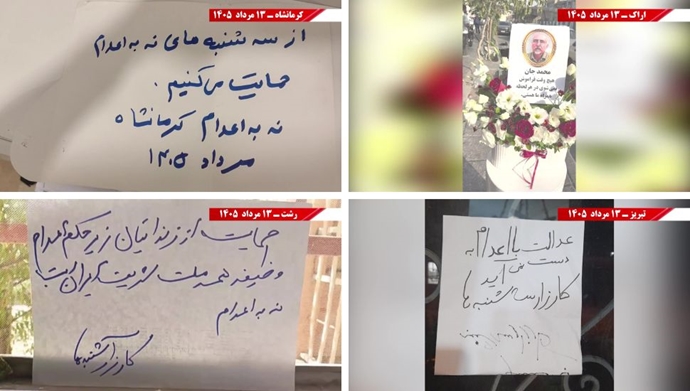

Despite the Iranian regime’s escalating use of public executions to maintain its fragile grip on power, PMOI Resistance Units have taken to the streets across Iran to project messages of defiance in support of the “No to Executions Tuesdays” campaign. Following the massive nationwide uprisings of January 2026, the religious dictatorship has increasingly resorted to systemic massacres of political prisoners in a desperate attempt to quell a rebellious society that no longer fears its apparatus of repression.
August 4—Iran
PMOI/MEK Resistance Units express their support of the "No to Execution Tuesdays" campaign with anti-regime activities in different cities across Iran. pic.twitter.com/2dCb60A4ob— People's Mojahedin Organization of Iran (PMOI/MEK) (@Mojahedineng) August 5, 2026
On August 4, Resistance Units launched a coordinated campaign across major cities—including Tehran, Shiraz, Isfahan, Tabriz, and Kermanshah—risking their safety to display placards and paint graffiti. Activists in Tehran painted graffiti reading, “Political prisoners must be freed” and “No to state executions,” while in Shiraz, messages declared, “No to the regime of executions.”
In Isfahan, Resistance Units held placards supporting the campaign and rejecting capital punishment. The messaging targeted the regime’s pseudo-legal justifications for its crimes, highlighted by activists in Tabriz who displayed a placard reading, “Justice will not be achieved with executions.”
Rasht
"No to the execution of the youth of the 'Alikhani Square dossier'" pic.twitter.com/iYDP5YXThh— People's Mojahedin Organization of Iran (PMOI/MEK) (@Mojahedineng) August 5, 2026
In Rasht, Resistance Units placed a special focus on the victims of the “Alikhani Square dossier.” Activists held placards reading, “No to the execution of the youth of the ‘Alikhani Square dossier'” and declaring that supporting death-row prisoners is the responsibility of all honorable people of Iran.
They specifically commemorated Abolfazl Sepahi, 24, and Amirhossein Safari, 27, two protesters who were publicly hanged in Isfahan’s Alikhani Square on July 28, 2026, for their participation in the January 2026 uprising.
Tried in kangaroo courts on bogus charges including “Moharebeh” (enmity against God), they were denied independent lawyers.
Resistance Units stressed the urgency of halting these state murders, as eight other protesters from this dossier remain in immediate danger of execution, following the hangings of 18-year-old Erfan Esfandiari and 24-year-old Gol-Mohammad Mohammadi on July 19.
Hamedan
Photos of PMOI martyrs Behrouz Ehsani and Mehdi Hassani pic.twitter.com/BpoSZtRlRL— People's Mojahedin Organization of Iran (PMOI/MEK) (@Mojahedineng) August 5, 2026
The Resistance Units also paid heartfelt tributes to fallen PMOI members who were active in the anti-execution campaigns. In Arak, a flower wreath was laid in a public space honoring Mohammad Taghavi, who was executed in Ghezel Hesar prison on March 30, 2026.
In Hamedan, activists displayed photos of Behrouz Ehsani and Mehdi Hassani, marking the one-year anniversary of their executions on July 27, 2025. Activists in Rasht also commemorated Mehdi Khanaki, a 26-year-old law graduate and PMOI member who was executed on July 22, 2026, following months of severe torture in Karaj. Arrested in February 2026 for his participation in the January protests, the regime’s attempt to hide Khanaki’s identity at the time of his arrest revealed its profound fear of Iranian youth increasingly gravitating toward the PMOI.