

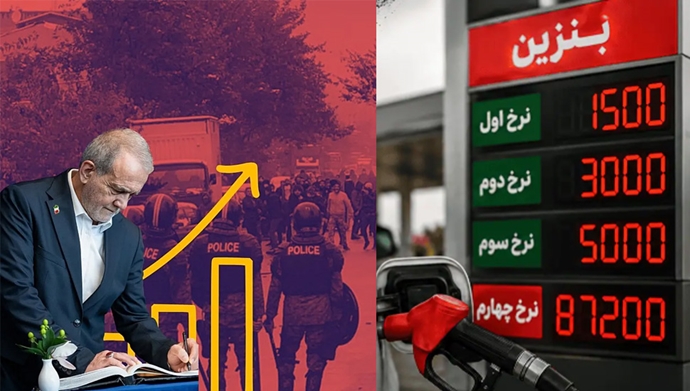

The Iranian regime is facing a paralyzing crisis that exposes the deep structural and economic bankruptcy of the ruling establishment. Recent remarks by government officials regarding a severe gasoline shortage are not merely technical reports; they are an admission of a complete economic and managerial deadlock.
The regime has reached what its own officials describe as a “point of compulsion,” trapping it between enforcing unbearable economic pressure on an already impoverished population and the terrifying prospect of sparking another nationwide uprising.
The regime’s inability to manage basic domestic needs is laid bare by its own statistics. Esmail Saghab Esfahani, head of the Energy Optimization Organization, confessed on August 15, 2026, that the government is no longer looking for “solutions” but is forced into “obligatory” decisions. According to Esfahani, Iran’s daily gasoline consumption has reached roughly 135 million liters, while domestic refinery and petrochemical production is only estimated at 121 million liters, resulting in a daily deficit of 14 to 15 million liters.
Nasser Ashouri, the secretary of the Oil Refining Association, revealed an even more dire picture. He admitted that the base production of Iran’s 10 refineries is actually only 111 million liters. Even by dangerously mixing in 15 million liters of petrochemical products to reach 127 million liters, the regime still faced an 8-million-liter deficit in early summer and expects a 15-million-liter daily deficit by September.
Three scenarios of despair: Choosing between “bad” and “worse”
Instead of addressing the root causes of the energy crisis—such as modernizing refineries, importing standard fuel-efficient vehicles, developing public transit, and ending the regime’s international isolation—the government is preparing to make the Iranian people pay the price for its systemic corruption and incompetence. The Pezeshkian administration is currently weighing three disastrous models.
The first scenario involves distributing only the domestic production and shutting down gas stations once the daily quota runs out. This would paralyze urban transport, cripple supply chains, and create chaotic miles-long lines.
The second scenario is a price shock via dual pricing, offering a limited subsidized quota per vehicle and selling the rest at a so-called “free market” rate. This policy will immediately trigger hyperinflation, drastically raise the cost of living, and push the middle and working classes deeper into poverty.
The third option is individual rationing, distributing a meager 30 liters per month to each citizen via the head of the household. This model would create bureaucratic chaos, fuel a massive black market, and empower corrupt middlemen.
The unspoken fourth solution: Defunding the repressive apparatus
While the government claims it has no choice but to pressure the public, the Iranian Resistance points to a glaring reality that officials deliberately ignore. The crisis could be resolved instantly without burdening the citizens, provided the regime changes its domestic security priorities.
The regime’s vast machinery of suppression—specifically the Revolutionary Guards (IRGC), the Basij, the Ministry of Intelligence (MOIS), and the State Security Forces (SSF)—consumes massive amounts of the country’s fuel daily to maintain their grip on power and suppress dissent.
If the regime were to simply cut 5 million liters of daily fuel consumption from each of these four repressive entities, it would free up 20 million liters of gasoline per day. This simple step would entirely wipe out the 15-million-liter national deficit and even leave a 5-million-liter surplus.
However, under the rule of Mojtaba Khamenei, the regime relies entirely on these security forces to prevent its overthrow, rendering this logical solution an impossibility for the ruling clerics.
The specter of November 2019 and internal panic
The regime is terrified of the social and security consequences of altering fuel prices. The government has nervously given itself a 10- to 15-day window to make a final decision, emphasizing the need to “prepare public opinion.” This highlights the regime’s deep-seated fear.
The memory of the November 2019 uprisings—sparked by a sudden gas price hike—continues to haunt the security apparatus. This fear is exponentially magnified following the massive, regime-shaking uprisings of December 2025–January 2026.
Panic is highly visible within the regime’s inner circles. During a virtual parliamentary session on August 16, 2026, Deputy Speaker Hamidreza Haji-Babaei openly warned the government against raising prices. He stated that taking raw steps that make life harder for the people is “not advisable” under current conditions and warned against actions that could “disrupt society.”
A spark in a powder keg
The fuel deficit is no longer just a technical imbalance on an energy spreadsheet; it is a profound reflection of a bankrupt ruling system. The regime is trapped in a deadly dilemma: it lacks the foreign currency to import fuel and the technical capacity to produce more, yet it is utterly terrified of the explosive anger of a society battered by inflation, currency devaluation, and relentless brutal suppression.
As the regime scrambles to enforce a “gasoline mandate,” it risks turning the fuel pumps into the trigger for the next massive social explosion, bringing the fire of the people’s uprising to the doorstep of the regime’s downfall.