

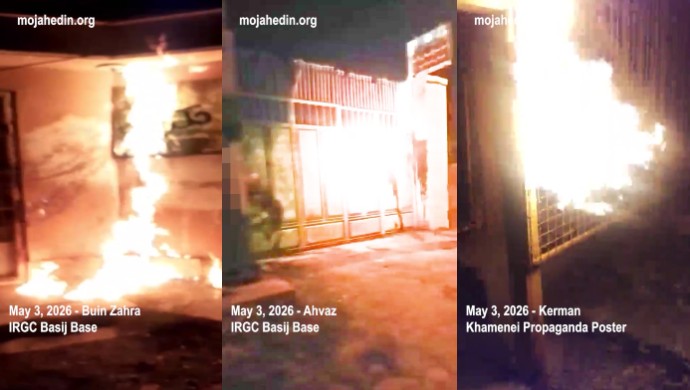

Across Iran, PMOI/MEK Resistance Units have launched a swift and daring wave of operations targeting the clerical regime’s symbols and centers of repression. These activities, carried out on May 3, sent a clear message that the regime’s reliance on the gallows will be met with unyielding defiance. The widespread operations were launched in direct retaliation for the recent execution of Sasan Azadvar, a courageous youth arrested during Iran’s massive January uprisings.
A desperate regime’s execution spree
At dawn on April 30, 2026, the Iranian regime executed Sasan Azadvar, a 21-year-old karate champion and rebellious youth from Isfahan. Arrested during the massive December 2025–January 2026 nationwide uprising that brought the clerical establishment to its knees, Azadvar was severely tortured before his death. The criminal death sentence was issued by Branch 1 of Isfahan’s sham Revolutionary Court, presided over by the notorious executioner Judge Morteza Barati, and was quickly upheld by the regime’s Supreme Court.
May 3—Iran
PMOI Resistance Units respond to the execution of Sasan Azadvar, a youth arrested during Iran's January uprising, by targeting the regime's centers and symbols of repression.https://t.co/nl1yNu2zNQ pic.twitter.com/TLkPKBTWh2— People's Mojahedin Organization of Iran (PMOI/MEK) (@Mojahedineng) May 6, 2026
Ironically, in an attempt to justify the murder, the judiciary’s Mizan news agency highlighted the young man’s bravery. State media detailed how Azadvar attacked a State Security Force (SSF) minibus with stones and clubs, broke its windows, and even attempted to obtain gasoline to set the vehicle on fire to confront the oppressive forces inside.
Azadvar’s hanging does not occur in a vacuum; it is part of an accelerated, desperate domestic purge following the nationwide protests. Just days earlier, on April 25, the regime hanged another rebellious youth from Isfahan, Erfan Kiani, for allegedly carrying Molotov cocktails during the protests.
The regime is also ruthlessly targeting oppressed minorities. On April 26, Amer Ramesh—a Baluch political prisoner who was only 18 at the time of his arrest and had been shot by security forces—was executed in Zahedan Central Prison.
Meanwhile, the threat of execution looms over other detained protesters.
Targeting the apparatus of suppression
Despite these brutal measures, the Iranian resistance continues to flourish. In response to Azadvar’s execution, PMOI Resistance Units systematically targeted the regime’s primary tools for domestic crackdown. In Ahvaz, Hamedan, and Kermanshah, defiant youth set fire to the entrances and signposts of IRGC Basij bases, while bases in Buin Zahra and Kermanshah were also directly targeted.
Hamedan
PMOI Resistance Units set fire to IRGC Basij base pic.twitter.com/Zm9wkOvBXH— People's Mojahedin Organization of Iran (PMOI/MEK) (@Mojahedineng) May 6, 2026
The Resistance Units also moved to dismantle state ideological propaganda. In Choram, they torched a billboard promoting the IRGC’s citizen espionage network. In Dezful, a regime-run center for promoting fundamentalism and terrorism was targeted, while a propaganda banner was burned in Hafshejan. In a highly symbolic act of defiance in Kerman, Resistance Units torched a propaganda poster featuring the regime’s eliminated supreme leader, Ali Khamenei.
The regime’s fear of this expanding network is palpable. Recently, the Ministry of Intelligence announced the arrest of a three-person cell in Lorestan, accused of burning government banners and planning armed attacks on regime centers.
While Tehran attempts to project an image of power and control through these brutal hangings, the reality is entirely the opposite. These ongoing executions expose a highly fragile regime that is terrified of its own citizens. The gallows do not signify a stable government; rather, they belie the regime’s deep-seated fear of an increasingly restive Iranian society that no longer fears standing up against the apparatus of repression.